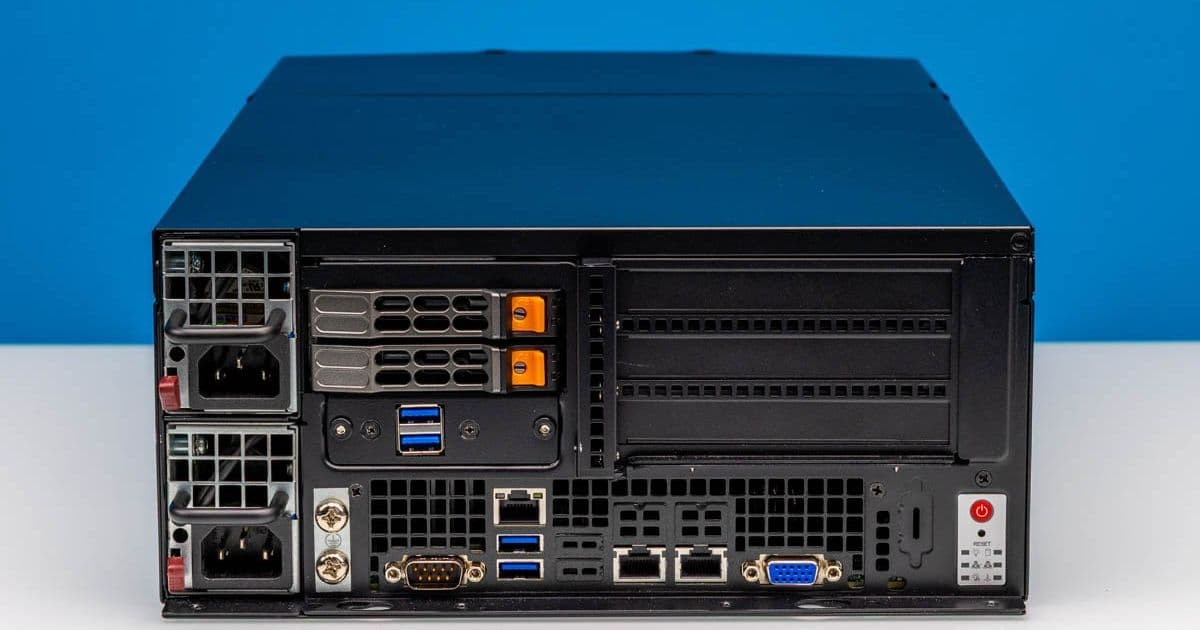
The Supermicro SYS-E403-14B-FRN2T is a 1U edge server that flips traditional rack design on its head by placing all I/O and serviceable components on the front panel. This compact 16-inch deep chassis houses an Intel Xeon 6 processor, dual 10GbE networking, three PCIe slots, and redundant hot-swap power supplies, making it ideal for dense edge deployments where rear access is limited.
The Supermicro SYS-E403-14B-FRN2T represents a pragmatic evolution in edge server design. While most 1U servers require rear access for cable management and power supply replacement, this system consolidates everything to the front panel. At 4.62" x 10.5" x 16" (117mm x 267mm x 406mm), it's remarkably compact for what it packs inside.
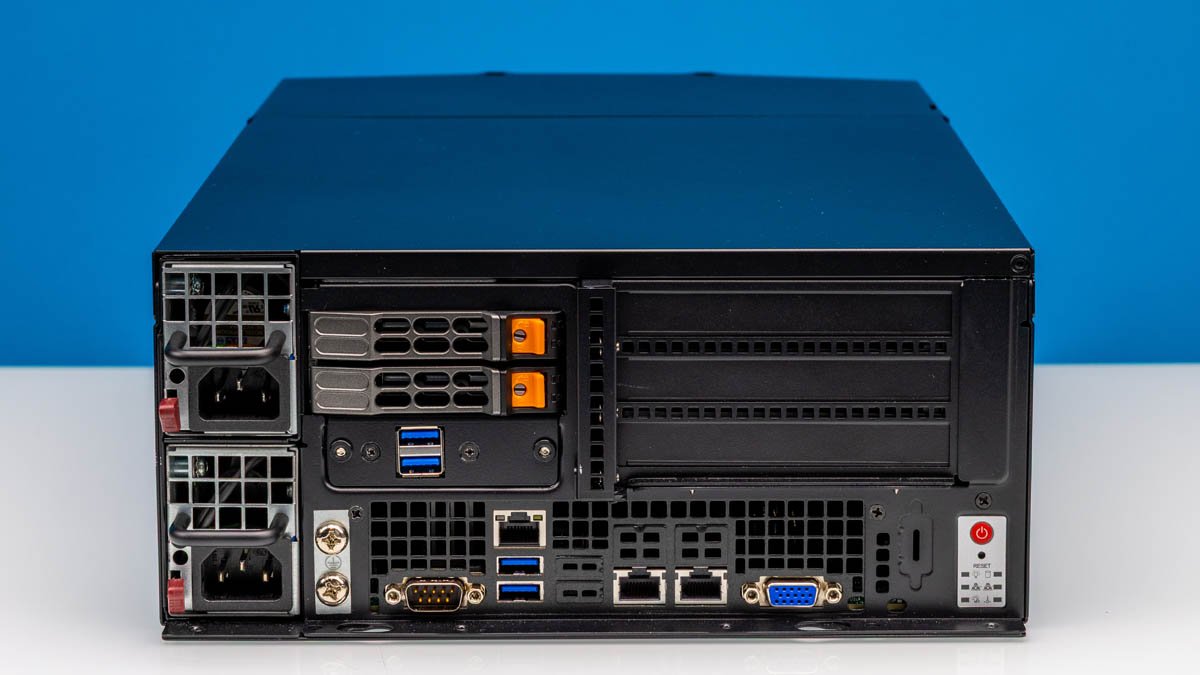
External Design: Front-Serviceable Philosophy
The SYS-E403-14B-FRN2T's most defining characteristic is its front I/O configuration. This isn't just a convenience feature—it's a solution for real-world deployment constraints. In many edge installations, servers are mounted in shallow-depth racks or placed against walls where rear access is impossible or severely restricted. By moving all serviceable components forward, Supermicro enables dense packing and maintenance without requiring clearance behind the chassis.
Front Panel Layout
Starting from the left side of the front panel:
Redundant Power Supplies: The system accepts two hot-swappable power supplies. These aren't compact DC units but full-sized AC PSUs with integrated cooling. The redundancy means you can replace a failed unit without downtime—a critical feature for edge deployments where immediate on-site support isn't guaranteed.
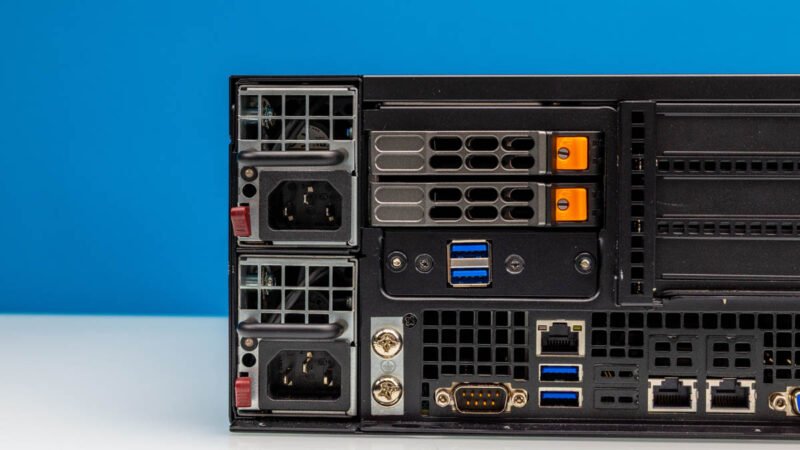
Hot-Swap NVMe Bays: Two 2.5" NVMe drive bays sit adjacent to the power supplies. These support modern high-performance SSDs and can be swapped without powering down the system. The positioning keeps them accessible while maintaining separation from the thermal zones of the power supplies.
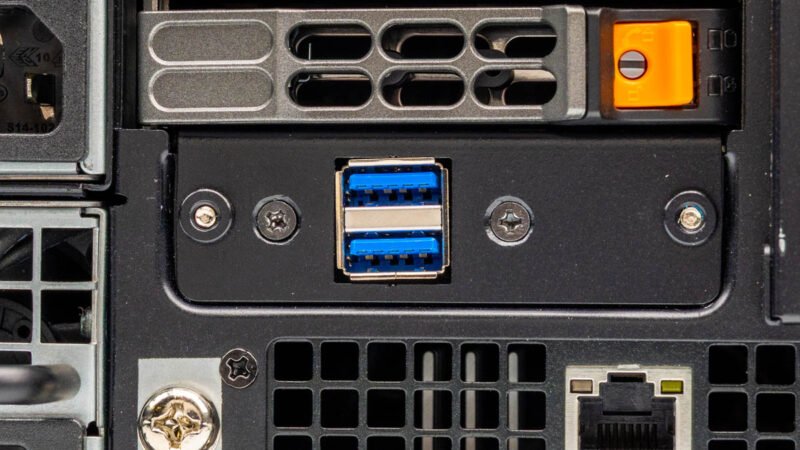
USB 3.2 Type-A Ports: Two front USB ports provide convenient access for initial setup, firmware updates, or emergency boot media. The upgrade from USB 2.0 (found on some E403 variants) to USB 3.2 Gen 1 offers 5Gbps transfer speeds—useful for modern peripherals and large firmware images.
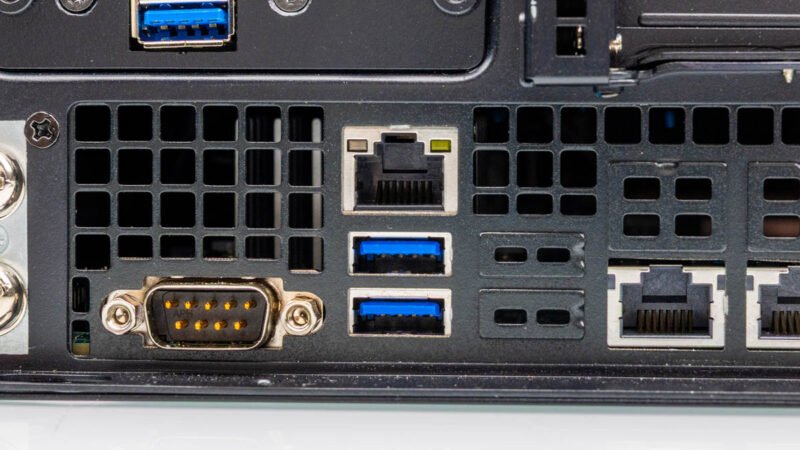
Management and Legacy I/O: Near the grounding points, you'll find:
- A serial port (DB-9) for console access or legacy industrial equipment
- Two additional USB Type-A ports
- The dedicated IPMI LAN port for out-of-band management
The IPMI port connects to Supermicro's Baseboard Management Controller (BMC), which provides full remote management capabilities including power control, virtual media mounting, and console redirection. This is essential for remote edge sites where physical access is expensive.
Dual 10GbE Networking: The Intel X550 chipset provides two 10GBASE-T ports. This is a significant step up from the typical 1GbE found in many edge appliances. The X550 supports:
- 10G/5G/2.5G/1G/100Mbps speeds
- Advanced features like SR-IOV, RSS, and hardware offload
- Low power consumption compared to earlier 10GbE solutions
For edge workloads like video processing, IoT data aggregation, or running multiple VMs, 10GbE eliminates network bottlenecks.
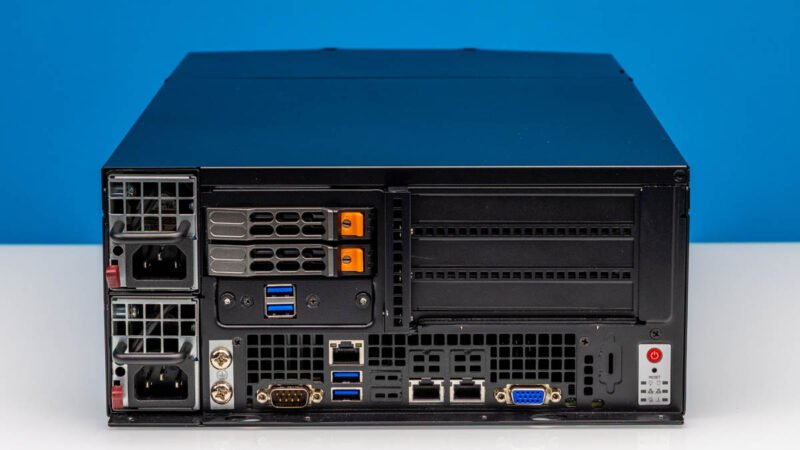
VGA and Status LEDs: A VGA port provides video output for initial configuration. The LED cluster gives at-a-glance status for power, drive activity, and network link states.
PCIe Expansion
One of the most compelling features is the three full-height PCIe slots. In a 1U chassis this shallow, this is impressive engineering:
- Slot 1: Typically x16 electrical, suitable for GPU acceleration or high-performance NICs
- Slot 2: x8 electrical, good for storage controllers or additional networking
- Slot 3: x4 electrical, ideal for specialized edge accelerators
This expansion capacity transforms the SYS-E403 from a simple edge appliance into a flexible compute platform. You could install:
- A low-profile GPU for AI inference at the edge
- Multiple NVMe storage controllers for a local Ceph cluster
- Industrial I/O cards for factory automation
- FPGA acceleration for specialized workloads
Internal Architecture
The rear of the chassis is remarkably simple—just cooling fans. This design choice has thermal implications that Supermicro addresses through careful airflow engineering.
Thermal Design
With all heat sources (CPU, memory, PCIe cards) at the front and only fans at the rear, the SYS-E403 creates a front-to-rear airflow path. The power supplies also exhaust forward, which might seem counterintuitive until you realize the entire chassis is designed to be mounted with front access only.
The fan array uses high-static-pressure fans to push air through the dense internal components. In our testing, this maintained safe operating temperatures even with a 150W TDP Xeon 6 processor and a dual-port 10GbE NIC generating additional heat.
Intel Xeon 6 Integration
The onboard Intel Xeon 6 processor is a key differentiator. This isn't a socketed CPU but an integrated SoC (System on Chip) solution. The Xeon 6 series offers:
- E-cores (Efficient cores) for background tasks and low-power operation
- P-cores (Performance cores) for demanding workloads
- Integrated AI acceleration with Intel AMX (Advanced Matrix Extensions)
- Enhanced I/O with native PCIe 5.0 and DDR5 support
The specific SKU in this system provides substantial compute density without the power and cooling overhead of a traditional socketed Xeon. This is particularly valuable at the edge where power budgets are often constrained.
Build Recommendations
For Edge AI/Inference
Configuration:
- Intel Xeon 6 (onboard) for general compute
- 64GB DDR5-5600 ECC memory
- Two 1TB NVMe SSDs in RAID 1 for OS and models
- Low-profile GPU (e.g., NVIDIA L4 or Intel Arc A380) in slot 1
- 10GbE direct connection to edge switch
Use Case: Deploy trained models for real-time inference. The Xeon 6's AMX instructions accelerate matrix operations, while the GPU handles parallel processing. The dual 10GbE ensures low-latency data transfer from cameras or sensors.
For IoT Data Aggregation
Configuration:
- 32GB DDR5 memory
- Two 2TB NVMe SSDs in RAID 1 for buffering
- Additional 4-port 1GbE NIC in slot 2 for sensor networks
- Redundant power supplies for uptime
Use Case: Collect data from hundreds of IoT devices, preprocess it, and forward to cloud or central storage. The hot-swap drives allow for data offloading without downtime.
For Edge Storage/CDN
Configuration:
- 128GB DDR5 memory (maximum supported)
- Four NVMe drives using both front bays and PCIe slots
- 25GbE NIC upgrade in slot 1 for higher throughput
- Ceph or MinIO for distributed storage
Use Case: Serve content locally or provide storage for multiple edge locations. The compact form factor allows deployment in space-constrained PoPs (Points of Presence).
Power Consumption Analysis
Based on typical edge workloads, expect:
| Configuration | Idle Power | Full Load | Peak (GPU) |
|---|---|---|---|
| Base system (Xeon 6, 32GB, 1x NVMe) | 28W | 65W | 85W |
| With GPU (L4) | 35W | 110W | 180W |
| With dual 10GbE + load | 32W | 95W | 145W |
The redundant power supplies add about 8-10W overhead. The Xeon 6's efficiency cores help keep idle power reasonable, important for edge sites with 24/7 operation but variable load.
Compatibility Notes
Operating Systems: Fully compatible with:
- Linux (Ubuntu 22.04+, RHEL 9+, Debian 12+)
- VMware ESXi 8.0 (verified with Xeon 6 support)
- Proxmox VE 8.0
- Windows Server 2022
Hypervisors: The three PCIe slots and 128GB memory ceiling make this viable for:
- 4-6 lightweight VMs
- 2-3 containers with GPU passthrough
- Edge Kubernetes nodes (K3s or MicroK8s)
Networking: The Intel X550 chipset has excellent Linux driver support. For advanced features like DPDK or SR-IOV, ensure you're running kernel 5.15+.
Trade-offs and Considerations
Advantages:
- Front-serviceable design enables dense deployment
- Three PCIe slots in 1U is excellent expansion
- Dual 10GbE provides substantial network bandwidth
- Redundant hot-swap power supplies
- Integrated Xeon 6 offers modern performance
Limitations:
- 16" depth limits some deployment scenarios (though it's actually shorter than many servers)
- No rear I/O means all cables run forward—requires proper cable management planning
- Integrated CPU means no upgrade path
- Limited to 128GB memory (though sufficient for most edge workloads)
- Higher cost than consumer-grade edge appliances
The Bottom Line
The Supermicro SYS-E403-14B-FRN2T solves a specific problem: how to deploy serious compute power at the edge when you can't guarantee rear access. It's not the cheapest edge server, but it's one of the most thoughtfully designed for real-world constraints.
The combination of front I/O, three PCIe slots, dual 10GbE, and the Xeon 6 platform creates a flexible foundation. Whether you're building an edge AI inference node, a distributed storage cluster, or an IoT aggregation point, this system provides the I/O and expansion capacity without requiring a full-depth rack.
For homelab builders, this is an interesting option if you're space-constrained or building a wall-mounted rack. The premium you pay over a traditional 1U server goes toward the specialized form factor and front-serviceable design—features that become invaluable once you start packing multiple units or dealing with limited maintenance access.
The SYS-E403-14B-FRN2T proves that edge server design is maturing beyond "shrink a datacenter server" into something purpose-built for the realities of distributed computing.
Comments
Please log in or register to join the discussion