
By the time a malicious package or compromised vendor makes headlines, the access that enabled it has often been changing hands in underground forums for weeks. Flare researchers walked through real posts to show what those early signals look like, and why a routine GitHub access sale can quietly carry supply-chain risk.

Most people learn about a supply-chain attack the same way: after it has already happened. A malicious npm package ships to thousands of projects, a poisoned software update reaches customers, a browser extension turns out to be harvesting tokens, or a trusted vendor discloses a breach. By then the damage is done and the incident report is just describing the wreckage.
The interesting part, according to a recent investigation by Flare researchers, is what comes before that. The early warning signs are often sitting in plain view inside underground forums and marketplaces, but almost never under a label that says "supply-chain attack." A post might advertise GitHub access, private repositories, source code, API keys, OAuth tokens, cloud credentials, or CI/CD data. Nothing about it announces what it actually threatens. The supply-chain danger lives in where that access sits and which trust relationships it touches.
That gap between how a listing looks and what it can actually do is the whole problem. Recognizing it early is hard, but it is exactly where defenders have a chance to get ahead of an incident instead of cleaning up after one.
What a software supply-chain attack actually is
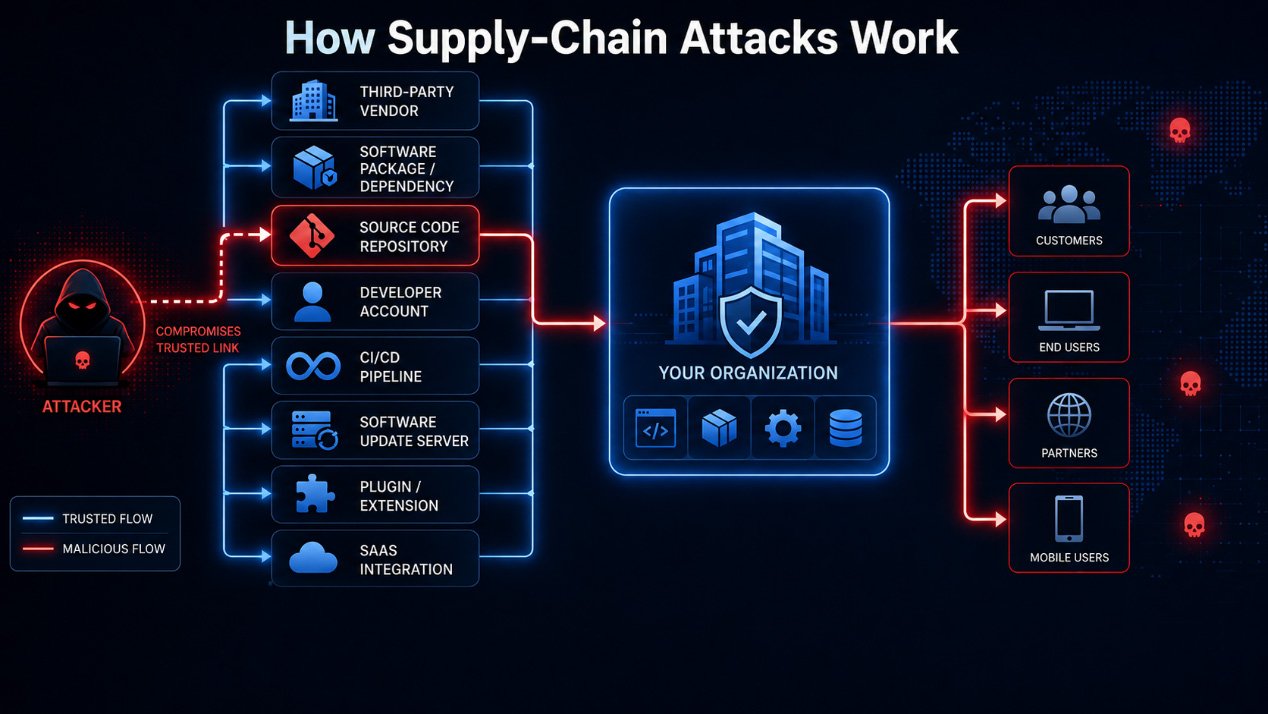
A software supply-chain attack goes after the trusted tools, vendors, components, services, and processes an organization depends on, rather than attacking the organization head-on. In practice that can mean compromising a third-party provider, a developer account, a source-code repository, a package registry, a CI/CD pipeline, an update mechanism, a plugin, or a SaaS integration.
The reason this category is so dangerous is structural. Once an attacker gets inside something trusted in the delivery chain, they can often reach downstream customers, users, and internal systems through access, updates, code, or integrations that all look completely legitimate. The malicious activity arrives wearing the credentials of a system everyone already trusts.
When ordinary access quietly becomes supply-chain relevant
One of the clearer examples Flare researchers surfaced was a forum post advertising GitHub-related access, with references to developer accounts, private repositories, access material, and exposed source code. Taken at face value, this reads like a standard access sale, the kind that scrolls past analysts every day.
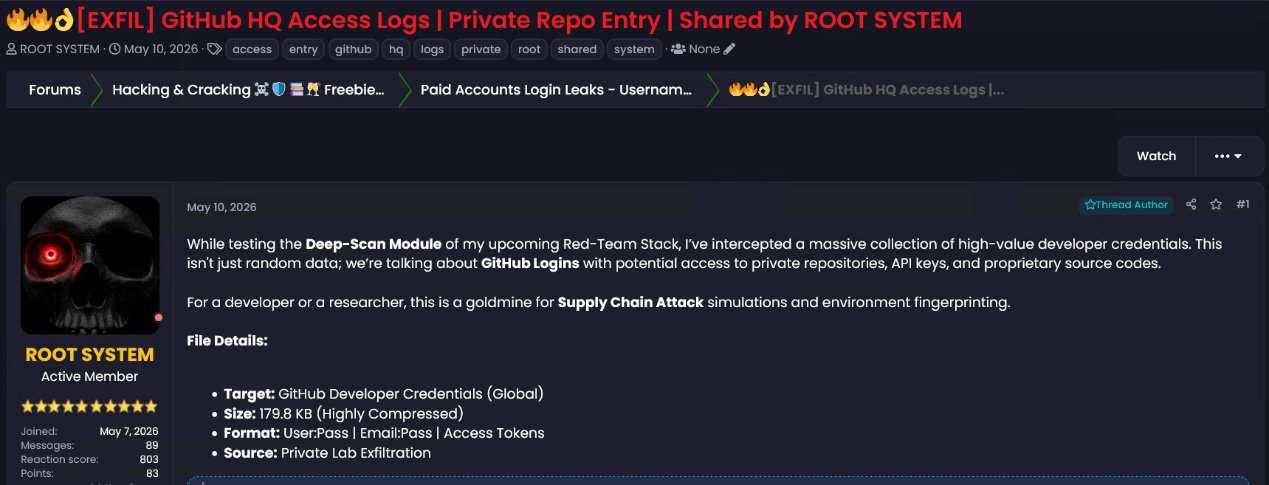
The trouble is that GitHub access is rarely just access to code. A developer account or private repository can expose secrets, deployment scripts, package publishing logic, cloud credentials, internal documentation, and CI/CD workflows. That is where the supply-chain angle opens up. An attacker who lands inside a developer identity can start to understand how the software is built, which dependencies it pulls in, where secrets are stored, and how updates get published. From there, the path can extend to customers, downstream users, and connected systems.
The Vercel incident in April 2026 is a useful reference point. It involved a compromise tied to a trusted third-party AI tool and OAuth-connected SaaS access, and it widened the security concern even though the affected company stated that sensitive customer data and source code were not reached. For someone reviewing underground posts, the lesson is not the incident itself, which was already public, but the kind of exposure it represents: trusted integrations, SaaS accounts, internal tools, environment variables, and developer platforms wired together through permissions that turn into liabilities the moment one link breaks. That is the reasoning behind paying attention to posts that mention OAuth access, SaaS tooling, or environment variables, even when the seller's claim is thin or unverified.
Source code is not just intellectual property
Flare researchers also looked at posts involving alleged vendor data and source-code exposure, including claims around Sportradar AG that later showed up in public reporting on the broader TeamPCP campaign. That case was linked to a compromised Trivy scanner and reportedly included database passwords, API key and secret pairs, Kafka credentials, and monitoring tokens.
That inventory is the point. This kind of material reveals how a vendor's systems connect to each other, which services and integrations are trusted, and which credentials could put partners or customers at risk. In a supply-chain investigation, the stolen database is often less dangerous than the access paths and trusted relationships the leak exposes.
The same pattern showed up in public reporting around TeamPCP and Mistral AI. In May 2026, reports claimed TeamPCP was selling hundreds of alleged Mistral AI repositories. Mistral disputed parts of the claim, but the episode still makes the case that source-code theft should not be filed under intellectual property and forgotten. Repositories can carry credentials, build logic, internal service names, deployment workflows, API documentation, and references to customers and integrations. Even when leaked code grants no immediate production access, it gives an attacker a map of the environment and a head start on finding future attack paths.
Package ecosystems show how access scales
The same analytical lens applies to package registries, where a single compromised account can multiply fast. Public reporting on Shai-Hulud, a self-spreading npm supply-chain attack that stole developer secrets and infected trusted packages, showed how compromised maintainer accounts and malicious package updates could harvest credentials, scoop up CI/CD secrets, and propagate across repositories. The damage came less from any single piece of malicious code than from the abuse of trusted publishing mechanisms that the entire ecosystem relies on.
Flare also observed forum discussion around Shai-Hulud-style activity and supply-chain attack competition. These posts were weaker as direct victim leads, but they work as threat context. They make clear that actors are studying public package compromise techniques and openly talking about how to reuse, modify, and extend them.
The LiteLLM incident adds a recent data point. Public reporting described unauthorized PyPI package publishes connected to a broader compromise path through developer and CI/CD environments. Because LiteLLM is used as an AI gateway, the case also signals that supply-chain risk is spreading into AI infrastructure and developer tooling, not just traditional application dependencies.
Developer environments are becoming targets in their own right. Recent reporting on malicious VS Code extensions demonstrated how trusted development tools can become a route straight into repositories and credentials. Extensions, plugins, and AI coding assistants sit unusually close to source code, terminals, tokens, and internal workflows, which makes them valuable even when they never touch production infrastructure.
What defenders can actually do with this
None of these posts proves that every underground access sale is a supply-chain threat. What they establish is why security teams should ask sharper questions when they encounter listings involving source code, developer accounts, SaaS access, API keys, OAuth tokens, package ecosystems, or CI/CD material.
The question to lead with is not just "was data leaked?" It is "could this access change how trusted software gets built, deployed, updated, or integrated?" That reframing turns a routine credential sale into a potential early indicator.
Practically, that means supply-chain monitoring has to cover more than vulnerability disclosures and package advisories. Teams should be watching for exposed developer credentials, GitHub and GitLab access, package registry tokens, leaked repositories, CI/CD secrets, cloud keys, OAuth grants, and any chatter naming significant vendors or software providers. The value of watching the underground is catching these signals while they are still ambiguous, before someone packages them into a finished incident report. The organizations that benefit most are the ones treating a quiet access listing as a question worth investigating rather than noise worth ignoring.
Comments
Please log in or register to join the discussion