
Taara's new Beam device uses silicon photonics to deliver 25 Gbps bidirectional optical communication up to 25 km without moving parts, offering a compact alternative to fiber and RF systems.
Taara, a company specializing in free-space optical communication, just released the Beam — a shoebox-sized device that uses its proprietary Photonics Platform to deliver up to 25 Gbps of bidirectional throughput. More than that, the company says that it has a range of 10 kilometers and claims that it has ultra-low latency, making it ideal for AI applications.
This isn’t the first optical transceiver developed by the company, as it has been working on the technology since 2017 at Google’s X development lab. In fact, Taara says that its Lightbridge device has already been deployed in over 20 countries alongside carriers including T-Mobile, Vodafone, Airtel, and Digicel. While this offers a longer range of 20 km, it has a slightly lower 20 Gbps throughput and uses mechanical parts to keep the beam aligned.
On the other hand, Beam uses silicon photonics to deploy an optical phased array with more than a thousand miniature emitters to track, shape, and steer the beams without requiring any moving parts. The company promotes this as an alternative to expensive and time-consuming fiber deployments or the complicated spectrum licensing requirements of radio frequency communications. Its compact size and relatively low power consumption mean that it can easily be deployed in hours instead of weeks or months, and you can install it practically anywhere — from existing towers and cell sites to rooftops and mountain tops — as long as the two transceivers retain line of sight (LOS).
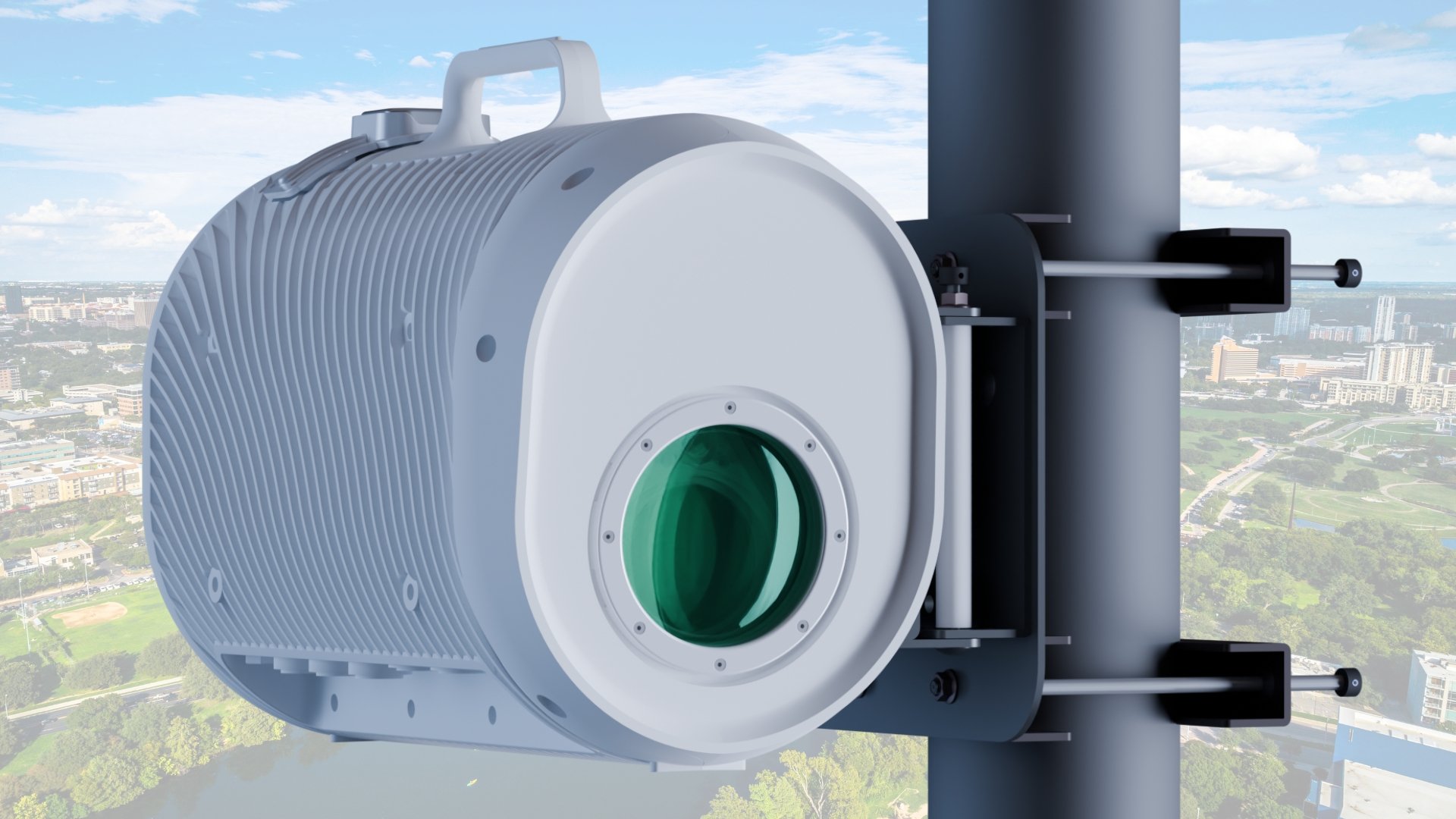
Aside from the compact size brought by silicon photonics, the company also says that using this technology would allow it to build more capable and more efficient generations of its optical communications transceivers in the future. This makes it similar to how semiconductors have evolved in the past, where Moore’s Law stated that transistors would have doubled in number on a particular chip every other year. While Taara did not give any details on how it expects to achieve this, other firms are working on this tech, with one startup even saying that it developed an optical transistor that’s 10,000 times smaller than existing tech and capable of handling 1,000 x 1,000 multiplication matrices.
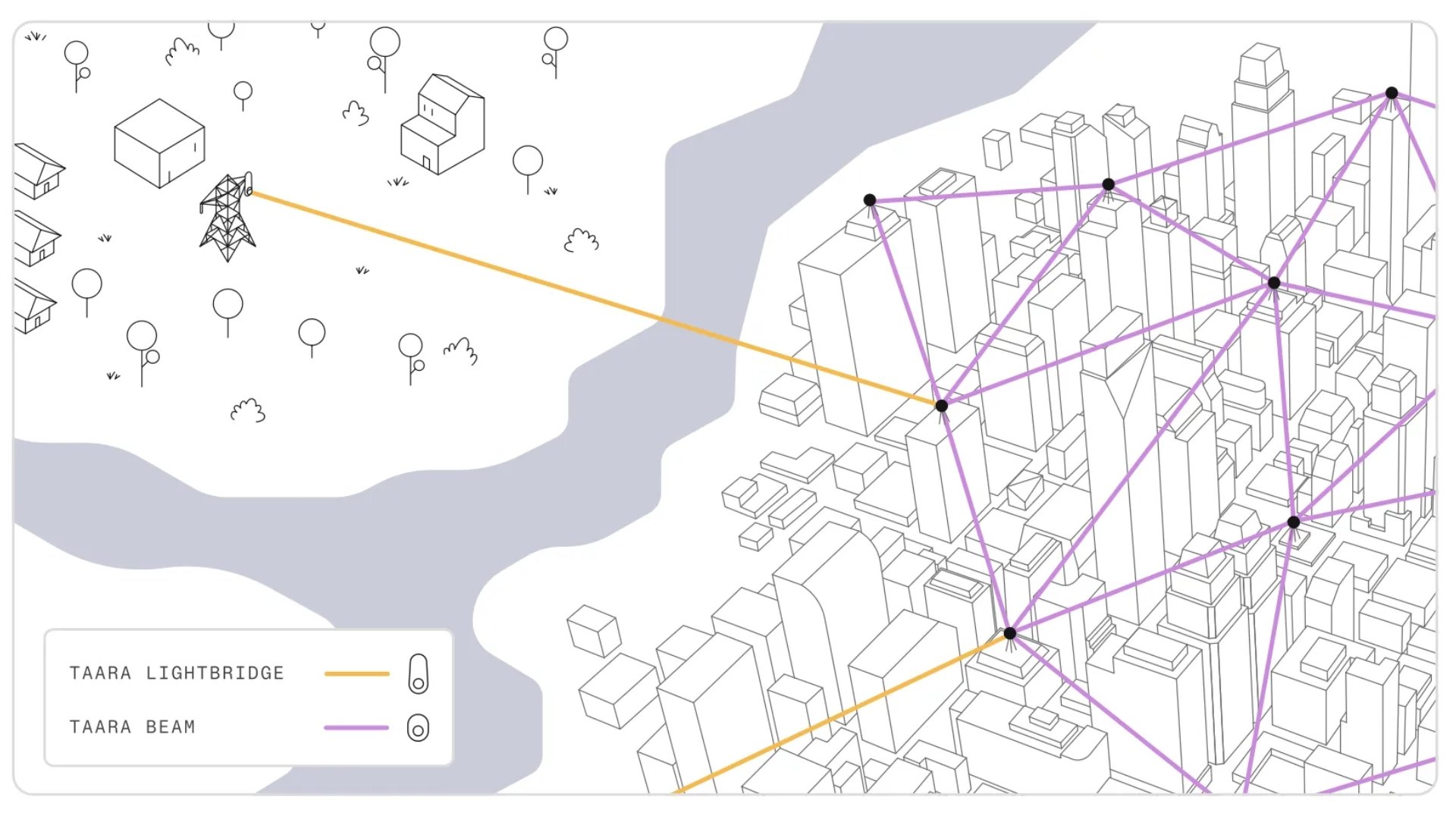
The only drawback to this technology is that it’s affected by weather conditions, like fog and heavy rain, and other disruptions, such as smoke, that can reduce visibility or cut line of sight altogether. Nevertheless, the company advertises the Beam as a part of a light mesh network, allowing communication to continue through different nodes. Aside from that, it also introduced the Lightbridge Pro, which adds an automatic radio frequency or fiber backup to the original Lightbridge, ensuring seamless switching in case suboptimal atmospheric conditions interfere with its optical communication.
Technical Architecture and Performance
The Beam represents a significant advancement in free-space optical communication technology. At its core, the device leverages silicon photonics - a technology that integrates optical components onto silicon chips using standard semiconductor manufacturing processes. This approach enables the creation of complex optical phased arrays containing thousands of miniature emitters that can electronically steer light beams without mechanical movement.
Each Beam unit contains an optical phased array with over 1,000 emitters that work in concert to create and direct the communication beam. The phased array technology allows for electronic beam steering with precision measured in microradians, enabling the system to maintain alignment even when the transceiver positions shift slightly due to wind, thermal expansion, or other environmental factors.
The 25 Gbps bidirectional capability means the device can simultaneously transmit and receive data at 12.5 Gbps in each direction. This symmetric bandwidth is particularly valuable for modern applications that require equal upload and download speeds, such as video conferencing, cloud computing, and AI model training.
Deployment Advantages
Traditional fiber optic deployment typically requires months of planning, permits, and physical construction to bury cables or string them along utility poles. The Beam system can be installed in hours by mounting two transceivers with clear line of sight between them. This dramatically reduces both deployment time and cost.
The device's shoebox-sized form factor (approximately 30 x 20 x 15 cm) and low power consumption (typically under 100 watts) make it suitable for mounting on existing infrastructure. Common deployment locations include:
- Telecommunications towers
- Building rooftops
- Water towers
- Mountain peaks
- Cell sites
- Utility poles
This flexibility allows network operators to quickly establish high-bandwidth links in areas where fiber deployment would be prohibitively expensive or technically challenging, such as crossing rivers, highways, or rugged terrain.
Silicon Photonics Evolution
The use of silicon photonics in the Beam follows the same evolutionary path that traditional electronics took over the past decades. By manufacturing optical components using standard CMOS processes, Taara can leverage the massive investments and economies of scale of the semiconductor industry.
This approach enables several advantages:
- Cost reduction: Mass production using existing semiconductor fabs drives down per-unit costs
- Performance scaling: Following trends similar to Moore's Law, optical component density and performance can improve over time
- Integration: Combining multiple optical functions on a single chip reduces size and power consumption
- Reliability: Solid-state operation without moving parts increases mean time between failures
Weather Resilience and Network Design
While free-space optical communication is susceptible to atmospheric interference, Taara has implemented several strategies to maintain reliability:
Mesh Networking: Multiple Beam devices can be configured in a mesh topology, allowing traffic to route around any node experiencing weather-related degradation. If one link becomes temporarily blocked by fog or rain, the network can automatically reroute through alternative paths.
Multi-Technology Backup: The Lightbridge Pro system includes automatic failover to radio frequency or fiber connections when optical conditions deteriorate. This ensures continuous service availability even during severe weather events.
Adaptive Power Control: The system can dynamically adjust transmission power based on atmospheric conditions, maintaining link quality while optimizing power consumption.
Market Implications
The Beam technology addresses several critical challenges in modern telecommunications:
5G Backhaul: As mobile networks deploy more small cells to increase capacity, they need high-bandwidth backhaul connections. Beam provides a cost-effective solution for connecting these distributed sites without the expense of fiber trenching.
Rural Connectivity: Areas with low population density often lack fiber infrastructure due to unfavorable economics. Beam can quickly establish high-speed connections to these underserved regions.
Emergency Response: During natural disasters or other emergencies that damage existing infrastructure, Beam systems can be rapidly deployed to restore communications.
Data Center Interconnects: For organizations needing to link facilities across moderate distances, Beam offers a lower-latency alternative to microwave links or leased fiber.
Technical Specifications
- Throughput: 25 Gbps bidirectional (12.5 Gbps TX/RX)
- Range: Up to 10 km (20 km for Lightbridge variant)
- Latency: Sub-millisecond, suitable for real-time applications
- Form Factor: Shoebox-sized (approx. 30 x 20 x 15 cm)
- Power Consumption: Under 100 watts typical
- Alignment: Electronic beam steering via optical phased array
- Environmental: IP67 rated for outdoor deployment
- Operating Temperature: -40°C to +60°C
Future Developments
Taara's roadmap suggests continued advancement in silicon photonics technology. The company hints at future generations that will further increase data rates and range while reducing size and power consumption. This follows the historical pattern of semiconductor development, where each generation brings significant improvements in performance and cost-effectiveness.
Other companies in the optical communications space are pursuing similar silicon photonics approaches. Recent developments include optical transistors that are 10,000 times smaller than traditional designs and capable of handling matrix multiplication operations at unprecedented speeds. These advances could eventually enable even more compact and powerful optical communication systems.

The Beam represents a practical application of cutting-edge photonics research, bringing laboratory innovations into real-world deployment. As the technology matures and scales, it could play a significant role in addressing the growing demand for high-bandwidth, low-latency connectivity in an increasingly connected world.
Comments
Please log in or register to join the discussion