
Carrie Webster distills ten research‑driven findings that link UX decisions to concrete financial outcomes—from the 1:100 cost ratio of fixing design flaws early to the 9,900 % ROI of a well‑executed experience—showing how speed, simplicity, readability and strategic testing drive revenue, retention and growth.
Ten Data‑Backed Truths of User Experience ROI
 )
)
User experience is no longer a decorative add‑on; it is a measurable engine of revenue. Carrie Webster, a veteran UX architect, walks through ten rigorously sourced facts that translate design choices into dollars and cents. The article is organized around three lenses: what’s new in the data, how it reshapes the developer experience, and the concrete impact on end‑users and the bottom line.
1. Fixing Issues in the Design Phase Is 100 × Cheaper
Studies from the IBM Systems Institute and Sugue Technologies confirm the classic 1:100 rule: a defect discovered after code is shipped costs up to a hundred times more to resolve than the same defect caught during sketching or prototyping. Early validation eliminates not only the direct rework cost but also the hidden expenses of technical debt, delayed releases and lost transactions while users wrestle with broken flows.
Developer experience: Teams that embed usability testing into the design sprint spend less time firefighting and more time building new features.
User impact: A smoother onboarding journey translates into higher completion rates and immediate revenue lift.
2. Performance Is the Foundation of UX
Performance data is stark: 47 % of users expect a page to load within two seconds; each additional second drops conversions by roughly 20 % and satisfaction by 16 %. Retail loses an estimated $2.6 billion annually to sluggish pages. Even a 0.1‑second improvement can boost retail conversions by 8.4 %.
Developer experience: Tools like Vite 5.0 and the new Chrome Lighthouse metrics make it easier to spot LCP bottlenecks early.
User impact: When a page loads in under one second, conversion rates hover around 40 %.
3. You Have 50 ms to Make a First Impression
Psychology research shows users form an opinion about visual appeal in ≈50 ms. That split‑second judgment drives whether they stay or bounce. Since 94 % of first impressions are design‑related, a stale UI can instantly erode trust.
Developer experience: Rapid style‑guide iteration (e.g., using Tailwind 3.x) lets designers experiment without costly rebuilds.
User impact: A fresh, modern visual language secures the attention needed for the next five seconds of content consumption.
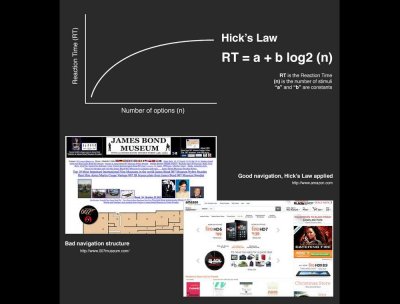
4. Hick’s Law: Every Extra Choice Is a Tax
The more options presented, the longer the decision time. Top‑performing sites that trim menus and form fields see conversion rates above 11 %, while average sites linger below 3 %.
Developer experience: Implementing progressive disclosure patterns in React 18 reduces component complexity and improves maintainability.
User impact: Removing a single checkout field can lift revenue overnight.
5. White Space Boosts Comprehension
Strategic whitespace can increase content comprehension by up to 20 %. In a fintech dashboard redesign, adding breathing room cut task time by 25 % and lifted trial‑to‑paid conversions.
Developer experience: CSS Grid and modern layout utilities make it trivial to allocate generous gutters without breaking responsive breakpoints.
User impact: Users process information faster and make confident decisions.
6. The Power of “Fake” Progress (Goal Gradient Effect)
A progress bar that starts at 15 %—even if artificially seeded—raises onboarding completion by over 40 %. The visual cue triggers dopamine release, nudging users toward the finish line.
Developer experience: Simple state‑management libraries (e.g., Zustand) let you animate progress without heavy re‑renders.
User impact: Faster sign‑ups, reduced churn during multi‑step flows.

7. Make Your Content Readable
Optimal typography (line‑height ≈ 1.5 × font size) and sensible line length improve reading speed by ≈20 %. Poor legibility raises perceived effort, increasing bounce rates.
Developer experience: Variable fonts and CSS
font‑optical‑sizelet designers fine‑tune readability across breakpoints.User impact: Clear text encourages scanning, leading to higher CTA click‑through.
8. Users Scan, Not Read
Only 20‑28 % of page text is read; users follow an F‑pattern. Design for scanning: bold headings, bullet points, ample whitespace, and high‑contrast CTAs.
Developer experience: Component libraries (e.g., Radix UI) provide accessible heading hierarchies out of the box.
User impact: Key messages become visible to 80 % of visitors.
9. Five Users Reveal 85 % of Usability Problems
Usability testing with five participants uncovers the majority of issues. Beyond that, the cost‑benefit curve flattens.
Developer experience: Remote testing platforms (e.g., UserTesting.com) streamline recruitment and iteration cycles.
User impact: Frequent, low‑cost testing keeps the product aligned with real‑world expectations.
10. The Financial ROI of UX: 9,900 %
On average, every $1 invested in UX returns $100. Mature UX practices can boost conversion rates by up to 400 % and cut support costs dramatically. Companies with high design maturity enjoy 32 % higher revenue growth and 56 % greater shareholder returns.
Developer experience: Continuous integration of design tokens reduces hand‑off friction, keeping the ROI pipeline flowing.
User impact: A frictionless experience turns casual visitors into loyal customers.
The AI Amplifier
AI doesn’t replace these truths; it accelerates them. AI agents now pre‑filter choices, mitigating Hick’s Law. Real‑time personalization, powered by machine‑learning models, re‑orders content to match individual eye‑tracking patterns. Generative tools cut prototype time, shrinking the 1:100 cost gap even further.
Bottom Line
The data is clear: design decisions ripple through engineering effort, performance budgets, and ultimately the profit margin. By treating UX as a continuous, data‑driven discipline, teams can capture market share that competitors leave on the table.
Further Reading
- “The Human Element: Using Research and Psychology to Elevate Data Storytelling” – Smashing Magazine
- “AI in UX: Achieve More With Less” – Paul Boag
- “Six Key Components of UX Strategy” – Vitaly Friedman
- “When Friction Is a Good Thing: Designing Sustainable E‑Commerce Experiences” – Anna Rátkai
Author: Carrie Webster – 20 years of user‑centered design, formerly at startups and enterprise teams alike.
Comments
Please log in or register to join the discussion