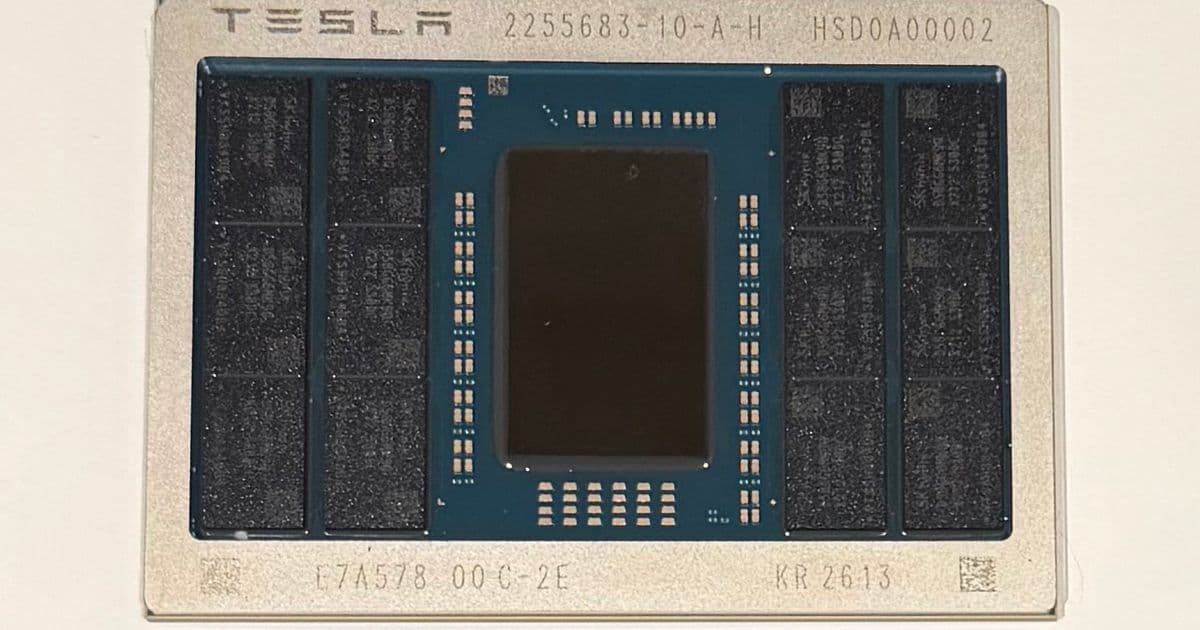
Elon Musk unveiled Tesla's AI5 chip with claims of 40X performance gains over AI4, featuring a half-reticle die and 384-bit memory interface, while confusion over TSC vs TSMC manufacturing raises questions about production timelines and Tesla's continued Dojo ambitions.
Tesla has unveiled its next-generation AI5 processor, with CEO Elon Musk claiming the chip delivers up to 40 times the performance of its predecessor in certain scenarios. The announcement, made via social media, showcases the first fabricated samples of what Tesla hopes will become one of the most produced AI chips in history.
Technical Specifications Revealed
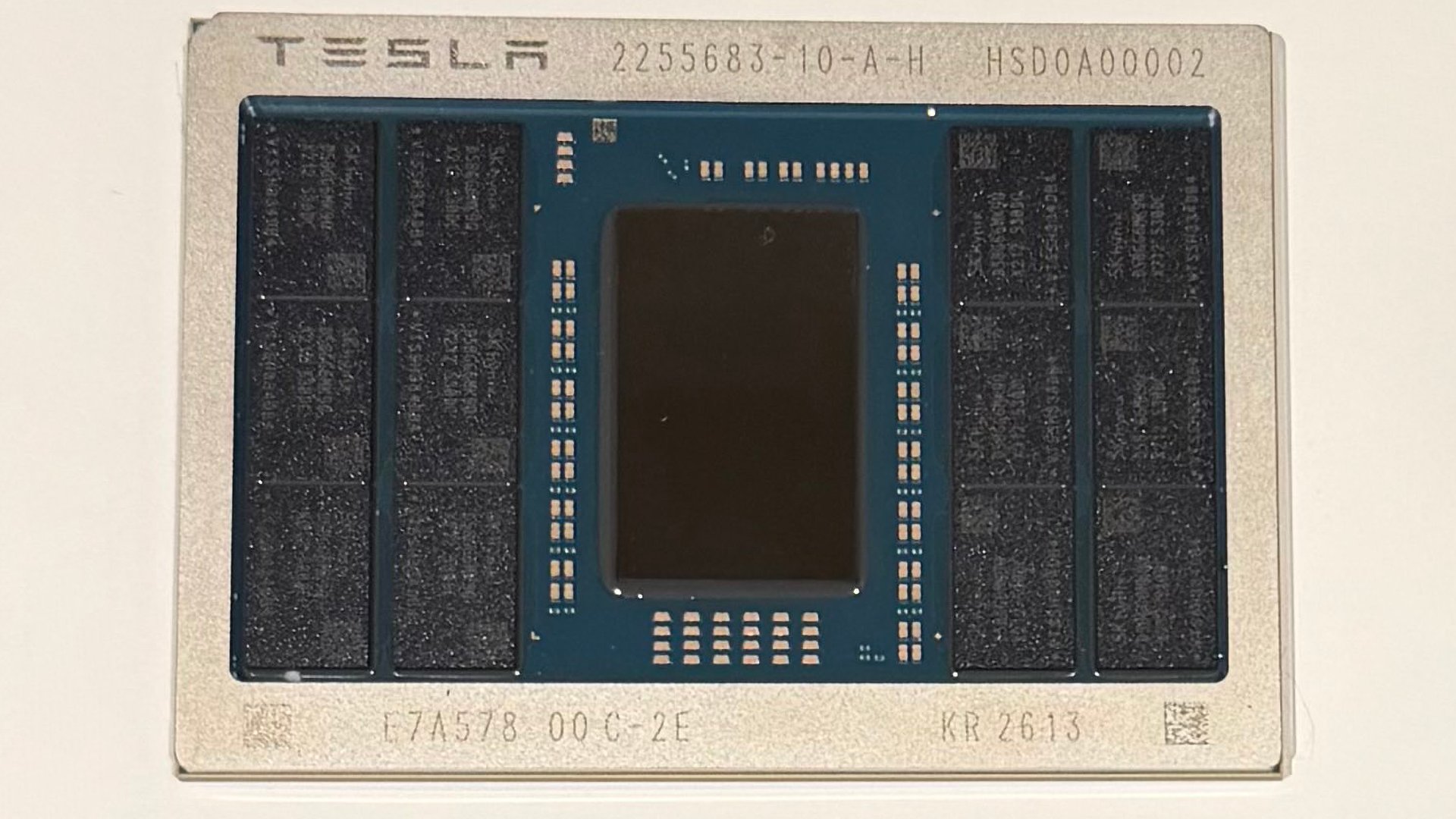
The AI5 processor features a notably compact design, utilizing approximately half of a standard reticle size. This smaller footprint allows Tesla to incorporate 12 memory packages surrounding the ASIC die, likely using GDDR6 or GDDR7 memory from SK hynix. The organic substrate design and industry-standard memory markings suggest a focus on manufacturing efficiency and supply chain reliability.
Based on the 12 memory packages, the AI5 appears to feature a 384-bit memory interface. Depending on the specific memory technology employed, this configuration could deliver between 768 GB/s and 1.536 GB/s of memory bandwidth—a substantial amount for automotive and robotics applications.
The chip's architecture includes Tesla's proprietary trip accelerators, Arm CPU cores, and PCIe blocks, all integrated into the half-reticle design. This consolidation was made possible by removing outdated hardware components, according to Musk's comments during Tesla's Q3 2025 earnings call.
Manufacturing Confusion and Timeline Questions
Perhaps the most puzzling aspect of the announcement involves Musk's acknowledgment of "@TaiwanSemi_TSC" for their support in bringing the chip to production. This appears to be a reference to Taiwan Semiconductor Manufacturing Company (TSMC), though the TSC abbreviation caused confusion among industry observers.
Adding to the mystery, Musk also thanked Samsung for their support, suggesting that Tesla is pursuing a dual-sourcing strategy for AI5 production. The chip sample shown bears a "KR 2613" marking, indicating it was packaged during the 13th week of 2026—suggesting Tesla has already progressed beyond the initial tape-out stage that Musk claimed to be celebrating.
If Tesla received these chips in March or April 2026 and no re-spins are required, commercial deployment could begin as early as 2027. However, the manufacturing ambiguity raises questions about Tesla's actual production timeline and which foundry will handle volume manufacturing.
Dojo 3 and Converged Architecture Plans
Despite previous reports suggesting Tesla had abandoned its Dojo wafer-level processor initiative, Musk confirmed that Dojo 3 remains in development. This contradicts August 2024 reports that the Dojo team had been dismantled following the retirement of project lead Peter Bannon.
Musk indicated that AI6 and Dojo 3 will feature a "converged architecture" with a unified instruction set architecture (ISA). This convergence would enable Tesla to standardize its software stack across different hardware platforms and potentially unify its hardware designs as well.
"I think about Dojo 3 and the AI6 as the first [converged architecture designs]," Musk stated during a July 23 earnings call. "It seems like intuitively, we want to try to find convergence there where it is basically the same chip that is used where we use, say, two of them in a car or an Optimus and maybe a larger number on a [server] board."
This unified approach could allow Tesla to deploy the same chip design across multiple applications—from automotive systems to humanoid robots like Optimus, and potentially in xAI data centers. The flexibility to use two chips in a vehicle or twelve on a server board demonstrates the architecture's scalability.
Market Implications and Industry Context
The AI5 announcement positions Tesla as a serious contender in the custom AI processor market, traditionally dominated by companies like NVIDIA and Google. By claiming 40X performance improvements over AI4, Tesla is signaling its ambition to reduce dependence on external AI hardware suppliers.
However, the manufacturing confusion and the apparent advancement beyond the tape-out milestone that Musk celebrated raise questions about Tesla's internal communication and project management. The dual acknowledgment of both TSMC and Samsung also suggests potential supply chain hedging or ongoing negotiations with multiple foundries.
Tesla's continued investment in Dojo, despite previous reports of its cancellation, indicates the company's commitment to vertical integration in AI hardware. This strategy aligns with Musk's broader vision of controlling the entire technology stack—from silicon design to software deployment—across Tesla's automotive, robotics, and AI ventures.
As the semiconductor industry continues to grapple with capacity constraints and geopolitical tensions affecting chip manufacturing, Tesla's dual-sourcing approach and focus on industry-standard components may provide valuable flexibility in an increasingly complex supply chain environment.
Comments
Please log in or register to join the discussion