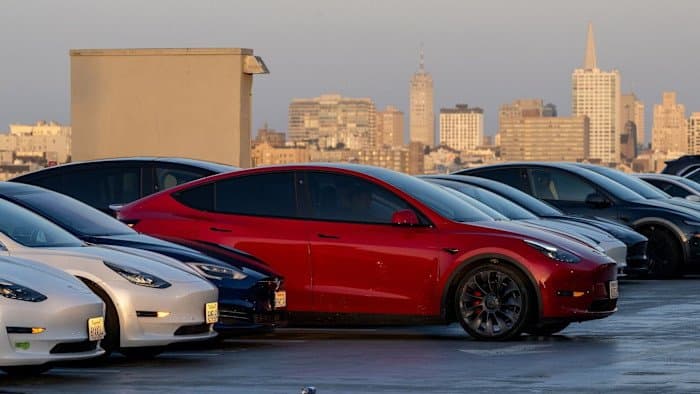
Tesla plans to discontinue its premium S and X models and transform its California factory into an Optimus manufacturing hub as Elon Musk refocuses the company on robotics and AI development.
Tesla is making a dramatic pivot away from its traditional electric vehicle lineup, announcing plans to discontinue its premium Model S and Model X vehicles while converting its California factory into a dedicated production facility for its humanoid robot, Optimus. The move represents a significant strategic shift for the company as CEO Elon Musk doubles down on artificial intelligence and robotics as Tesla's future growth drivers.
According to sources familiar with the company's plans, Tesla will cease production of the Model S and Model X by the end of 2026, focusing instead on its more affordable Model 3 and Model Y vehicles, along with the upcoming Cybertruck. The Fremont, California factory, which has been the cornerstone of Tesla's manufacturing operations since the company's early days, will undergo a major transformation to become the primary production hub for Optimus robots.
The decision comes as Musk increasingly views AI and robotics as the company's most promising long-term opportunities. "We're at the beginning of a new era where physical AI will transform every aspect of our lives," Musk reportedly told investors during a recent strategy meeting. "Optimus represents our most important product, not just for Tesla but for humanity."
Tesla has been developing the Optimus robot for several years, with the company unveiling working prototypes that can perform basic tasks like carrying objects and navigating simple environments. The company claims the robot could eventually handle dangerous, repetitive, or boring tasks, potentially revolutionizing industries from manufacturing to healthcare.
Industry analysts note that the shift makes strategic sense given Tesla's expertise in AI, battery technology, and manufacturing. "Tesla has unique capabilities in autonomous systems, power management, and large-scale production that position it well for the robotics market," said automotive analyst Mary Barra. "This could be Musk's most ambitious bet yet."
The conversion of the Fremont factory is expected to begin in mid-2026, with full production of Optimus robots targeted for late 2027. Tesla plans to invest approximately $2 billion in the facility's transformation, including new manufacturing equipment and research facilities.
However, the move has raised concerns among Tesla's traditional customer base and investors. The Model S and Model X, while representing a smaller portion of Tesla's sales compared to the Model 3 and Y, have been important for the company's brand image and profit margins. Some analysts worry that abandoning these premium models could open opportunities for competitors like Lucid and Rivian in the luxury electric vehicle market.
"This is a high-risk, high-reward strategy," said investment analyst James Anderson. "Tesla is essentially betting the company's future on a product that doesn't yet exist at scale. If Optimus succeeds, it could be transformative. If it fails, Tesla could lose its competitive edge in the EV market."
The announcement comes amid broader changes at Tesla, including the company's recent $2 billion investment in Musk's AI company, xAI. The investment, which was approved by Tesla's board despite some shareholder concerns about conflicts of interest, will see xAI's technology integrated into Tesla's vehicles and robotics projects.
Tesla's stock price has been volatile in recent months as investors grapple with the company's shifting strategy. While some see the focus on AI and robotics as visionary, others worry about Tesla losing focus on its core automotive business amid increasing competition in the EV market.
The company's rivals are watching closely. Traditional automakers like Ford and GM have been investing heavily in their own electric vehicle programs, while tech companies like Amazon and Google have been developing robotics technology. Tesla's move could force competitors to accelerate their own AI and robotics initiatives.
For now, Tesla employees at the Fremont factory are preparing for the transition, with many expressing mixed feelings about the company's new direction. "We've built amazing cars here for years," said one longtime employee. "Now we're building the future. It's exciting but also a little scary."
As Tesla prepares for this transformation, the automotive industry is left wondering whether this marks the beginning of a new era where traditional car manufacturers evolve into AI and robotics companies, or whether Tesla is making a risky bet that could leave it vulnerable in the increasingly competitive EV market.
The coming years will reveal whether Musk's vision of a robotics-driven future materializes, or whether Tesla will need to recalibrate its strategy once again. What's clear is that the company that revolutionized electric vehicles is now aiming to revolutionize how humans interact with machines.
Comments
Please log in or register to join the discussion