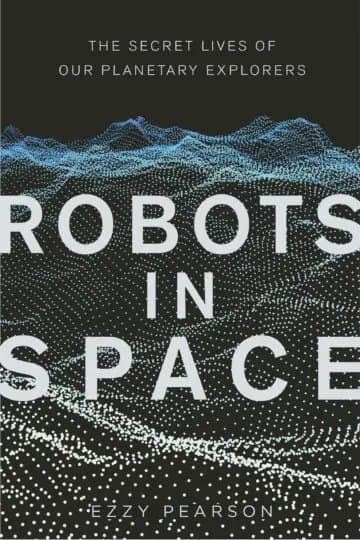
A detailed review of Dr Ezzy Pearson's book on robotic space exploration, examining its strengths in technical detail while noting political bias and editorial issues.
The Red Planet stands alone as the only world in our solar system entirely populated by robots. This curious fact forms the backdrop for Dr Ezzy Pearson's comprehensive examination of robotic explorers in Robots in Space: The Secret Lives of Our Planetary Explorers, a book that catalogues humanity's mechanical emissaries to the cosmos.
The Technical Triumphs and Tragedies
What emerges most powerfully from Pearson's work is the sheer complexity of landing a machine a million miles away. The book excels at detailing the practicalities faced by space agencies as they attempted to send these robotic pioneers into the void. For those of us in the computer industry, the recurring theme is particularly sobering - we're often the weakest link.
Consider the case of Phobos 1, a Soviet mission to Mars's moon. On September 2nd, a computer command was sent to activate the gamma ray spectrometer. A single hyphen had been left out of the code, transforming it into an order for Phobos 1 to shut down completely. There was no way to turn it back on. The mission was lost to a typographical error.
The book is full of such titbits - minor errors leading to major catastrophes. These stories serve as both cautionary tales and fascinating glimpses into the fragility of space exploration. Each failure, whether technical or political, becomes a learning opportunity that shaped future missions.
The Political Landscape
One of the book's weaker areas is its political analysis. The narrative occasionally feels one-sided, particularly in its treatment of Soviet versus American space efforts. A Soviet lunar rover is described as being "daubed with the sickle and hammer" - yet there's no similar derogatory mention of the stars, stripes, and eagles on American craft. We hear about "the Soviet plans to invade Mars proceeded unabated" - but there's no deriding description of American plans to colonise various planets.
The European Space Agency's efforts receive particular scrutiny, with Pearson noting that "more than fifty industrial contractors from fifteen nations were involved in construction. Safe to say, it was a logistical nightmare." This criticism stands in contrast to the book's relative silence about the various back-room deals that led to the American space programme being distributed around their country, with their resultant logistical problems.
It isn't relentlessly pro-American - there are plenty of descriptions of American failures - but the political commentary occasionally feels unbalanced. The book would have benefited from a more even-handed approach to international space politics.
Visual Elements and Production Quality
Scattered throughout the book are gorgeous photos that capture the beauty and isolation of our robotic explorers. Sadly, the ebook version relegates most of these images to the end rather than interspersing them with the relevant text. This editorial choice diminishes their impact and makes it harder to connect the visual elements with the narrative.
There's also at least one instance where an image is incorrect, though thankfully the attribution hyperlinks to the correct photo on NASA's site. Such errors, while minor, suggest a need for more careful proofreading and fact-checking in the production process.
The Human Element
The book shines brightest when it focuses on the people behind these missions - the engineers, scientists, and administrators who made robotic exploration possible. Pearson captures the passion, dedication, and occasional frustration of those working at the cutting edge of space technology.
We learn about the political pressures that shaped mission priorities, the budget battles that determined which projects lived or died, and the personal sacrifices made by those committed to expanding our knowledge of the solar system. These human stories provide the emotional core that elevates the technical details from mere facts to compelling narrative.
Verdict and Recommendation
Robots in Space is a decent enough look at the problems faced by space agencies as they tried to send machines into the void. It serves as a good starting point for anyone with an interest in space exploration and how technical and political challenges can be overcome.
The book's strength lies in its detailed technical descriptions and the fascinating stories of mission failures and successes. Its weakness is the occasionally one-sided political analysis and some production issues in the ebook version.
For readers interested in the history of space exploration, particularly the robotic missions that have expanded our understanding of the solar system, this book offers valuable insights. It's not a perfect work, but it provides a solid foundation for understanding the complex interplay of technology, politics, and human ambition that has driven our robotic exploration of space.
The featured image captures the isolation and beauty of robotic exploration - a fitting visual metaphor for the book's subject matter.
Comments
Please log in or register to join the discussion