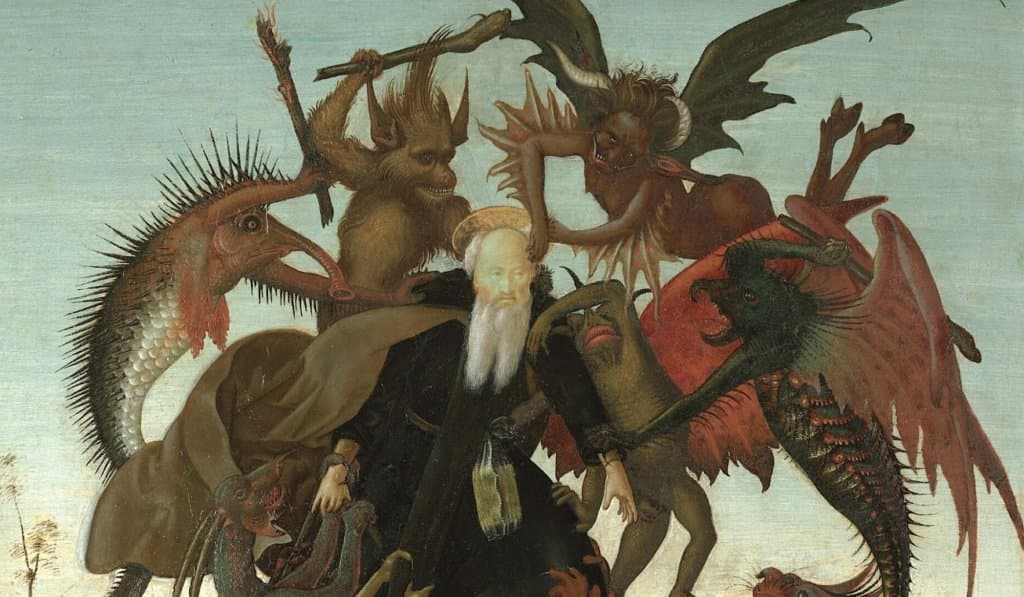
A painting once dismissed as a copy is now recognized as Michelangelo's earliest known work, offering a rare glimpse into the formative years of a Renaissance master and challenging assumptions about artistic genius.
The idea of a masterpiece emerging from the hand of a child seems almost mythical, yet the art world now possesses a tangible example: The Torment of Saint Anthony, a painting completed by Michelangelo when he was just twelve or thirteen years old. For centuries, this work languished in obscurity, its provenance questioned and its authorship attributed to lesser hands. Its journey from anonymity to canonical status reveals as much about the evolving science of art authentication as it does about the prodigious talent of the young Buonarroti.
The painting depicts the titular saint, a hermit of the fourth century, being assailed by demons in the Egyptian desert. The subject was popular in Renaissance Florence, largely due to a widely circulated engraving by the German artist Martin Schongauer. Michelangelo’s version, however, was not a slavish copy. As infrared scans later revealed, the young artist introduced pentimenti—subtle corrections and alterations in the composition. These marks, invisible to the naked eye, are a telltale sign of an artist working with creative freedom rather than mechanical reproduction. They show a mind actively problem-solving, adjusting the placement of figures and refining forms as the painting progressed.
For approximately five hundred years, the painting’s history was murky. It was only in 2008, when the work came up for auction at Sotheby’s, that its modern chapter began. The buyer, a private collector, took the painting to the Metropolitan Museum of Art for examination and cleaning. Beneath layers of dirt and discolored varnish, conservators uncovered a color palette of remarkable sophistication. The tones, the blending of hues, and the treatment of the human form bore a striking resemblance to the style Michelangelo would later employ in the Sistine Chapel ceiling frescoes, painted decades after this small panel.
This visual evidence prompted the Kimbell Art Museum in Fort Worth, Texas, to take a significant risk. The museum’s then-director purchased the painting after extensive research failed to produce a single convincing argument against its attribution to Michelangelo. The acquisition was a landmark: it made The Torment of Saint Anthony the only painting by Michelangelo located in the Americas and one of only four easel paintings attributed to him throughout his entire career—a career during which he famously disparaged oil painting, favoring fresco and sculpture.
The definitive confirmation came a decade later from the renowned art historian Giorgio Vasari scholar, Giorgio Bonsanti. After further technical analysis, Bonsanti published his authoritative conclusion, solidifying the painting’s place in the Michelangelo canon. Yet, as with any attribution of this magnitude, doubters remain. Some scholars argue the stylistic evidence, while compelling, is not conclusive. Others point to the possibility that Michelangelo may have considered the work an immature effort, unworthy of his later, more refined reputation. The artist himself was notoriously self-critical and often disavowed early works.
This tension between technical analysis and historical context highlights a central challenge in art history. How do we reconcile the cold, empirical data of infrared reflectography and pigment analysis with the subjective, often incomplete records of an artist’s life? The painting’s journey underscores a pattern in the rediscovery of lost masterpieces: they often emerge not from grand archival finds, but from the meticulous application of modern technology to objects that have been in plain sight for generations. The same process that authenticated The Torment of Saint Anthony has recently been used to reveal a hidden portrait of Lisa Gherardini beneath the surface of Leonardo da Vinci’s Mona Lisa, suggesting that many more secrets may still lie buried beneath the paint layers of our cultural heritage.
The existence of this painting forces a reevaluation of the very concept of genius. We tend to imagine great artists as fully formed from the start, their talent a sudden, divine spark. Michelangelo’s early work suggests a more complex reality: genius as a process of relentless practice, imitation, and incremental innovation. At twelve or thirteen, he was already mastering techniques that would define his career, yet he was still working within the constraints of his time, relying on established compositions as a scaffold for his own emerging voice. The painting is not a flawless masterpiece, but it is a profound document of artistic becoming.
For those interested in the technical and historical details, the Kimbell Art Museum’s page on the painting provides extensive information, including high-resolution images and conservation reports. The Metropolitan Museum of Art’s conservation department also offers insights into the scientific methods used to analyze such works. The journey of The Torment of Saint Anthony from a disputed attribution to a celebrated treasure is a testament to the ongoing dialogue between past and present, where every new scan and chemical test can rewrite the story of a single brushstroke laid down half a millennium ago.
Comments
Please log in or register to join the discussion