The Document Foundation has issued a public letter disputing marketing around Euro-Office, a newly announced office suite billed as the first open-source productivity software built in Europe. The dispute is less about national pride than about what counts as open, and who actually controls the documents users create.
When The Document Foundation writes an open letter, it usually means a line has been crossed that the organization feels it cannot leave unanswered. The recent letter to office suite users, published just ahead of the Euro-Office announcement, is one of those moments. On its surface, the dispute reads like a quarrel over historical bragging rights: who built the first open-source office suite in Europe? Underneath, it raises a more durable question about what sovereignty over our own data actually requires, and whether a European flag on a product tells you anything meaningful about the freedom it grants.
The claim under dispute
Euro-Office has been positioned in recent coverage as the first open-source office suite developed in Europe, arriving conveniently on the rising tide of interest in Digital Sovereignty across European governments and institutions. The Document Foundation's response is direct. The first open-source office suite developed in Europe was OpenOffice.org in 2001, built on StarOffice source code that originated in Europe, followed by LibreOffice starting in 2010. These were not freeware clones of Microsoft Office with undisclosed code provenance. They were full applications whose lineage is open and traceable, developed and audited in public.
The Foundation's objection is not merely chronological. A claim to be "first" carries an implicit claim to having done the difficult, unglamorous work of building something from the ground up and maintaining it through years when the prevailing wisdom held that desktop office suites were a dying category. The letter argues that this work was done by a community that kept going precisely when few were watching, and that rewriting the history now, to attach a new product to a fashionable cause, erases the people who did the actual building.
Why the format matters more than the brand
The sharpest part of the letter concerns document formats, and this is where the technical substance lives. Euro-Office, according to the Foundation, defaults to OOXML, the format developed and controlled by Microsoft. This is the detail that turns a marketing complaint into a real argument about sovereignty.
To understand why, it helps to separate two things that often get blurred. One is the application you use to edit a document. The other is the format in which that document is stored. You can run a European application, with European developers and European hosting, and still save every file in a format whose specification and future direction are decided in Redmond. If the format is controlled by a single vendor, then the long-term readability and portability of your content depends on that vendor's choices, not yours. That is the dependency the term "content lock-in" describes.
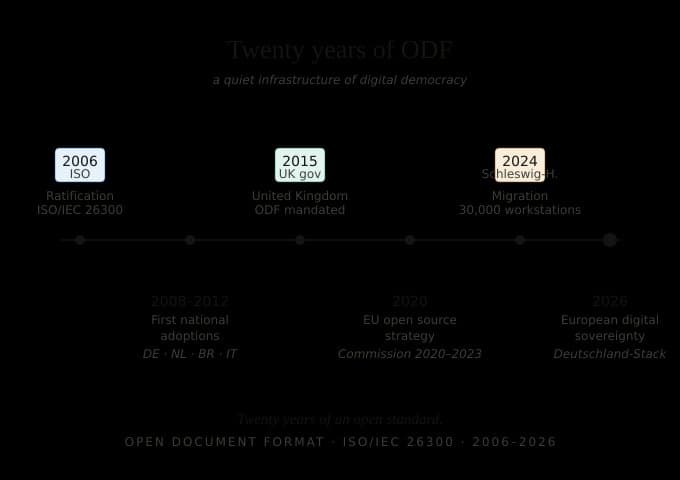
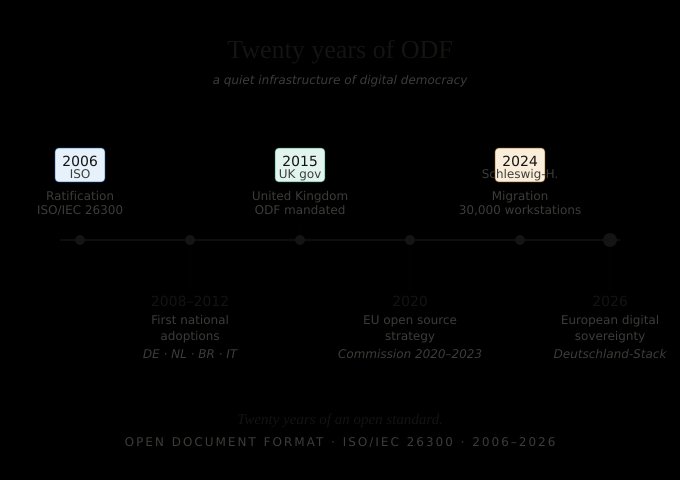
This is why The Document Foundation has spent two decades championing the OpenDocument Format (ODF), ratified as an open ISO/IEC standard in 2006. ODF is a published, vendor-neutral specification. Any developer can implement a reader or writer for it without permission, and a document saved in ODF today remains parseable by independent tools indefinitely, because the rules that govern it are public and stable. For an organization worried about controlling its own records over a span of decades, that property is the entire point. Sovereignty over content is not an abstraction; it is the practical ability to open a file in twenty years using software you chose, from a vendor you trust, or from no vendor at all.
The letter's strongest line follows from this distinction. A product that wraps itself in the language of Digital Sovereignty while defaulting to a Microsoft-controlled format is, in the Foundation's framing, reinforcing the very lock-in that sovereignty is supposed to escape. The geography of the developer becomes almost beside the point if the format keeps the leverage somewhere else.
The longer memory at work
There is an undercurrent of grievance in the letter that is worth taking seriously rather than dismissing as tone. The Foundation notes that many of today's loudest advocates for Digital Sovereignty were absent, or quietly condescending, back in 2006 when ODF was standardized and the case for open formats was unfashionable. The complaint is not just that credit is being misallocated. It is that the hard intellectual work of establishing why open standards matter was done years ago by people who were ignored at the time, and is now being repackaged by newcomers who skipped that argument entirely.
That history shapes how the Foundation reads the present. ODF did not win because it was convenient. It won acceptance slowly, against a format ecosystem dominated by a single company with enormous market power, through patient standardization and implementation. The Foundation's claim is that European Digital Sovereignty in office software exists as a viable concept today only because that groundwork was laid and maintained, often thanklessly.
Counter-perspectives
It would be fair to push back on parts of this. A new entrant defaulting to OOXML can reasonably argue that interoperability with the documents people actually receive, the vast majority of which arrive as .docx and .xlsx files, is a precondition for adoption rather than a betrayal of principle. LibreOffice itself reads and writes OOXML competently for exactly that reason. The difference the Foundation is pointing to is one of default and direction: which format a tool treats as its native home, and therefore which format it gently pushes users toward over time. Reasonable people can disagree about how much a default choice constrains real behavior.
There is also the question of what "open source" guarantees on its own. The letter is careful here, and correctly so. Open source licensing of an application says nothing about the openness of the formats it produces, nor about the provenance of the code if that provenance is undisclosed. A suite can be open source and still channel users into a proprietary, single-vendor format. Conversely, the property that actually protects a user's documents, an open and independently implementable format, is a separate guarantee that has to be checked separately. The Foundation's letter is, in effect, an argument that buyers and public institutions should learn to ask the second question and not stop at the first.
What the episode illustrates, beyond the specific products involved, is how readily the vocabulary of openness gets borrowed once it becomes valuable. Words like sovereignty and open source carry weight now in European procurement decisions, which means there is real incentive to attach them to products regardless of whether the underlying architecture earns them. The defense against that is unglamorous and technical: look at the default format, check whether its specification is public and vendor-neutral, and ask who decides what the format does next. The Document Foundation's letter is a reminder that those questions, not the marketing, are where sovereignty is actually won or lost.
Comments
Please log in or register to join the discussion