What often appear as beginner C# concepts are actually the fundamental building blocks of process communication, CI/CD reliability, and defensive systems design.
Many developers treat the early stages of learning a language as a series of hurdles to clear before reaching the "real" engineering. They view Console.ReadLine(), exit codes, and null-conditional operators as trivialities. This is a mistake. These concepts are not just syntax, they are the primary interfaces between a running process and the operating system.
When we move from writing a script to building a distributed system, the focus shifts from business logic to process communication. A professional engineer does not just write code that works, they write code that fails predictably.
The Process Communication Model
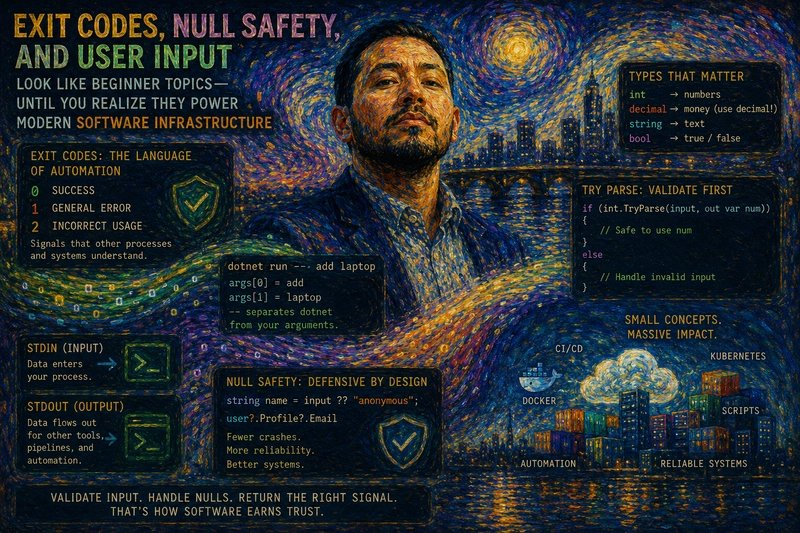
To a developer, an application is a collection of classes and methods. To the operating system, an application is a process. Processes do not communicate via method calls, they communicate through standard streams: STDIN and STDOUT.
STDIN and STDOUT as Integration Points
Standard Input (STDIN) is the entry point for external data. While a beginner sees a user typing a string, a systems engineer sees a data stream that could be coming from a shell script, a redirected file, or a Kubernetes probe.
Similarly, Standard Output (STDOUT) is the primary communication channel back to the environment. Modern infrastructure tools like Docker and Terraform rely on the output of processes to determine the state of a deployment. If your application writes diagnostic noise to STDOUT instead of structured data or clean signals, you break the automation pipeline.
The Language of Exit Codes
Exit codes are the most critical yet overlooked contract in software automation. A process is a black box to the OS, and the exit code is the only way that box communicates its final state.
- Exit Code 0 (Success): The signal that the pipeline can proceed. In a CI/CD context, this is the green light for the next stage of deployment.
- Exit Code 1 (General Error): A signal of runtime failure. This triggers alerts and stops the pipeline to prevent a broken build from reaching production.
- Exit Code 2 (Incorrect Usage): A crucial distinction. This tells the orchestrator that the application is healthy, but the input provided was invalid.
Distinguishing between a crash (1) and a usage error (2) allows infrastructure to differentiate between a bug in the code and a misconfiguration in the deployment YAML. This distinction reduces mean time to recovery (MTTR) by pointing the operator to the correct source of the problem.
Defensive Programming and Boundary Reliability
Most system failures occur at the boundaries. Whether it is an API request, a database query, or user input, the boundary is where uncertainty enters the system.
Validation vs. Execution
Using int.Parse() is a gamble. It assumes the input is correct and throws an exception if it is not. In a high-scale system, relying on exceptions for flow control is an anti-pattern that degrades performance and complicates error handling.
int.TryParse() represents a shift in mindset: validate first, execute second. This is the essence of defensive programming. By treating all external data as untrusted, you move the failure point to the edge of the system, preventing corrupted data from propagating deep into the business logic where it becomes harder to trace.
The Cost of Nullity
Null is not a value, it is the absence of a value. In distributed systems, nulls often represent uncertainty or missing data from a remote service. The C# Nullable Reference Types feature is not just a quality-of-life improvement, it is a tool for defining strict runtime contracts.
Using the null-coalescing operator (??) and the null-conditional operator (?.) allows developers to define safe fallbacks. This prevents the dreaded NullReferenceException, which is often the result of an unhandled edge case in a distributed environment where a network call returned an empty response.
Precision and Technical Debt
Choosing the wrong primitive type is a form of technical debt that is incredibly expensive to refactor. A classic example is the use of double for financial data.
Floating-point arithmetic uses binary representations that cannot accurately represent base-10 decimals. This leads to precision drift, where 0.1 + 0.2 does not equal 0.3. In a banking system, these tiny discrepancies accumulate into significant financial errors. The decimal type in .NET provides the necessary precision for financial calculations by using a base-10 representation, ensuring that the math remains predictable.
Trade-offs in System Design
Building for reliability requires balancing simplicity with robustness.
| Approach | Trade-off | Impact |
|---|---|---|
| Implicit Trust | Faster development, higher risk | Frequent runtime crashes, unstable pipelines |
| Defensive Validation | More boilerplate, higher reliability | Predictable failures, easier debugging |
| Floating Point | High performance, low precision | Inaccurate financial data, rounding errors |
| Decimal Precision | Slightly slower, high precision | Correct financial calculations, auditability |
Summary of the Engineering Mindset
Professional software engineering is the art of managing uncertainty. The transition from a junior to a senior engineer happens when the focus shifts from "how do I make this work?" to "how does this fail?"
By mastering process communication, strict typing, and boundary validation, you aren't just writing a console app. You are building a resilient component that can survive the chaos of a production environment. The basics are not beginner topics, they are the foundation of everything that scales.
Comments
Please log in or register to join the discussion