The calculation of Easter dates reveals the deep mathematical complexity of reconciling lunar and solar calendars, with ancient astronomers developing sophisticated approximations for the lunar cycle that still influence religious observances today.
The calculation of Easter's date illuminates a fascinating intersection of astronomy, mathematics, and religious tradition that has challenged scholars for millennia. At its core lies a fundamental problem: how to reconcile the moon's irregular orbital period with the earth's rotation and the solar year, all while maintaining a practical calendar system for religious observance.
The Ecclesiastical Challenge
The church's decision to fix Easter as the first Sunday after the first full moon following the Spring equinox created an immediate mathematical puzzle. This date was chosen to commemorate an event whose timing was known according to the Jewish lunisolar calendar, but needed to be expressed in the Roman Julian calendar. The result is a calculation that depends not on the actual astronomical full moon, but on predictive algorithms for when that full moon would occur.
This explains why Eastern and Western churches celebrate Easter on different dates. While both use March 21 as the ecclesiastical start of Spring, they employ different calendar systems—Julian for the East, Gregorian for the West. But an equally significant factor is that they use different algorithms for calculating the first full moon, reflecting the inherent difficulty in predicting lunar phases with precision.
The Lunation Problem
The moon's orbital period presents a fundamental challenge for calendar makers. The time between full moons—called a lunation—varies between 29 and 30 days. The average length is approximately 29.530588853 days, a number that resists simple mathematical manipulation. This is why lunar calendars must alternate between 29 and 30-day months and require periodic adjustments, much like leap years in solar calendars.
Ancient astronomers recognized this challenge early. Meton of Athens, in 432 BC, discovered that 235 lunar cycles closely matched 19 tropical years (6,940 days), yielding an approximation of L ≈ 29.5319. A century later, Callippus refined this to 940 cycles in 76 years (27,759 days), giving L ≈ 29.53085. These were remarkable achievements for their time, demonstrating sophisticated astronomical observation and mathematical reasoning.
The Search for Better Approximations
The quest for accurate lunar approximations continues to this day, driven by both practical and theoretical interests. Modern analysis reveals that certain fractions provide remarkably accurate approximations to the lunation period. When evaluating these approximations, we must consider not just absolute accuracy but also the complexity of the fraction itself.
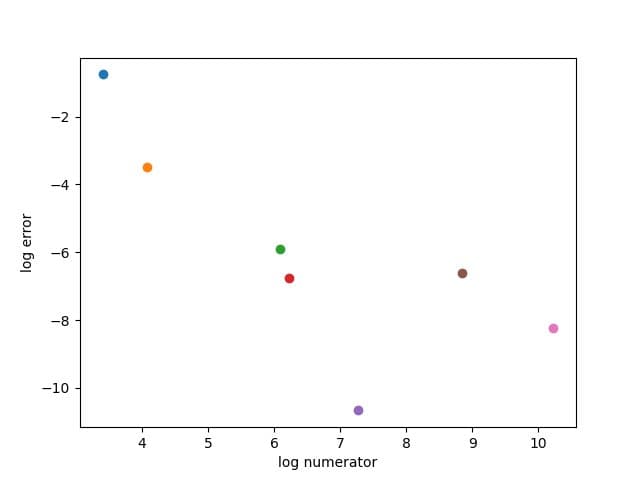
Using what mathematicians call the "classic" height function—log(max(n, d)) where n and d are the numerator and denominator—we can compare different approximations on a complexity-accuracy spectrum. The most accurate approximation among commonly used fractions is 1447/49, which provides exceptional precision but suffers from the practical limitation that 1447 is not conveniently related to the number of days in a year.
The Mathematical Landscape
When we plot the accuracy of various approximations against their complexity, a clear pattern emerges. Simple fractions like 30/1 (corresponding to a 30-day month) are easy to use but relatively inaccurate. More complex fractions provide better accuracy but at the cost of computational difficulty. The approximation 1447/49 stands out dramatically, offering accuracy far beyond what its complexity might suggest.
This mathematical landscape reveals why calendar design remains challenging. The ideal approximation would be both highly accurate and composed of numbers that relate nicely to the solar year. The tension between these competing demands explains why no perfect solution exists and why different traditions have adopted different approaches.
Beyond Simple Fractions
The continued fraction representation of the lunation period provides a systematic way to generate increasingly accurate approximations. The first five convergents of this continued fraction yield fractions that balance accuracy and complexity in interesting ways. Each convergent represents a different trade-off between computational simplicity and astronomical precision.
This mathematical framework helps explain why different cultures and traditions have adopted different calendar systems. The choice of approximation reflects not just astronomical knowledge but also practical considerations about computational ease and cultural preferences for numerical patterns.
The Synodic-Sideral Distinction
An important subtlety in lunar calculations is the distinction between the synodic month and the sidereal month. The synodic month—the time between full moons—is what matters for calendar purposes. It's longer than the sidereal month (the time for the moon to complete one orbit relative to the fixed stars) because the earth is also moving around the sun during this period.
This distinction highlights the complexity of celestial mechanics and why simple observations of the moon's position aren't sufficient for accurate calendar calculations. The interplay between multiple orbital periods creates the irregular patterns that make lunar calendar design so challenging.
Modern Implications
The mathematical challenges of lunar calendars continue to influence modern religious observances and cultural practices. The persistence of different Easter calculation methods across Christian traditions demonstrates how ancient mathematical compromises continue to shape contemporary religious life. Similarly, Islamic and Jewish calendars, which are still primarily lunar-based, must grapple with the same fundamental challenges that puzzled Meton and Callippus over two millennia ago.
Understanding these mathematical foundations provides insight into why calendar reform efforts have historically faced resistance. Any change to established calculation methods requires not just astronomical justification but also consideration of computational practicality and cultural continuity. The lunation problem remains a beautiful example of how pure mathematics intersects with practical necessity and cultural tradition.
Comments
Please log in or register to join the discussion