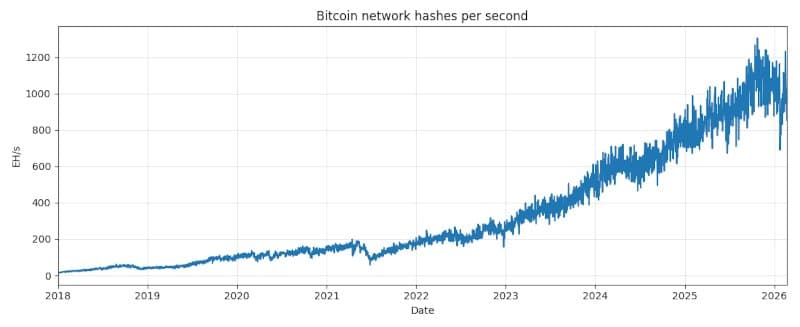
Bitcoin's mining operations now exceed one zettahash per second—a computational magnitude demanding new scientific prefixes and fundamentally altering our perception of digital resource consumption.
When cryptographic hash functions first emerged as theoretical "one-way functions," few anticipated they would evolve into the backbone of a global computational phenomenon. Today, Bitcoin mining alone processes approximately 1.136 zettahashes (1.136 × 10²¹) every second—a scale so immense it renders traditional numerical frameworks inadequate and compels us to adopt previously obscure scientific prefixes just to quantify it.
This astronomical hashrate stems from Bitcoin's proof-of-work consensus mechanism, where miners compete to solve cryptographic puzzles. The network dynamically adjusts mining difficulty every 2,016 blocks (roughly every two weeks) to maintain a consistent block time of ten minutes. As mining hardware efficiency improves—from CPUs to GPUs, FPGAs, and now ASICs—the difficulty escalates correspondingly, creating an arms race where computational output grows exponentially. Economic factors like Bitcoin's market price also influence activity; during price downturns, unprofitable miners disconnect, temporarily reducing hashrate until difficulty adjusts downward.
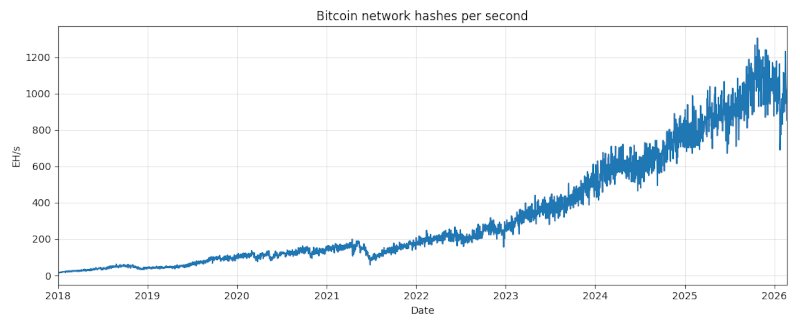 Bitcoin network hashrate over time (source: johndcook.com)
The linguistic implications reveal deeper societal shifts. Common prefixes like giga- (10⁹) and tera- (10¹²) entered mainstream vocabulary through consumer technology, yet peta- (10¹⁵) and exa- (10¹⁸) remain largely unfamiliar outside technical circles. Bitcoin's ascent forced zetta- (10²¹) and yotta- (10²⁴) into relevance—prefixes ratified by the International System of Units in 1991 but rarely used until recently. When annualized, Bitcoin's current hashrate approaches ronnalevels (10²⁷), a prefix formalized in 2022 specifically to address data explosion.
While other proof-of-work cryptocurrencies exist, their collective hashrate remains negligible compared to Bitcoin's dominance. This computational monopoly underscores Bitcoin's dual nature: a security mechanism requiring staggering energy expenditure, yet also an innovation accelerator pushing hardware and numerical literacy forward. Each new prefix adoption—from exa to zetta, yotta, and ronna—marks not just linguistic evolution but a cognitive shift in how humanity conceptualizes value creation in the digital age. As mining scales toward quetta hashes (10³⁰), we confront philosophical questions about resource allocation in a world where abstract tokens command tangible planetary energy expenditure.
Comments
Please log in or register to join the discussion