
A designer-centric framework transforms personalization from fragmented tactics into a coherent architectural approach prioritizing strategic alignment and ethical implementation.
The persistent gap between marketing hype around personalization technologies and practical implementation frameworks has left UX practitioners navigating uncharted territory. While organizations increasingly demand personalized digital experiences—from e-commerce platforms to content ecosystems—the absence of standardized methodologies often results in fragmented campaigns, misaligned stakeholder expectations, and inconsistent user experiences. The Personalization Pyramid emerges as a structural response to this challenge, offering UX designers, researchers, and strategists a comprehensive architecture for transforming raw data into human-centered experiences.
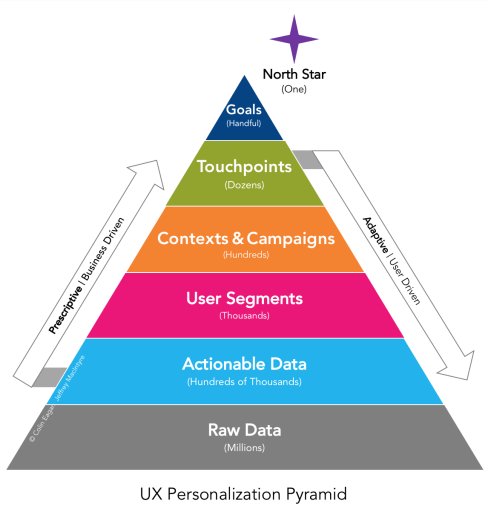
At its core, the framework establishes seven interdependent layers that progress from abstract strategy to technical execution. The apex begins with the North Star—the singular strategic objective guiding the entire personalization initiative. This foundationally shifts the conversation from "Can we personalize?" to "Why should we personalize?" Examples range from functional optimizations (basic user configurations) to product-level transformations like Spotify's algorithmic playlists. Directly beneath this, Goals translate vision into measurable outcomes—conversion rates, engagement metrics, or satisfaction scores—establishing concrete validation criteria for success.
The middle layers operationalize strategy through user interaction points. Touchpoints define where personalization manifests across channels, whether email sequences, in-app notifications, or contextual web modules. This directly informs interface design requirements, necessitating dedicated "personalization zones" in wireframes. Below this, Contexts and Campaigns determine what content users encounter based on their engagement mode—casually browsing versus task-focused behavior. The framework distinguishes between context models (Browse/Skim/Nudge/Feast) and content models (Alert/Enrich/Cross-Sell), creating a matrix for intentional content delivery.

The pyramid's base layers confront data realities. User Segments move beyond basic anonymous/authenticated distinctions toward dynamic cohorts shaped by behavioral patterns and explicit preferences. Crucially, the Actionable Data layer forces critical evaluation of data ethics and quality, emphasizing Twilio's finding that 80% of businesses now prioritize first-party data for its accuracy and reduced "creep factor." Finally, Raw Data represents the broader ecosystem of available information, requiring deliberate filtering into trustworthy signals.
Three significant implications emerge from this architectural approach:
- Strategic Alignment Over Technical Capabilities: By inverting traditional implementation paths (which often start with data availability), the framework ensures personalization serves business objectives rather than technical possibilities.
- Ethical Guardrails: Mandating GDPR-compliant segmentation and first-party data prioritization embeds privacy considerations into the design process rather than treating them as post-hoc constraints.
- Cross-Functional Vocabulary: The accompanying card system transforms abstract layers into workshop tools, enabling designers to articulate needs to developers and stakeholders to visualize trade-offs.
Potential limitations warrant consideration. Organizations with immature data infrastructure may struggle with foundational layers, risking "pyramid collapse" without adequate data governance. Additionally, while the framework acknowledges privacy compliance, it doesn't fully address algorithmic bias mitigation—a critical dimension for equitable personalization. The model's strength in structuring complexity could also become a weakness in lean environments requiring rapid iteration.
The Personalization Pyramid ultimately redefines personalization from a feature checklist to a holistic design philosophy. By anchoring every tactical decision to strategic intent and ethical data practices, it provides UX professionals with the architectural blueprint long missing from personalization discourse—turning fragmented tactics into coherent, human-centered systems.
Comments
Please log in or register to join the discussion