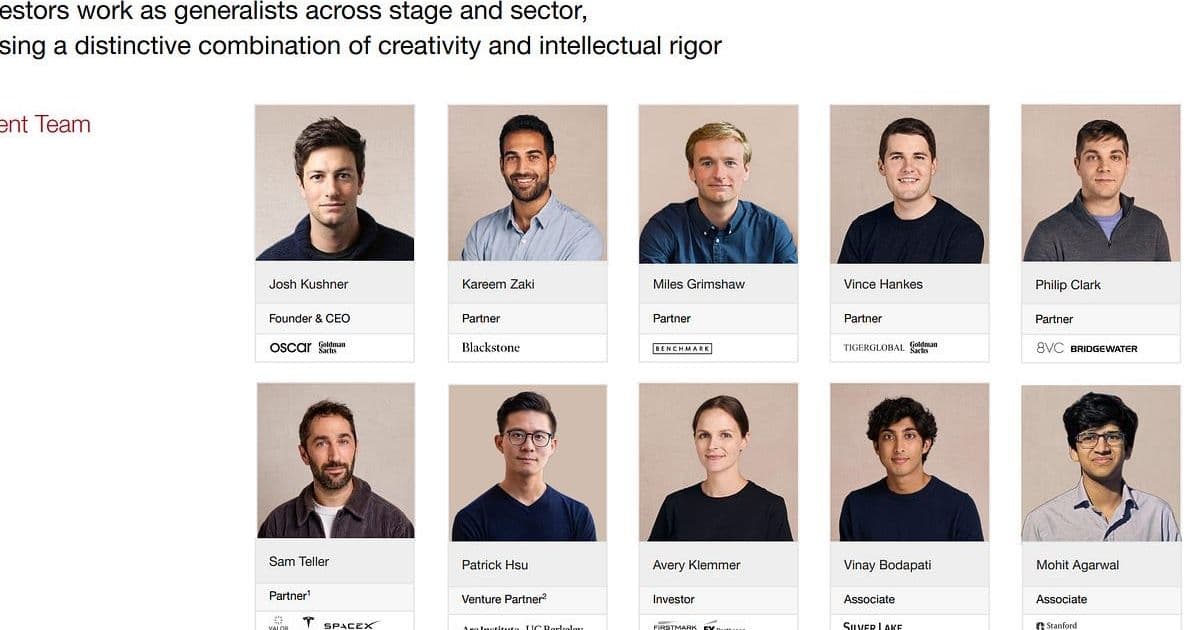
Leaked financial documents from Josh Kushner's Thrive Capital reveal impressive performance metrics, including $26.8 billion in assets under management as of June 2025, with early funds generating significant returns. The news comes amid Thrive's recent $1 billion investment in OpenAI, highlighting the venture firm's strategic positioning in the AI boom.
A leaked pitch deck from Thrive Capital, obtained by Eric Newcomer, provides rare insight into the performance of one of Silicon Valley's most prominent venture capital firms. The documents reveal that Thrive Capital managed $26.8 billion in assets under management (AUM) as of June 30, 2025, with deal value peaking in Q4 2021 during the height of the pandemic-era investment boom.
What's particularly striking is the fund performance metrics. Thrive has achieved positive distributions to paid-in capital (DPI) for four of its early funds, with the 2016 Thrive V fund delivering a remarkable 2.4x return. This performance places Thrive among the top-tier venture firms, demonstrating consistent ability to generate substantial returns for its limited partners.
The leaked documents emerge at a pivotal moment for Thrive, which recently invested $1 billion in OpenAI at a $285 billion valuation—a figure notably lower than the $830 billion valuation at which OpenAI was separately raising funds. This strategic investment, characterized as akin to a call option, positions Thrive to benefit from OpenAI's continued growth while potentially limiting downside risk.
Thrive's investment strategy appears to have successfully navigated the market volatility that followed the 2021 peak. While deal values have moderated since Q4 2021, the firm's ability to maintain strong performance across multiple funds suggests a disciplined approach to deployment and exit timing.
The leaked deck underscores the broader venture capital trends in the AI sector. As major tech companies and startups race to develop and deploy AI capabilities, leading venture firms like Thrive are positioning themselves to capture value across the AI ecosystem. From infrastructure providers to application developers, the AI landscape has attracted significant capital, with Thrive's OpenAI investment being one of the most notable examples.
Beyond the headline numbers, Thrive's performance reflects several important dynamics in the current investment environment:
Diversification across funds: Achieving positive DPI across four early funds suggests a diversified approach that has mitigated the impact of any single underperforming investment.
Strategic timing: The firm appears to have deployed capital effectively across market cycles, with deal value peaking in 2021 and subsequent investments made at more valuations.
AI focus positioning: Recent investments in OpenAI and other AI companies demonstrate a strategic focus on what many consider the defining technology of our time.
The venture capital landscape has evolved significantly since the 2021 peak, with more cautious deployment and greater emphasis on sustainable business models. Thrive's strong performance suggests that while the exuberance of 2021 has subsided, quality investments in transformative technologies continue to generate substantial returns.
For the broader AI ecosystem, Thrive's performance metrics provide validation of the sector's long-term potential. As Anthropic acquires Vercept to advance Claude's computer use capabilities, and Perplexity launches its "general-purpose digital worker" that routes tasks across 19 AI models, the underlying infrastructure and applications continue to mature.
Meanwhile, practical applications of AI are expanding across industries. Adobe's Firefly update introduces Quick Cut, an AI tool for video editing, while Samsung's Galaxy S26 series integrates agentic AI capabilities. These developments, alongside Google's task automation for Gemini on Pixel devices, suggest that AI is moving beyond experimental phases toward practical, everyday applications.
The venture capital community continues to watch Thrive's performance closely as a bellwether for the health of the tech investment ecosystem. With $26.8B in AUM and strong returns on early funds, Thrive appears well-positioned to capitalize on the ongoing AI revolution while maintaining the discipline that has characterized its investment approach.
As the leaked documents make their way through the venture community, they serve as both a report card on Thrive's performance and a snapshot of the current state of venture capital in an era defined by artificial intelligence and technological transformation.
Comments
Please log in or register to join the discussion