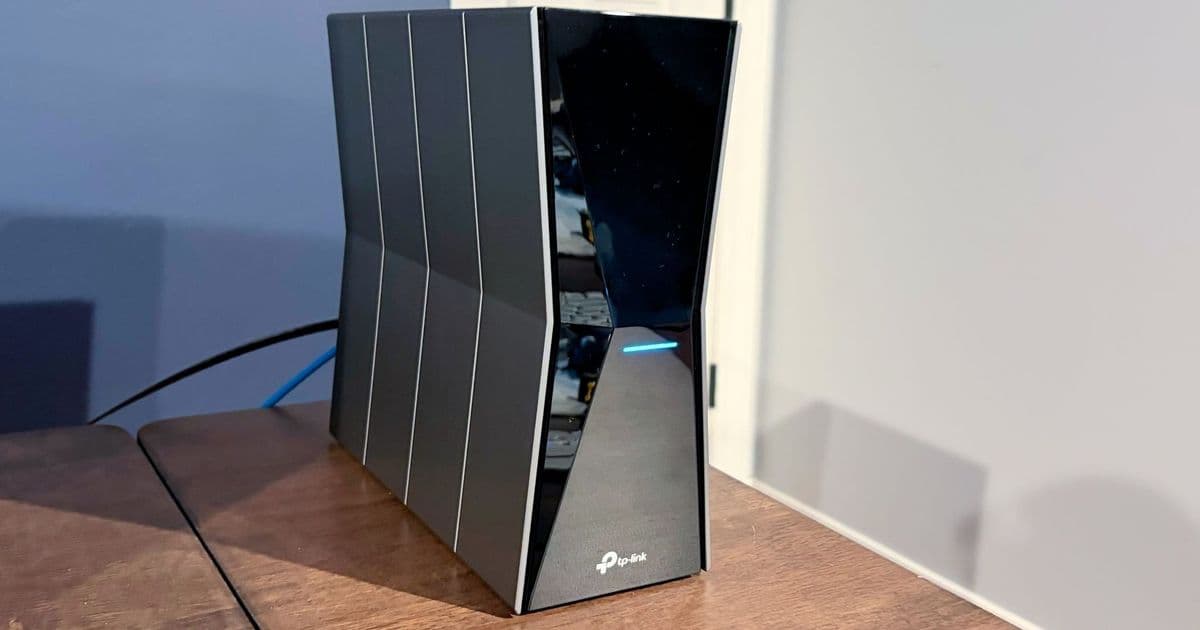
The Archer BE770 delivers impressive 6 GHz and 5 GHz throughput for a sub‑$400 price, but its four 1 GbE LAN ports feel outdated. Two 10 GbE ports and a generous USB‑3.0 offering are highlights, while 2.4 GHz range and the lack of 2.5 GbE LAN keep it from being a complete package.
Announcement
TP‑Link’s Archer BE770 entered the mainstream Wi‑Fi 7 market at a street price of $399.99. It targets power users who need tri‑band performance without stepping into the premium gaming tier. The router ships with an imposing 4.1 × 11.7 × 10.4 in footprint, two 10 GbE ports (one usable as WAN), four 1 GbE LAN ports, and dual USB‑3.0 connectors.
Technical specifications
| Feature | Archer BE770 | Competing models |
|---|---|---|
| Wi‑Fi standard | Wi‑Fi 7 (802.11be) | Wi‑Fi 7 |
| Bands | 2.4 GHz / 5 GHz / 6 GHz | 2.4 GHz / 5 GHz / 6 GHz |
| Peak PHY rates | 688 Mbps (2.4 GHz) · 5,764 Mbps (5 GHz) · 11,529 Mbps (6 GHz) | Similar across the class |
| Coverage | 3,600 sq ft (rated) | 3,300‑3,600 sq ft |
| WAN/LAN ports | 1 × 10 GbE (WAN), 1 × 10 GbE (LAN), 4 × 1 GbE LAN | 1 × 10 GbE + 4 × 2.5 GbE (Archer BE800) ; 1 × 10 GbE + 3 × 1 GbE (Nighthawk RS600) |
| USB | 2 × USB 3.0 | 1 × USB 3.0 |
| Price | $399.99 | $449‑$599 |
Wireless performance
In our iPerf3 tests the BE770 hit 2,700 Mbps on the 6 GHz band at 6 ft, dropping to 1,813 Mbps at 25 ft. Under congested traffic (six simultaneous 4K streams) the router maintained 2,533 Mbps (6 ft) and 1,520 Mbps (25 ft), only a few percent behind the higher‑priced Archer GE800.
On the 5 GHz band the BE770 posted 2,200 Mbps (6 ft) and 1,150 Mbps (25 ft) in clean conditions, again ranking second in our sample set. The 2.4 GHz band lagged with 84 Mbps (6 ft) and 73 Mbps (25 ft) when idle, but it held up better under load, delivering 82 Mbps and 58 Mbps respectively with six extra clients.
These numbers show that the BE770’s 6 GHz and 5 GHz radios are well‑engineered, delivering close to the theoretical maximums of the 4×4 MIMO configuration used in the chipset. The 2.4 GHz radio, however, appears limited to a 2×2 configuration, which explains the modest throughput.
Wired connectivity
The inclusion of two 10 GbE ports is a clear win for users with 10 GbE NAS or workstations. One port can be repurposed as WAN, giving a symmetrical 10 GbE uplink/downlink scenario. The downside is the four 1 GbE LAN ports. At a $400 price point, many competitors now ship 2.5 GbE or even 5 GbE ports as standard. The lack of faster LAN ports forces users to either upgrade to a more expensive model (e.g., Archer BE800) or add external switches, which adds cost and complexity.
Software and management
Setup is streamlined via the TP‑Link Tether app: scan the QR code, assign SSIDs, and apply the first firmware update in under six minutes. The web GUI is functional, with tabs for Network Map, Internet, Wireless, HomeShield, and Advanced. Notable features include:
- Smart Connect (optional band steering)
- MLO (Multi‑Link Operation) for simultaneous use of 5 GHz and 6 GHz
- EasyMesh support for expanding the network with compatible TP‑Link devices
- HomeShield free tier (basic security, parental controls) and a paid Security+ subscription ($35.99 / yr) for advanced threat protection.
The interface is not as polished as some gaming‑oriented routers, but it provides all the knobs power users expect, including VPN passthrough, firmware scheduling, and full backup/restore.
Market implications
The BE770 arrives at a time when Wi‑Fi 7 adoption is still early, but flagship devices are beginning to appear. Its $400 price positions it between entry‑level Wi‑Fi 7 routers (≈$200) and high‑end gaming units (≈$600). By delivering near‑top wireless throughput while keeping the price below $500, TP‑Link aims to capture the “prosumer” segment that values performance for work‑from‑home setups, small‑office LANs, and high‑resolution streaming.
However, the wired port strategy may limit its appeal in that segment. Enterprises and power users increasingly expect at least 2.5 GbE on all LAN ports to future‑proof against rising internal traffic (e.g., 8K video editing, large‑scale file sync). Competitors such as Asus ROG Strix GS‑BE18000 and Netgear Nighthawk RS600 already ship multiple 2.5 GbE or mixed 10 GbE/2.5 GbE configurations at similar price points.
From a supply‑chain perspective, the BE770 uses a Qualcomm Networking Pro 9006 chipset, fabricated on a 4 nm process. The 4 nm node offers a good balance of power efficiency and silicon area, enabling the router to support three simultaneous 4×4 streams without thermal throttling. The presence of two 10 GbE MACs suggests that TP‑Link sourced a Broadcom BCM57414 PHY, a component that has seen tight allocation in recent quarters. The decision to pair it with four 1 GbE PHYs likely reflects component cost constraints rather than a technical limitation.
In the broader market, the BE770’s performance validates that Wi‑Fi 7 can deliver multi‑gigabit speeds in real‑world home environments, reinforcing the shift away from wired Ethernet for high‑throughput devices. Yet the router’s LAN port mix underscores a transitional period: manufacturers are still balancing cost, component availability, and consumer expectations.
Bottom line
- Wireless: 6 GHz and 5 GHz performance are excellent, placing the BE770 among the top tier of current Wi‑Fi 7 routers.
- Wired: Two 10 GbE ports are a highlight, but four 1 GbE LAN ports feel outdated at this price.
- Software: Tether app and web GUI are solid; HomeShield adds a modest security layer.
- Value: For users who prioritize wireless speed and already own 10 GbE devices, the BE770 is a compelling choice. Users who need faster LAN ports should look at the Archer BE800 or comparable models.
Overall, the Archer BE770 is a strong Wi‑Fi 7 contender that leans heavily on wireless performance while leaving wired connectivity as an area for improvement.
Comments
Please log in or register to join the discussion