With Nvidia now TSMC's largest customer, the semiconductor giant is reportedly demanding Apple pay significantly more for its advanced chips, potentially raising prices for iPhones, iPads, and MacBooks starting in 2026.
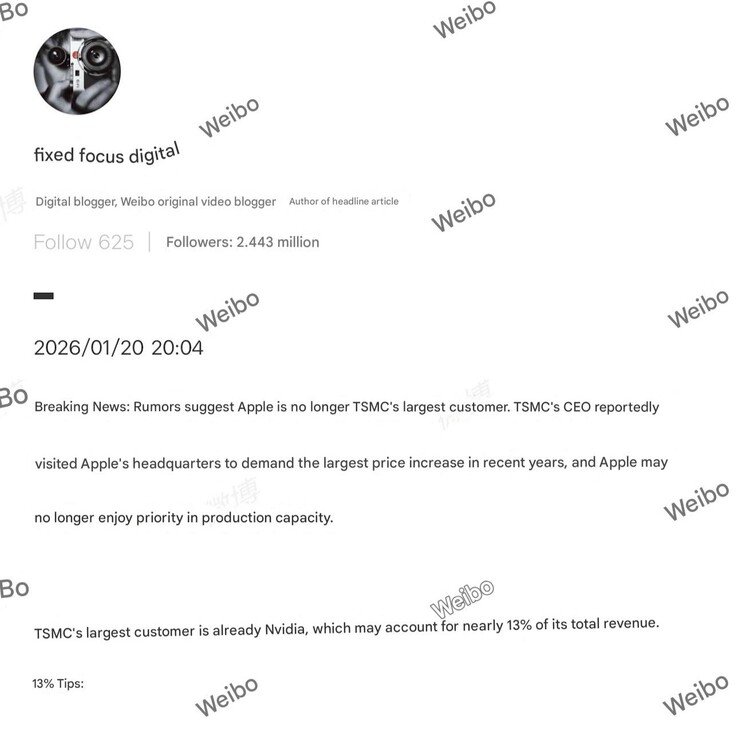
The semiconductor industry's power dynamics have shifted dramatically. For years, Apple held the coveted position as TSMC's largest customer, securing preferential pricing and priority access to the most advanced manufacturing nodes. That changed when Nvidia's explosive growth in AI chips propelled it past Apple to become TSMC's biggest revenue source. Now, according to leaker Fixed Focus Digital, TSMC CEO C.C. Wei has personally visited Apple to demand what's being called "the largest price increase in recent years."
This isn't happening in isolation. TSMC has been steadily raising prices for its advanced process nodes for several years, and the company has signaled this pattern will continue through 2026 and beyond. The timing is critical because Apple is preparing to use TSMC's 2nm process for the A20 SoC in the iPhone 18 series, and the M6 chips for next-generation MacBooks. With Apple no longer holding the top customer position, TSMC appears to be leveraging its new market reality to renegotiate terms.
The Cost of Losing Priority Access
When Apple was TSMC's largest customer, the relationship was mutually beneficial. Apple received discounted pricing and guaranteed access to cutting-edge nodes, while TSMC secured a stable, high-volume customer that could absorb the enormous costs of developing new manufacturing processes. This arrangement allowed Apple to maintain relatively stable pricing despite the increasing complexity of chip manufacturing.
Now that Nvidia has taken the top spot, Apple's negotiating position has weakened. TSMC's demand for a significant price increase suggests the company is no longer willing to offer the same preferential treatment. This could mean Apple pays substantially more for its A-series and M-series chips, with those costs inevitably passed on to consumers.
What This Means for Future Apple Products
If TSMC's demands are accepted, the impact will be felt across Apple's entire product line:
iPhone 18 Series (2026): The iPhone 18 will likely be the first product to use TSMC's 2nm process. With chip costs increasing, Apple may need to raise prices to maintain margins. The iPhone 17 is expected to continue using the 3nm node, so the price jump to 2nm could be more pronounced than previous generational changes.
M6 MacBooks (Late 2026/Early 2027): The M6 series, expected to power next-generation MacBook Air and Pro models, will also use the 2nm process. Combined with potential memory market volatility, these laptops could see price increases of several hundred dollars compared to M5 models.
iPad Lineup: The iPad Pro, which shares the same M-series chips as MacBooks, would likely see similar price adjustments. The standard iPad and iPad Air, which use A-series chips, would also be affected.
The Broader Industry Context
This price renegotiation reflects a fundamental shift in the semiconductor industry. Nvidia's rise to the top of TSMC's customer list isn't just about gaming GPUs—it's about the AI revolution. Data center GPUs for AI training and inference have become TSMC's most profitable segment, commanding prices far above consumer chip margins.
For TSMC, this diversification reduces dependence on any single customer. For Apple, it means losing some of the bargaining power that came with being the dominant volume customer. The company now faces a choice: absorb higher costs, raise prices, or potentially explore alternative manufacturing partners like Intel Foundry or Samsung, though neither currently matches TSMC's 2nm capabilities.
The Consumer Impact
Apple products have already seen significant price increases in recent years. The iPhone 15 Pro Max started at $1,199, up from $1,099 for the 14 Pro Max. The MacBook Pro with M3 Pro starts at $1,999, compared to $1,999 for the M2 Pro model (though with more base storage). Further increases could push flagship iPhones above $1,300 and MacBook Pros above $2,200 for base configurations.
For consumers, this means the premium for Apple's ecosystem could grow even higher. The company's strategy of integrating hardware, software, and services has always commanded a premium, but chip manufacturing costs are a fundamental component that Apple can't easily optimize away.
What Comes Next
The rumor from Fixed Focus Digital, shared via Jukan on X, should be treated as unconfirmed. Apple and TSMC don't publicly discuss pricing negotiations, and the leaker's track record, while generally reliable, isn't perfect. However, the underlying dynamics—Nvidia's rise, TSMC's ongoing price increases, and Apple's reduced leverage—are well-documented industry trends.
If the price increase materializes, Apple may need to make strategic choices. The company could accept lower margins on hardware, though this seems unlikely given its focus on premium positioning. Alternatively, it might accelerate efforts to diversify its manufacturing partners, though this would require years of development and qualification.
For now, consumers planning their next Apple purchase might want to consider the current generation. The iPhone 16 and M4 MacBooks represent the last models before the rumored 2nm transition and potential price restructuring. While not confirmed, the pattern suggests that waiting for future models could mean paying significantly more for similar performance gains.
The semiconductor industry's consolidation around a few key players—TSMC for advanced nodes, Nvidia for AI chips, and Apple for consumer devices—creates a complex web of dependencies. As these relationships evolve, the costs and benefits will ultimately flow through to the devices we use every day. The question is whether Apple's ecosystem value can justify the premium when the underlying chip costs are rising.
Comments
Please log in or register to join the discussion