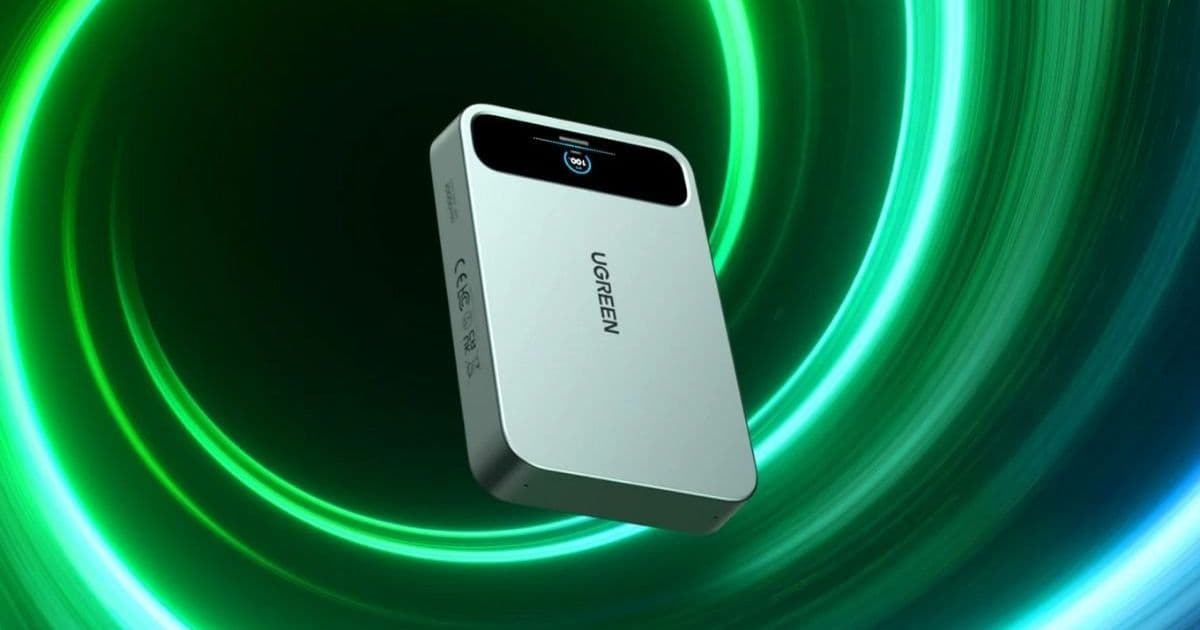
Ugreen's latest MagFlow power bank adds AI-powered voice recording and summarization to its magnetic charging capabilities, creating a hybrid accessory that targets both power users and productivity-focused travelers.
Ugreen has unveiled the MagFlow AI Voice Recording Magnetic Power Bank at CES 2026, a device that attempts to merge two distinct categories: portable charging and voice-based productivity. While the company's announcement focuses on the dual functionality, the real story lies in how this product represents a growing trend of hardware companies layering AI features onto traditionally single-purpose accessories.
What's New: A Power Bank That Listens
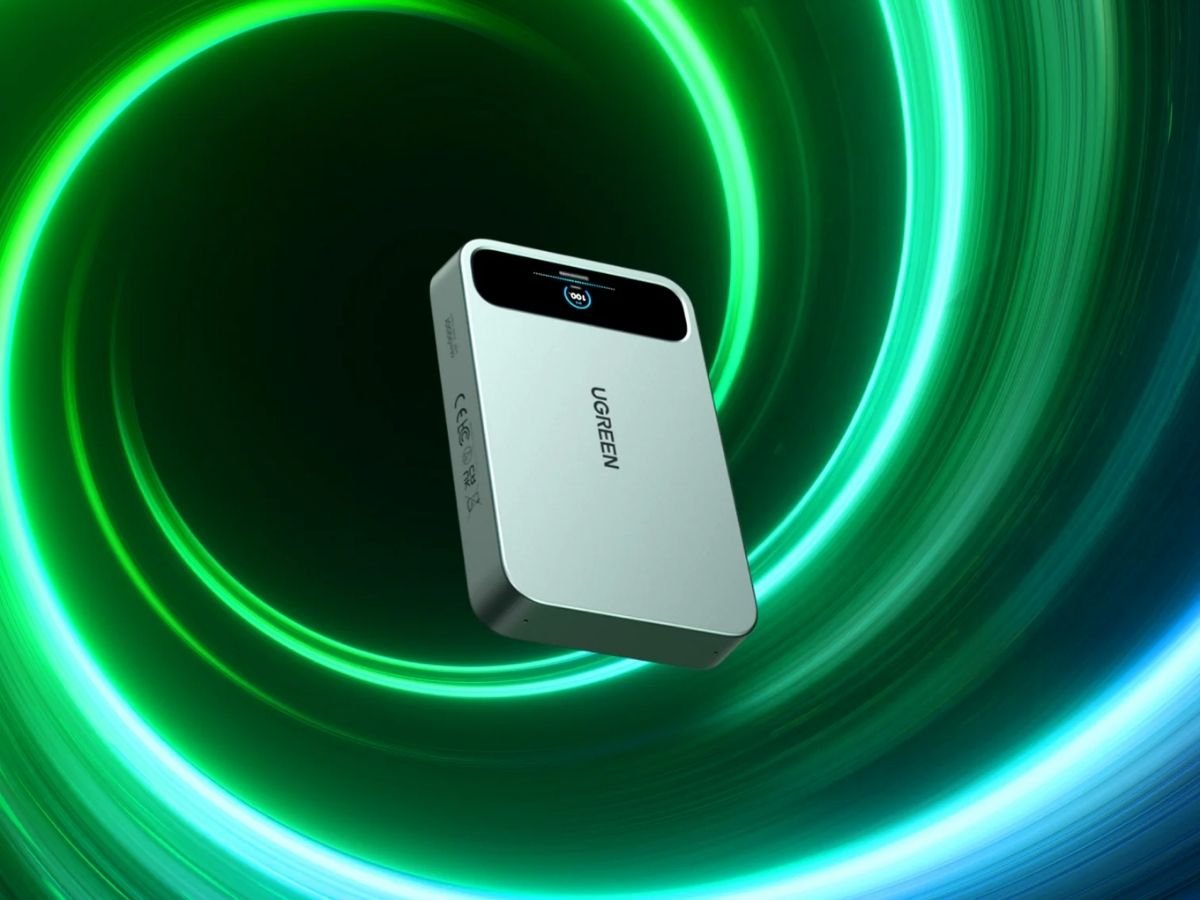
The MagFlow AI Voice Recording Magnetic Power Bank builds on Ugreen's existing Qi2 magnetic charging line but adds a significant twist: built-in AI that can record, translate, and summarize voice notes. The 10,000 mAh battery capacity matches the company's previous Qi2 25W MagFlow Power Bank, which retails for $89.99 in the US. The device features a wireless charging pad with magnetic alignment, a digital display showing battery levels and charging data, and the new AI voice recording capability.
The integration of voice recording isn't merely an add-on feature. According to Ugreen, the "built-in AI" enables real-time translation and summarization of recorded notes. This suggests the device processes audio locally or connects to cloud services for AI processing. The company hasn't clarified how users access these recordings or summaries—whether through a companion app, direct USB transfer, or another method. The product page image shows only the device's front display, leaving questions about additional connectivity options like USB-C ports or physical controls for recording.
How It Compares: Evolution of the MagFlow Line
Ugreen's previous MagFlow power bank, the Qi2 25W model, focused purely on charging. It supported 15W wireless charging via MagSafe compatibility and included a digital display for battery status. The new AI Voice Recording version appears to maintain these charging specifications while adding the recording functionality. This represents a significant value-add if the AI features work as advertised, though it likely comes at a premium price.
Compared to traditional power banks from competitors like Anker or Belkin, the MagFlow AI Voice Recording model enters uncharted territory. Most power banks prioritize charging speed, capacity, and port variety. Ugreen's approach instead targets a different need: the ability to capture thoughts and ideas while on the move, with AI processing to make those notes more useful. This positions the device not just as a charger, but as a mobile productivity tool.
The timing is interesting. At CES 2026, Ugreen also announced the NASYnc iDX Series and the Nexode Pro 300W 8-Port Desktop GaN Fast Charger, showing the company's broader push into AI-integrated and high-power charging solutions. The MagFlow AI Voice Recording Power Bank fits into this ecosystem as a portable, personal device rather than a desktop or network solution.
Who It's For: Travelers, Journalists, and Productivity Enthusiasts
The target audience for this device isn't obvious. Traditional power bank users—those who simply need extra battery life for phones and tablets—may find the AI voice recording feature unnecessary. The added cost and potential complexity might not justify the benefit for casual users.
However, several groups could find genuine value here:
Travelers and digital nomads who need to capture ideas, directions, or observations while moving between locations, without pulling out a phone or laptop. The magnetic attachment could allow the power bank to stick to a backpack or bag while recording.
Journalists and researchers conducting interviews or fieldwork where quick note-taking is essential. The AI summarization could help organize thoughts immediately after an interview, though the quality of the summarization will be crucial.
Professionals in meetings where taking notes manually is cumbersome. The device could discreetly record discussions (with appropriate consent) and provide summaries afterward.
The key question is whether the AI processing happens locally or requires an internet connection. Local processing would make the device more useful in areas with poor connectivity, but would likely limit the sophistication of the AI. Cloud-based processing would offer more powerful features but introduce dependencies and potential privacy concerns.
Technical Considerations and Trade-offs
Adding AI voice recording to a power bank introduces several engineering challenges. First is power consumption: AI processing, especially for real-time translation and summarization, requires significant computational resources. This could drain the 10,000 mAh battery faster than expected, reducing its effectiveness as a charger.
Second is thermal management. Power banks already generate heat during charging, especially with wireless charging. Adding a processor for AI tasks could compound this issue, potentially requiring more sophisticated thermal design.
Third is data privacy. Voice recordings contain sensitive information. How Ugreen handles this data—whether it's stored locally, transmitted to servers, or processed in real-time—will be critical for user adoption. The company hasn't addressed these privacy concerns in its announcement.
Finally, there's the question of audio quality. The device likely has built-in microphones, but their quality in noisy environments will determine how useful the recording feature actually is. Background noise could make transcription and summarization unreliable.
Pricing and Availability
Ugreen hasn't announced pricing or release dates for the MagFlow AI Voice Recording Magnetic Power Bank. As a reference, the previous Qi2 25W MagFlow Power Bank sells for $89.99 (currently $69.99 on Amazon). The AI version will likely command a premium—possibly $120-$150—given the added hardware and software capabilities.
The lack of detailed specifications suggests this is still a pre-production announcement. CES reveals often showcase concepts that undergo changes before retail availability. Ugreen will need to address several unanswered questions before consumers can make informed decisions:
- How are recordings stored and accessed?
- What AI models power the translation and summarization?
- Does the device require a companion app?
- What languages does it support for translation?
- How accurate is the summarization feature?
- What's the battery impact of using AI features?
The Bigger Picture: AI in Everyday Hardware
The MagFlow AI Voice Recording Power Bank represents a broader trend of embedding AI into hardware that traditionally didn't need it. Companies are exploring how AI can add value beyond smartphones and laptops, bringing intelligence to accessories like headphones, cameras, and now power banks.
This approach has potential but also risks. If the AI features are gimmicky or unreliable, they detract from the core function of charging. If they work well, they could create a new category of "smart accessories" that justify their existence through genuine utility.
For Ugreen, this product is a calculated risk. The company has built a reputation for reliable charging accessories at competitive prices. Venturing into AI-powered features could either strengthen that reputation or dilute it if the execution falls short.
Conclusion: Promise vs. Practicality
The Ugreen MagFlow AI Voice Recording Magnetic Power Bank is an intriguing concept that addresses a real need: capturing thoughts while on the move. However, its success depends entirely on execution. The AI features must be genuinely useful, not just marketing buzzwords. The device must maintain its core competency as a reliable power bank. And it must justify what will likely be a significant price premium over traditional power banks.
Until Ugreen provides more details about pricing, availability, and technical specifications, this remains a promising but unproven product. For now, it serves as an interesting case study in how hardware companies are experimenting with AI integration, for better or worse.
Related Links:
- Ugreen Official Website (for product announcements)
- CES 2026 Coverage (for broader context on tech trends)
- Ugreen Qi2 25W MagFlow Power Bank on Amazon (for price comparison)
Note: This article is based on preliminary announcements. Specifications and features may change before retail availability.
Comments
Please log in or register to join the discussion