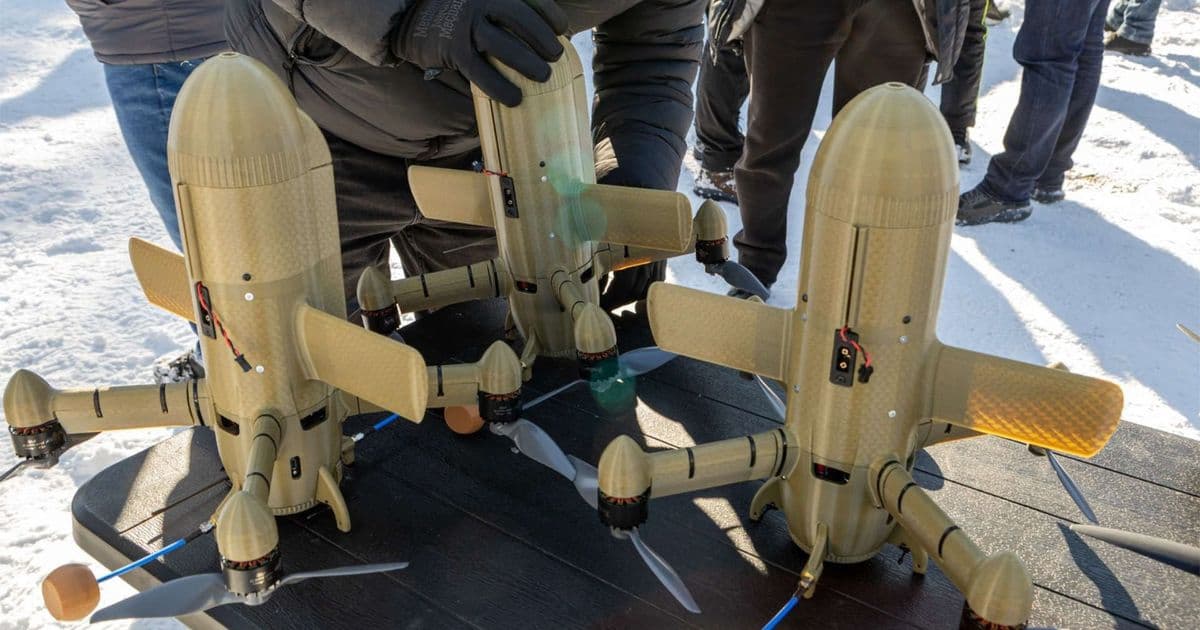
Ukraine deploys low-cost 3D-printed drone interceptors to US and Gulf allies as Iran's Shahed-136 kamikaze drones create urgent need for affordable air defense solutions.
Ukraine has begun deploying its domestically developed drone interceptor systems to the United States and Gulf State allies as the Iran War intensifies, with the lowest-cost model—the Skyfall P1-SUN—priced at just $1,000 per unit and built using 3D-printed airframes.
The first shipments of Ukrainian interceptor devices and military personnel arrived in Jordan as early as March 6, according to Al Jazeera reports. Ukrainian President Volodymyr Zelenskyy confirmed that his country has been responding to US requests for "specific support in protection against 'shaheds' in the Middle East region," referring to the Iranian-made Shahed-136 kamikaze drones that have become a major threat.
Zelenskyy has been actively pursuing expanded cooperation, revealing on March 12 that he was awaiting "approval from the White House" to "sign a big drone production deal" with the United States. The proposed agreement would involve various types of drones and air defense systems that operate as integrated systems capable of defending against hundreds or thousands of Iranian Shahed drones.
The Interceptor Arsenal
The Ukrainian systems being deployed include several models:
- Sting - A high-performance interceptor
- Bullet - Mid-range drone killer
- P1-Sun - The flagship low-cost model
- Octopus 100 - Multi-target capable system
- ODIN Win_Hit - Advanced targeting platform
The Skyfall P1-SUN represents a breakthrough in cost-effective air defense, utilizing 3D-printed components to achieve its remarkably low price point of approximately $1,000 per unit.
Cost Comparison Drives Adoption
The economic advantages of Ukrainian interceptors are stark when compared to traditional air defense systems. While a single Patriot missile costs approximately $4 million, Ukrainian interceptors range from $1,000 to $2,000 per unit.
This cost differential becomes even more significant considering operational requirements. Patriot missile systems require a launcher system and three soldiers for a single launch, but approximately 90 personnel for full sustained operation and maintenance. In contrast, Ukrainian interceptors can be launched and controlled by a single operator.
Gulf States are rapidly depleting their air defense supplies, with some commentators noting that more Patriot missiles have been fired during the Iran War than Ukraine has received during the past four years of conflict with Russia.
Asymmetric Warfare Innovation
Ukraine's development of these interceptor systems represents one of its most notable achievements in the ongoing conflict with Russia. Facing a larger, better-equipped military, Ukraine has pioneered innovative approaches using smaller, cheaper, and sometimes surprisingly high-tech responses.
This experience has proven invaluable as the same Shahed drones that Iran has supplied to Russia are now being used against US allies in the Middle East. The technology transfer represents a significant shift in how asymmetric warfare capabilities are shared among democratic nations.
Strategic Implications
The rush for Ukrainian interceptors comes as Iran is believed to have thousands of its domestically produced Shahed drones in stock. These cheap, effective weapons have proven difficult to counter using traditional air defense systems due to their cost-effectiveness and swarm tactics.
However, the situation carries ironic complications. A probable unintended consequence of the Iran invasion is the recently judged necessity to ease Russian oil sanctions. This move could provide more funds to fuel Putin's war machine, potentially extending the Russia-Ukraine war and prolonging Ukraine's own struggle against Shahed drones and other advanced weapons.
Zelenskyy has made clear that Ukraine's willingness to help comes with expectations: "We are ready to help," he stated, but the quid pro quo is that Ukraine should also gain access to more advanced US defense systems.
The deployment of Ukrainian interceptors to Gulf States represents a significant evolution in international defense cooperation, where battlefield-tested technologies from one conflict are rapidly adapted to address emerging threats in another theater of operations.
Comments
Please log in or register to join the discussion