
UnifyDrive is launching two new network-attached storage devices that depart from its battery-powered mobile roots, offering entry-level and premium configurations with Intel processors, multi-drive support, and pre-built hardware aimed at users who want a working NAS without building from scratch.
UnifyDrive has built its reputation on portable, battery-powered storage devices like the pocket-sized UT2 and the UP6 mini PC with integrated battery. That changes with the company's latest announcements: the UC250 and UC450 Pro represent a pivot toward traditional, always-on NAS hardware. These new models drop the battery concept entirely in favor of wall-powered systems designed for permanent deployment.
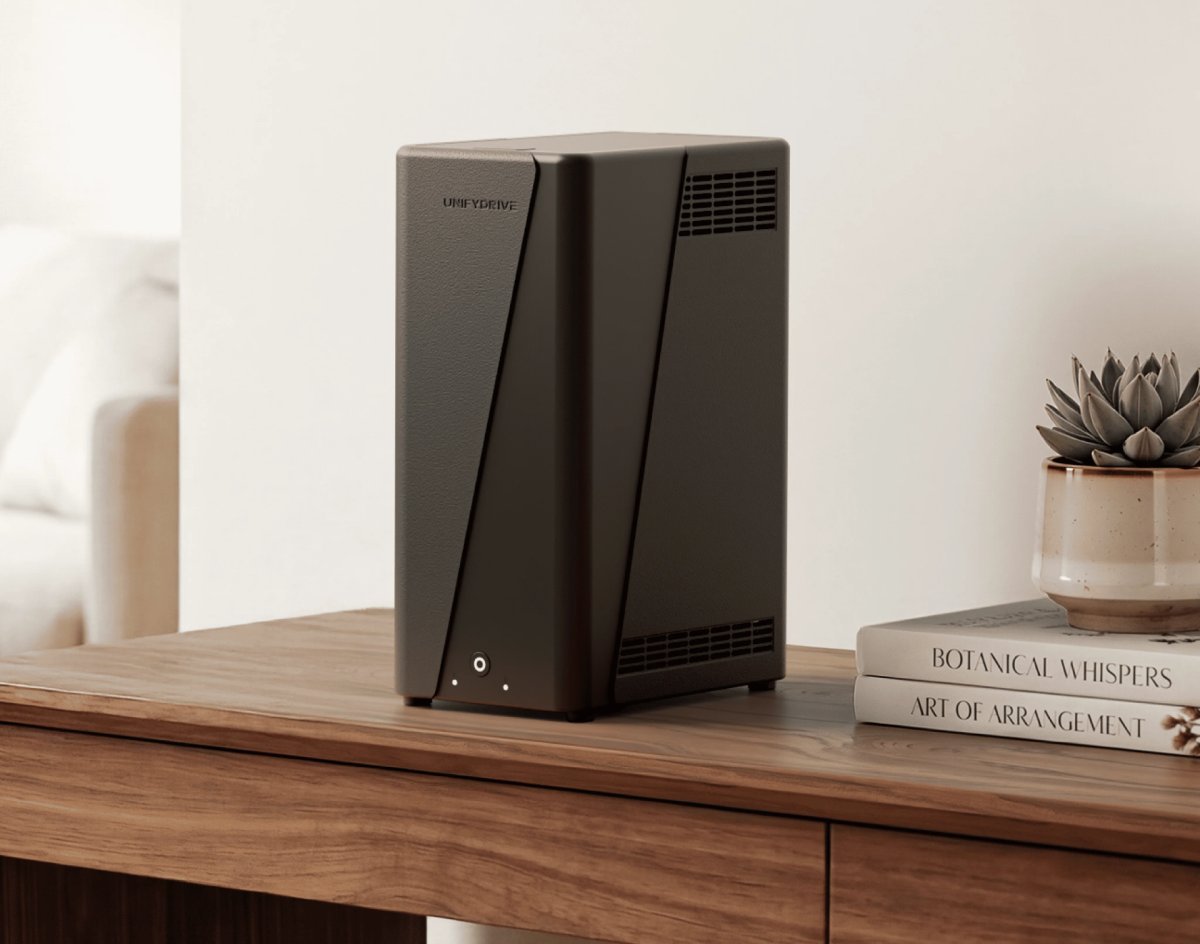
Two tiers, two processors
The UC250 serves as the entry point, priced at $399. It uses Intel's N150 processor—a 4-core, 4-thread chip based on Intel's efficient E-cores, clocked up to 3.6 GHz with a 6W base power draw. This is paired with 8GB of DDR4-3200 RAM, officially expandable to 16GB, though the N150's memory controller may support more depending on the specific implementation.
Storage configuration includes two SATA bays for 2.5" or 3.5" drives, plus two M.2 2280 slots with PCIe 3.0 x4 support. There's also 32GB of eMMC storage, likely for the operating system. Networking is limited to 1 Gigabit Ethernet, which may be a bottleneck for users with multi-gigabit home networks or SSD-based storage arrays.
Ports are modest: one USB 3.2 Gen 2 Type-A (10 Gbps), one USB 3.2 Gen 2 Type-C (also 10 Gbps), and HDMI 2.1 output. The unit measures 158 × 98 × 233 mm (6.2" x 3.9" x 9.2") and draws power from a 12V / 6A (72W) adapter.
UC450 Pro: Core Ultra 5 with expandability
The UC450 Pro, at $1499, is a substantially different beast. It's built around Intel's Core Ultra 5 225H, a 14-core processor combining 4 performance cores and 8 efficiency cores, with boost clocks up to 4.9 GHz. This chip includes Intel Arc 130T integrated graphics and a Neural Processing Unit delivering 13 TOPS, contributing to a total platform TOPS of 83. The processor operates within a 28-115W TDP range, giving the system significant headroom for demanding workloads.
RAM support is a major upgrade: 16GB DDR5 standard, with capacity up to 128GB. Storage options are far more flexible:
- Two SATA 3 bays (3.5" or 2.5")
- Two U.2 slots for enterprise-grade NVMe drives
- Four M.2 slots: three at PCIe 4.0 x4, one at PCIe 3.0 x4
- 32GB eMMC for system storage
Networking reflects the premium positioning: one 10 Gigabit Ethernet port, one 1 Gigabit port, and two 2.5 Gigabit ports. This multi-tier networking allows for network segmentation or link aggregation.
Port selection includes two Thunderbolt 4 ports (40 Gbps), a USB 3.2 Gen 2 Type-A (10 Gbps), HDMI 2.1, and the same USB-C and USB-A ports found on the UC250. The unit supports external UPS accessories and includes built-in smart UPS functionality. Power input is 19V / 7.9A (150W), and dimensions are 184.4 × 184.4 × 242.5 mm (7.3" x 7.3" x 9.5").
The build-vs-buy equation
UnifyDrive is positioning these systems against DIY NAS builds running TrueNAS, Unraid, or OpenMediaVault on mini PCs. The value proposition is straightforward: purpose-built hardware that works out of the box. For developers and power users, this raises interesting trade-offs.
Building your own NAS gives you complete control over hardware selection, OS choice, and upgrade paths. A mini PC with external drive enclosure can be assembled for less than UnifyDrive's asking price, especially for the UC450 Pro. You can also tailor the system exactly to your needs—choose a processor with the right core count, select specific NICs, configure RAM precisely.
However, UnifyDrive's approach offers integration benefits. The UC250 and UC450 Pro come with drive bays, power supplies, and networking pre-configured. There's no need to source compatible enclosures, worry about SATA controller compatibility, or debug boot issues with custom hardware. For developers who need to deploy storage quickly without becoming NAS hardware experts, this matters.
The UC250's N150 processor is particularly interesting. While it won't match a modern desktop CPU, it's more than adequate for file serving, media streaming, and running lightweight containers. The 6W base power means minimal electricity costs for 24/7 operation. At $399, it's competitive with building a similar system from a mini PC plus drive enclosure.
The UC450 Pro's pricing is harder to justify purely on hardware costs. A mini PC with a Core Ultra 5 225H, 16GB DDR5, and similar connectivity would cost significantly less, even adding a quality multi-bay enclosure. But the UC450 Pro includes Thunderbolt 4, U.2 support, and multi-gigabit networking—features that would require careful component selection in a DIY build.
Cross-platform considerations
For mobile developers maintaining apps on both iOS and Android, these systems could serve as local build servers or CI/CD nodes. The UC450 Pro's 14-core processor and up to 128GB RAM could handle parallel Android builds or iOS simulators. The Thunderbolt 4 ports enable fast external storage for large asset libraries or test device fleets.
The N150-based UC250 is more limited but still viable for smaller projects. It could run Git repositories, artifact storage, or lightweight testing environments. The key limitation is the 1 Gigabit networking—file transfers to and from the device will be slower, which affects build times when pulling dependencies or pushing artifacts.
Both systems likely run Linux-based NAS software, though UnifyDrive hasn't specified the OS. For developers, this means SSH access, Docker support, and standard Linux tooling should be available. The ability to run containers makes these systems more flexible than locked-down consumer NAS devices.

Storage architecture details
The UC450 Pro's mix of SATA, U.2, and M.2 slots enables tiered storage strategies. You could use:
- U.2 NVMe for hot data and databases
- M.2 PCIe 4.0 for application storage and containers
- SATA drives for bulk media storage
- eMMC for OS and boot
This mirrors enterprise storage patterns but at a consumer price point. The UC250's simpler two-SATA, two-M.2 configuration is more constrained but still supports SSD caching strategies—use M.2 drives as cache for SATA HDDs to accelerate file access.
Power and thermal design
Battery power was UnifyDrive's earlier differentiator. Removing it simplifies thermal design—no need to manage battery heat or optimize for mobile power envelopes. Both systems use standard AC adapters, eliminating concerns about runtime or battery degradation.
The UC450 Pro's 150W power supply suggests active cooling for the processor and drives. At 242.5mm tall, it has enough volume for fans and heatsinks. The UC250's 72W adapter indicates a lower thermal envelope, likely using passive cooling or a small fan.
For developers running these in home labs or small offices, noise and heat output matter. The UC450 Pro's larger size should allow quieter cooling than a cramped mini PC under sustained load.
Network topology
The UC450 Pro's four network ports open up interesting configurations:
- Use 10GbE for primary network, 2.5GbE for storage network, 1GbE for management
- Bond multiple ports for increased throughput
- Isolate containers or VMs on separate networks
The UC250's single 1GbE port limits flexibility, but it's sufficient for most home use cases. For developers, this means accepting one network path for all traffic—builds, file access, and management compete for bandwidth.
Migration path
If you're currently running a DIY NAS on a mini PC, migrating to UnifyDrive's systems would involve:
- Exporting existing configuration and data
- Installing drives in the new hardware
- Restoring OS and data
- Reconfiguring network settings
The process is straightforward if you're using standard NAS software. However, if you've customized your current system heavily (custom scripts, specific kernel modules, hardware-specific tweaks), you may need to adapt those to UnifyDrive's hardware.
For developers considering a first NAS purchase, the choice depends on your tolerance for hardware tinkering. If you want to focus on software and deployment rather than hardware compatibility, UnifyDrive's pre-built systems offer a pragmatic path. If you enjoy hardware selection and optimization, DIY remains attractive.
Availability and positioning
UnifyDrive's shift from mobile to stationary NAS reflects broader market trends. Remote work has increased demand for home storage solutions, while the rise of containerized development makes local compute resources more valuable. The company's experience with compact hardware design translates well to small-form-factor NAS systems.
The UC250's $399 price point positions it against consumer NAS devices from Synology and QNAP, while offering more modern processors and expandability. The UC450 Pro at $1499 competes with higher-end pre-built systems and DIY builds using premium components.
Both systems are available through UnifyDrive's website and select retailers. The company hasn't announced specific ship dates, but the product pages indicate they're ready for production.
For developers who value time over hardware optimization, these systems represent a pragmatic alternative to DIY NAS builds. For those who prefer complete control, the hardware specifications provide a blueprint for building something similar at lower cost.
UnifyDrive UC250 product page UnifyDrive UC450 Pro product page Intel Processor N150 specifications Intel Core Ultra 5 225H specifications TrueNAS community forums Unraid documentation OpenMediaVault project site
Comments
Please log in or register to join the discussion