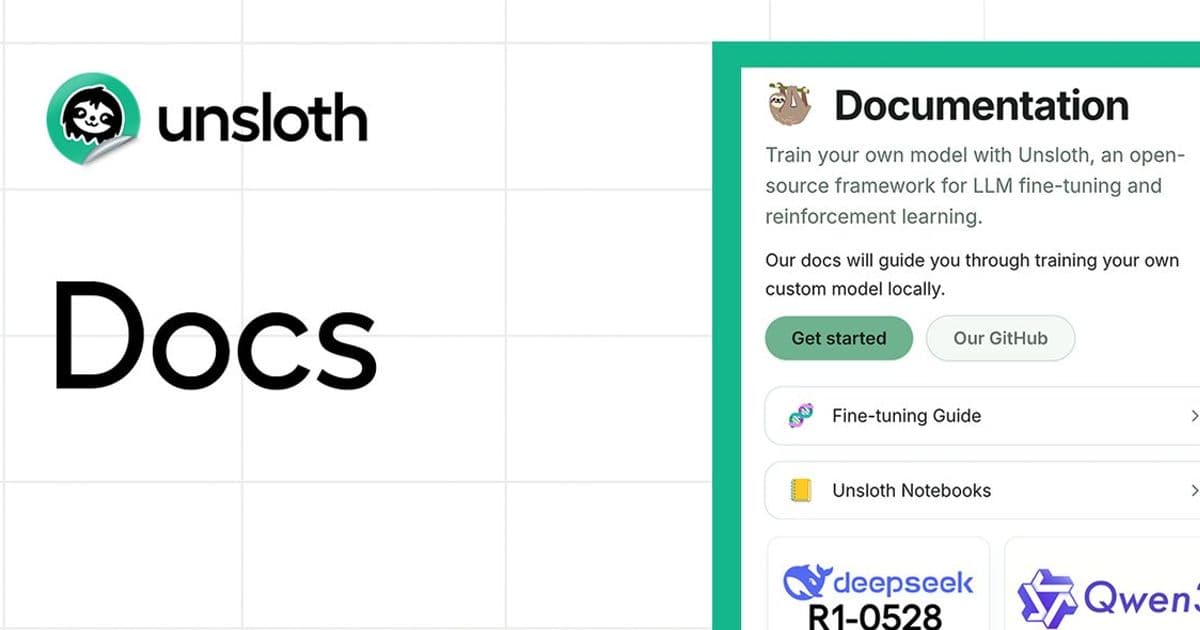
Unsloth Studio emerges from beta with a unified interface for running and training open models locally, featuring 2x faster training with 70% less VRAM and support for 500+ model families.
Unsloth Studio has officially launched its beta platform, offering developers a unified, no-code web interface for training, running, and exporting open models entirely locally. The open-source tool aims to democratize AI development by eliminating the complexity typically associated with model fine-tuning and deployment.
The platform supports both GGUF and safetensor model formats across Mac, Windows, and Linux systems. Users can run models locally without requiring dataset preparation—Unsloth Studio automatically creates datasets from PDF, CSV, JSON, DOCX, and TXT files. The tool also includes features like self-healing tool calling, web search capabilities, code execution, and auto-inference parameter tuning.
Training performance stands out as a key differentiator. According to the documentation, Unsloth's kernels optimize LoRA, FP8, FFT, and PT across more than 500 text, vision, TTS/audio, and embedding models, delivering training speeds that are twice as fast while consuming 70% less VRAM without any accuracy loss. The platform supports fine-tuning of cutting-edge models including Qwen3.5 and NVIDIA's Nemotron 3.
Multi-GPU functionality works automatically, with a major upgrade planned for the near future. The platform also includes Data Recipes, a feature powered by NVIDIA DataDesigner that transforms unstructured documents into usable synthetic datasets through a graph-node workflow.
Privacy remains central to Unsloth Studio's design—the entire system runs 100% offline locally, with token-based authentication including password and JWT access flows. The company emphasizes that it collects only minimal hardware information for compatibility purposes and does not gather usage telemetry.
Installation is straightforward through pip: pip install unsloth && unsloth studio setup unsloth studio -H 0.0.0.0 -p 8888. While initial setup may take 5-10 minutes due to llama.cpp compilation, precompiled binaries are in development to reduce this time. A Google Colab notebook is also available for users wanting to explore features on cloud GPUs.
The platform includes Model Arena for side-by-side comparison of different models, real-time observability for tracking training metrics, and flexible export options to safetensors or GGUF formats compatible with llama.cpp, vLLM, Ollama, and LM Studio.
Looking ahead, Unsloth plans to add official support for Apple Silicon/MLX, AMD, and Intel hardware, with multi-GPU improvements being developed in collaboration with NVIDIA. The company has adopted a dual-licensing approach where the main Unsloth package remains under Apache 2.0 while certain components like the Studio UI use AGPL-3.0.
For developers interested in exploring the platform, comprehensive documentation and video tutorials are available, including a guide created by NVIDIA. The beta launch represents a significant step toward making local AI model development more accessible to a broader audience without requiring deep technical expertise.
Comments
Please log in or register to join the discussion