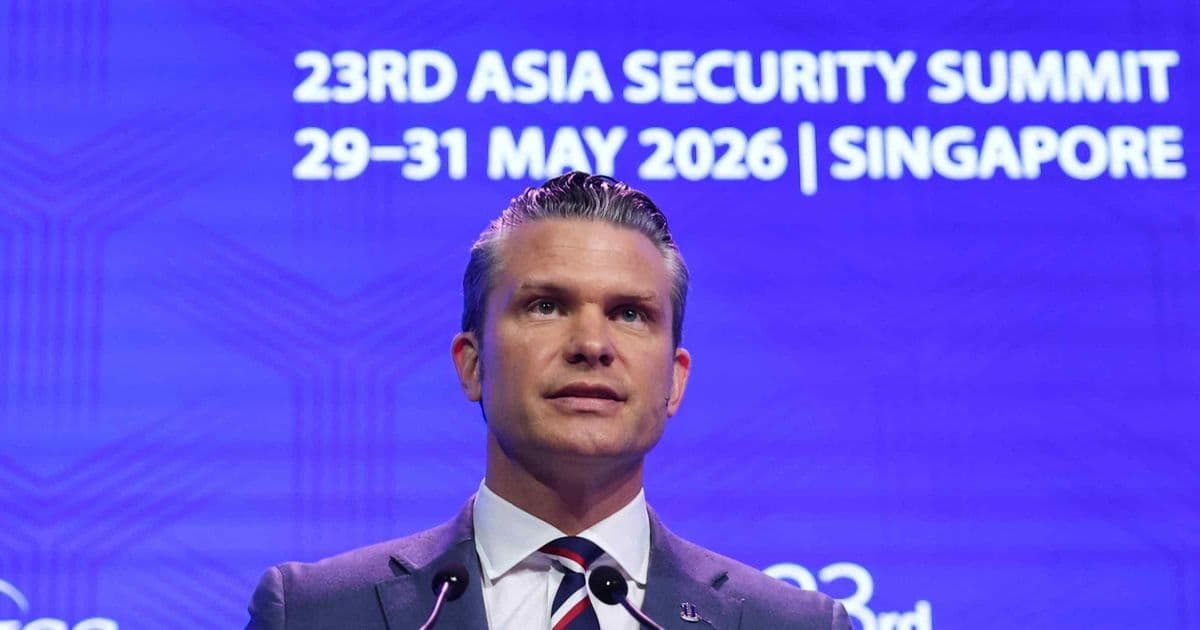
US Defense Secretary Pete Hegseth outlines America's commitment to maintaining regional balance in the Indo-Pacific, explicitly countering Chinese hegemony while reassuring Asian allies of continued US strategic engagement.
At the IISS Shangri-La Dialogue security summit in Singapore, US Defense Secretary Pete Hegseth articulated a clear strategic vision for the Indo-Pacific region, emphasizing America's commitment to preserving a balance where no single power, particularly China, can dominate. The remarks came against a backdrop of heightened regional tensions and evolving security dynamics in the Asia-Pacific.
"We seek a stable equilibrium in the Indo-Pacific, where no state, including China, can impose hegemony," Hegseth stated during his address on May 30, 2026. This formulation represents a nuanced evolution from previous US strategic language, moving beyond simple "freedom and openness" rhetoric to explicitly acknowledge the competitive nature of great power relations while advocating for a managed balance of power.
The Shangri-La Dialogue, hosted by the International Institute for Strategic Studies, serves as a crucial forum for defense ministers across the Indo-Pacific to discuss security challenges. This year's gathering occurs amid concurrent conflicts in the Middle East, which have complicated strategic calculations for regional powers.
Hegseth's speech contained several significant strategic implications:
Explicit Naming of China: Unlike previous administrations that sometimes employed more diplomatic language, the current US posture directly identifies China as the primary challenge to regional stability, reflecting a more transparent acknowledgment of the competitive nature of US-China relations.
Decoupling of Regional Priorities: The Pentagon chief explicitly stated that Taiwan arms sales decisions would be "decoupled" from concurrent US military engagements in the Middle East. This represents a strategic recalibration to ensure that regional security commitments in Asia are not subordinated to other global crises.
Alliance Reassurance: The speech emphasized continuity in US security commitments to Asian allies, addressing concerns about potential strategic distraction due to conflicts elsewhere and questions about the reliability of US engagement under the current administration.
The concept of "stable equilibrium" suggests a strategy that combines elements of containment with engagement, aiming to prevent Chinese domination while avoiding direct conflict. This approach likely involves:
- Strengthening existing security partnerships
- Maintaining military presence and capabilities
- Supporting regional institutions that balance Chinese influence
- Countering specific Chinese actions deemed destabilizing
This strategic posture comes as China continues to expand its military capabilities and assert its claims in the South China Sea, along with its growing influence in the Pacific Islands and Southeast Asia. The US response has increasingly focused on building coalitions and supporting allies in their own efforts to resist Chinese pressure.
The Taiwan arms sales aspect deserves particular attention, as it represents a potential flashpoint in US-China relations. By decoupling these decisions from the Iran conflict, the US signals that its commitments to Taiwan's self-defense remain a constant, regardless of other global distractions. This could potentially embolden Taiwan while signaling resolve to Beijing.
Regional allies have expressed mixed reactions to the US approach. While appreciating the explicit commitment to countering Chinese hegemony, some remain concerned about the consistency and duration of US engagement, particularly given the concurrent global conflicts and domestic political uncertainties in the United States.
The strategic implications of Hegseth's remarks extend beyond immediate military considerations to encompass broader economic and technological competition. The Indo-Pacific has become the primary theater for US-China competition, with significant implications for global supply chains, technological standards, and economic governance.
As the region continues to navigate these complex dynamics, the concept of "stable equilibrium" may prove challenging to maintain. It requires constant recalibration as military capabilities shift, alliances evolve, and domestic politics in both the US and China influence strategic priorities.
The Pentagon's approach suggests that while the US remains committed to preventing Chinese hegemony, it seeks to do so through a combination of strength, alliance building, and strategic clarity—avoiding both appeasement and direct conflict. Whether this delicate balance can be maintained in the face of accelerating geopolitical competition remains a critical question for regional and global security.
Comments
Please log in or register to join the discussion