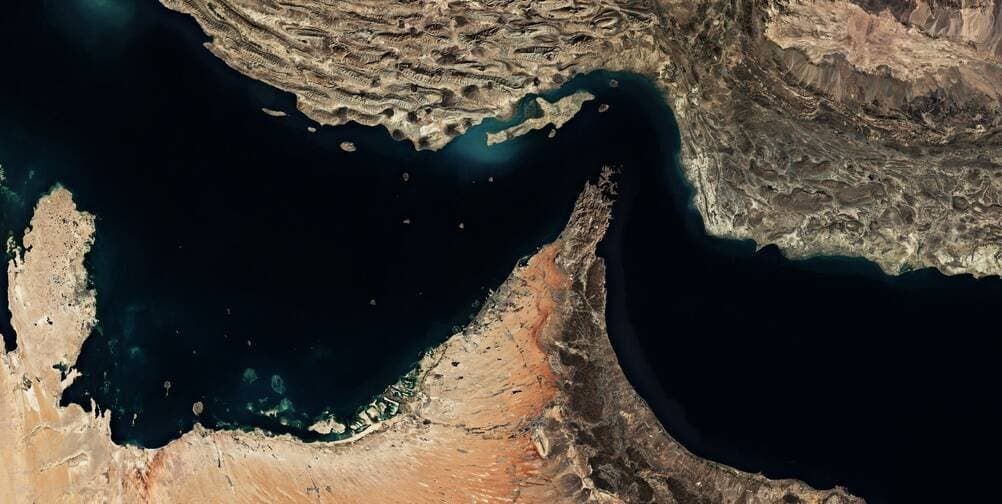
The US and UK have launched a joint competition seeking technology to detect and counter underwater drones, with an April 3 deadline, as tensions with Iran escalate.
The UK and US are urgently seeking technology to counter the growing threat of underwater drones to ships, harbors, and critical maritime infrastructure, with a joint competition launched under the REEF (Robotic Exclusion and Engagement Framework) program.
The competition comes amid escalating tensions with Iran, which is believed to be behind at least two explosive-laden sea drone attacks on oil tankers in the Gulf since the US and Israel first attacked Iran on February 28. The first drone attack reportedly took place on March 1, about 44 nautical miles off Oman, and the second, on March 5, hit a Bahamas-flagged crude oil tanker near the Iraqi port of Khor Al Zubair.
Iran has been shipping torpedo-like drones and "one-way attack" underwater drones to Houthi rebels in Yemen since 2024. These small autonomous underwater vehicles (AUVs) can inflict "significant damage on ships," according to experts.
Ukraine has also demonstrated the potential danger of these weapons. Last year, the country's armed forces claimed they struck and disabled a Russian Kilo-class submarine docked in Novorossiysk harbor on the Black Sea coast using a drone referred to as "Sub Sea Baby." This 6-meter-long kamikaze UUV can carry a payload of about one ton with a range of up to 1,000 kilometers.
Britain has its own underwater drone projects, including BAE Systems' Herne (officially known as an extra-large autonomous underwater vehicle or XLAUV) and the similar-sized Excalibur. These are not one-way suicide drones but can carry mission-specific payloads, potentially including depth charges or other weapons.
On a much larger scale, Russia's "Poseidon" weapon—sometimes described as a torpedo—is 20 meters long, has a range of 10,000 kilometers, and is armed with a nuclear warhead capable of destroying ports and coastal cities.
The REEF competition seeks solutions addressing four key areas:
Sensors: Must detect, track, and classify underwater threats even in challenging environments, with the ability to distinguish genuine threats from natural contacts to reduce false alarms.
Counteraction technologies: Could include kinetic solutions that physically strike UUVs directly or use acoustic directed energy. Both the UK and US are also interested in decoy systems to confuse hostile underwater craft.
Communications: Solutions must deliver secure data transmission for near real-time sensor-level visibility, which can be challenging for underwater communication with defensive UUVs or anti-drone torpedoes.
Command and control systems: Technologies must integrate tracking and sensor data with existing C2 systems, providing AI decision-making assistance with explanations for recommended actions.
The competition is being run and managed by the US Defense Innovation Unit (DIU), with British companies able to apply through jHub, the innovation team of the UK's Cyber & Specialist Operations Command. Vendors can submit proposals for any components they think they can satisfy or a complete solution.
However, interested parties had better act quickly—the deadline to submit ideas for the challenge is April 3.
This urgent push for counter-UUV technology highlights how underwater drones have become a critical threat in modern naval warfare, with both defensive and offensive capabilities rapidly evolving across multiple nations.
Comments
Please log in or register to join the discussion