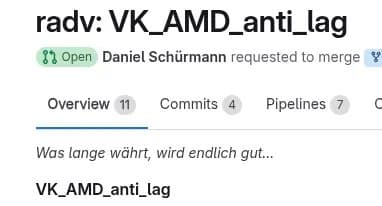
Valve's Linux team introduces a new VK_AMD_anti_lag implementation for the open-source Radeon Vulkan driver, replacing the previous Mesa layer approach with a more efficient framework.
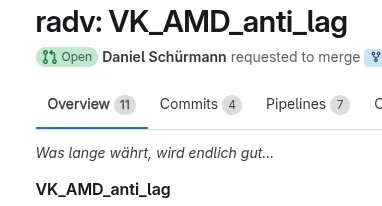
Daniel Schürmann of Valve's Linux team has posted a new VK_AMD_anti_lag implementation for the RADV open-source Radeon Vulkan driver, representing a significant advancement in low-latency gaming for Linux users. The implementation, detailed in a recent Mesa pull request, fundamentally restructures how Anti-Lag functionality is integrated into the open-source graphics stack.
The new implementation is based on the code from MESA_LAYER_ANTI_LAG but represents a complete architectural overhaul. As Schürmann explained, "This implementation is based on the code from MESA_LAYER_ANTI_LAG and fully replaces it. We essentially split the existing layer into a base utility framework and a slim driver implementation."
This architectural approach offers several advantages over the previous implementation. By separating the framework into distinct components, the code becomes more maintainable and efficient. The base utility framework handles common functions, while the driver-specific implementation remains lean and focused on Radeon-specific functionality.
Technical Implementation Details
The framework operates by setting up QueryPools and CommandBuffers during initialization, enabling precise timestamping capabilities. This timing infrastructure is critical for accurately measuring frame rendering times and identifying sources of input lag. The implementation hooks into key Vulkan functions including QueueSubmit2 and QueuePresentKHR, allowing it to intercept and analyze the graphics pipeline at critical points.
Per-frame timing information is retrieved by the driver through a callback function, which provides the necessary data to implement Anti-Lag's latency reduction techniques. This approach allows the driver to identify and compensate for delays in the rendering pipeline, effectively reducing the time between input and visual response.
Compatibility and Future Potential
One particularly noteworthy aspect of this implementation is its flexibility. Schürmann explicitly mentioned that "it would be possible (and quite simple) to implement VK_NV_low_latency_2 on top of this framework." This suggests that the new architecture could potentially support NVIDIA's proprietary anti-lag technology through the Vulkan API, addressing a common compatibility concern in the Linux gaming ecosystem.
Anti-Lag technology, originally developed by AMD, works by reducing the time between user input and the corresponding visual response. This is achieved by intelligently managing the GPU's workload and optimizing the rendering pipeline to minimize delays. For competitive gaming and fast-paced applications, even small reductions in input lag can significantly improve the user experience.
Impact on Linux Gaming
This implementation represents a significant step forward for Linux gaming, particularly for users with AMD hardware. The open-source Radeon drivers have historically lagged behind their Windows counterparts in supporting advanced gaming features like Anti-Lag. By implementing this functionality directly in the RADV driver, Valve is helping to close this gap.
The timing of this implementation is particularly noteworthy, coming shortly after Valve has been expanding its Linux gaming initiatives through Proton and Steam Deck hardware. As more games are optimized for Linux and more hardware vendors invest in open-source drivers, features like Anti-Lag become increasingly important for maintaining a competitive gaming experience on the platform.
For developers and system administrators managing Linux gaming environments, this implementation provides a more robust and integrated solution than the previous Mesa layer approach. The direct integration into the driver should result in better performance and fewer compatibility issues.
Looking Forward
The Mesa pull request containing this implementation can be found here, where interested parties can review the technical details and follow the development process. As this implementation progresses through the Mesa review process, we can expect to see it included in future Mesa releases.
For Linux users with AMD hardware, this implementation promises a more responsive gaming experience without requiring proprietary drivers or additional software layers. The architectural improvements also suggest that future enhancements to anti-lag functionality could be implemented more easily as the framework provides a solid foundation for further development.
As Valve continues to invest in Linux gaming infrastructure, implementations like this demonstrate the company's commitment to improving the open-source gaming stack. With the increasing popularity of Linux-based gaming platforms like the Steam Deck, features that were once exclusive to Windows are becoming increasingly accessible to Linux users through well-designed open-source implementations.
Comments
Please log in or register to join the discussion