Microsoft and apparel maker VOORMI are wiring worker health signals like heat stress and fatigue into Azure IoT, treating people as a first-class telemetry source alongside machines. For enterprises already standardized on Azure, the move folds connected-worker data into existing identity, governance, and analytics rather than another isolated safety silo.
Industrial organizations have spent a decade instrumenting their machines. Vibration sensors, temperature probes, and pressure gauges feed continuous streams into operational dashboards, and most large operators can tell you the health of a turbine or pump in real time. The people working next to that equipment have been a blind spot. VOORMI, the performance apparel brand under SWNR, and Microsoft are now closing that gap by routing human telemetry into Azure IoT through VOORMI's Mij platform, letting heat stress and fatigue signals sit in the same operational architecture as machine data.
What Changed
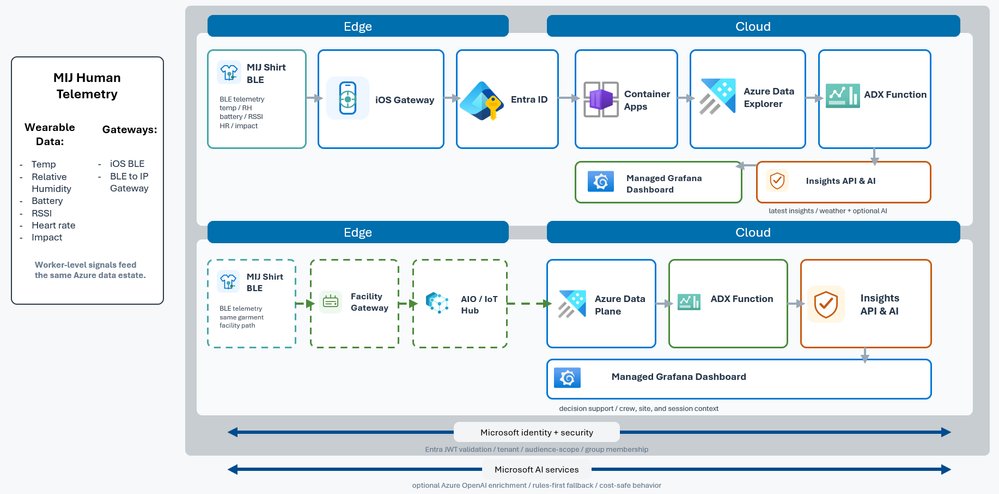
The practical shift is that garment-integrated sensors now broadcast Bluetooth Low Energy telemetry that flows through edge gateways into Azure services. Mij-enabled garments push readings into Azure IoT Operations using MQTT and dataflows, where the data gets processed locally or routed to the cloud. From there it lands in Azure Data Explorer for analysis, Azure Managed Grafana for dashboards, and Microsoft Fabric for long-term reporting. The same garment data can reach Foundry Local-hosted generative AI agents that deliver context-aware guidance, such as prompting a worker in high-heat conditions to hydrate.
What matters here is not the wearable itself but where the data lands. Historically, worker telemetry lived inside proprietary wearable platforms with their own clouds, their own logins, and their own governance rules. That fragmentation created a real problem for enterprise IT and OT teams: every safety vendor became another integration project, another credential store, another compliance review. Mij is built to skip that step by integrating directly into a customer-controlled Azure environment rather than standing up a separate platform that someone later has to connect.
Provider Comparison and Architecture Choices
The interesting part of this announcement is architectural flexibility, and it maps onto a decision enterprises already face when designing IoT systems: how much do you process at the edge versus in the cloud. Microsoft is offering both paths under one roof.
For latency-sensitive safety scenarios, telemetry runs through Azure IoT Operations at the edge on Arc-enabled Kubernetes infrastructure. This keeps virtual safety agents and operational workflows close to the worker, so responses do not depend on a round trip to a distant region. In a remote field site with constrained bandwidth or intermittent connectivity, that local processing is the difference between a real-time intervention and a delayed alert. Edge processing also enables sensor fusion, combining worker vitals with ambient environmental data, machine parameters, and site-level signals to drive context-aware decisions.
For organizations that do not want to deploy and maintain dedicated edge gateways, the alternative pattern ingests telemetry directly through Azure IoT Hub for cloud-first analytics. This route uses Microsoft Entra External ID and Azure Container Apps to secure the data path, which solves a genuine security concern: client devices never receive operational infrastructure credentials. That distinction is worth weighing carefully. The edge path gives you responsiveness and resilience but carries operational overhead. The cloud-first path simplifies deployment and centralizes processing but accepts cloud round-trip latency. Most large operators will end up running a mix, with edge processing where seconds count and cloud ingestion where they do not.
This dual approach reflects Microsoft's broader adaptive cloud strategy, which leans heavily on Azure Arc to extend a consistent control plane across distributed environments. The pitch to enterprises evaluating multi-site or hybrid deployments is that you get distributed edge-native services while keeping security, governance, and analytics centralized. For a buyer comparing this against building on AWS IoT Greengrass or Google Distributed Cloud, the deciding factor is usually existing commitment. Shops already standardized on Microsoft Entra for identity and Fabric for analytics gain the most, because human telemetry inherits the access controls and data governance they have already built.
Business Impact
The strategic value comes from treating human telemetry as a first-class data source rather than a bolt-on. When worker conditions live beside machine and environmental data under the same identity and governance model, the compliance and audit story gets simpler. You are not reconciling a safety vendor's data export against your operational records; the data already sits in your estate, subject to your retention policies and your access reviews. For regulated industries in energy and manufacturing, that consolidation reduces both audit friction and the attack surface that comes with every additional third-party platform.
Migration considerations favor organizations with an existing Azure IoT footprint. If you are already running Azure IoT Operations for machine telemetry, adding garment data is an incremental extension of pipelines you operate today, not a new platform to procure and secure. For organizations on a competing cloud or running disconnected safety systems, adopting Mij effectively means committing to the Azure IoT stack, which is a larger decision than a wearables purchase. The cost equation should account for that platform gravity, not just the per-garment price.
The longer-term opportunity is in adaptive workflows. Once worker telemetry is part of the operational fabric, it can feed incident response, field readiness checks, environmental compliance monitoring, and AI-driven decision support. A fatigue signal cross-referenced with a hazardous task assignment becomes an actionable intervention rather than a number on a dashboard nobody watches. That is where the connected-worker concept moves from monitoring to genuine operational intelligence, and where the convergence of human, machine, and environmental signals starts to pay back the integration effort.
VOORMI is the first apparel brand bringing this into garments built for actual field conditions, but the architecture is designed as an onboarding point for additional sensor and wearable scenarios over time. Organizations evaluating connected-worker programs should read this less as a single product launch and more as Microsoft staking out worker telemetry as a category it intends to own within its IoT portfolio. Teams interested in testing the approach can reach SWNR for a pilot at [email protected], and the Azure IoT Operations documentation is the natural starting point for architects scoping the integration.
Comments
Please log in or register to join the discussion