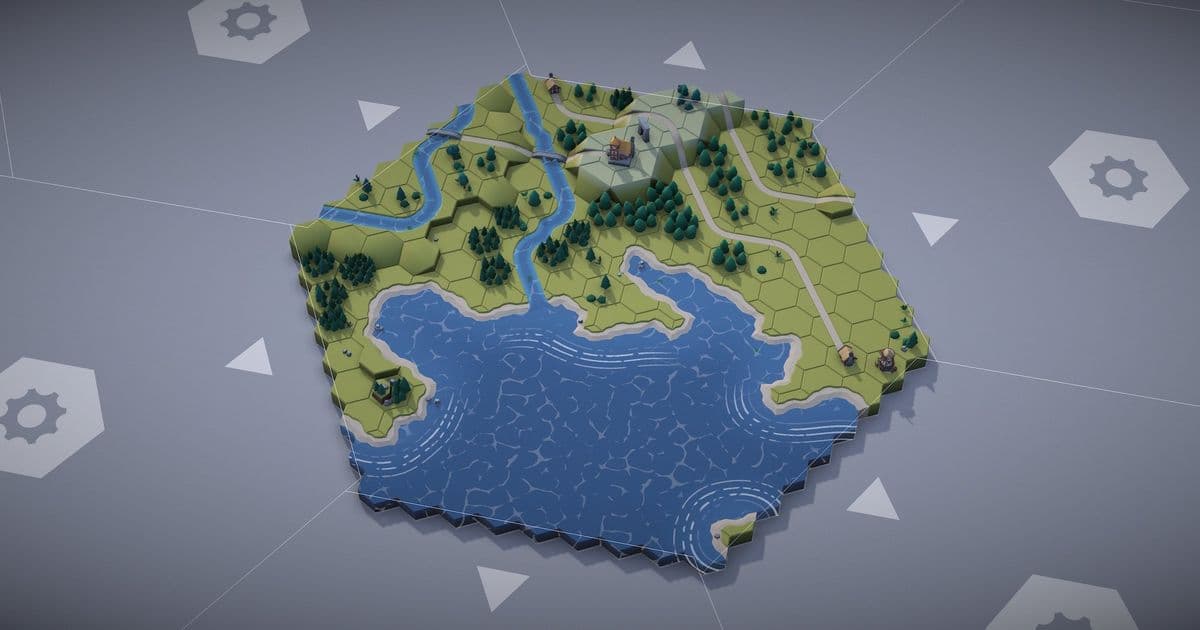
Wave Function Collapse has emerged as a powerful technique for procedural content generation, particularly for map generation in games and simulations. This deep dive explores how the algorithm works, its implementation challenges with hexagonal grids, and the trade-offs that developers must consider when adopting this approach.
Procedural content generation has long been a fascination in the developer community, but one algorithm has recently captured particular attention: Wave Function Collapse (WFC). Originally developed by Maxim Gumin, WFC has become a darling of procedural generation gamedev circles, offering a unique approach to creating complex, structured content that feels both random and intentional.
The algorithm's rise in popularity isn't just academic. It represents a shift from purely random generation to constraint-based synthesis, where the output must satisfy certain rules and relationships. This has profound implications for game development, world-building tools, and even architectural visualization.
Understanding the Wave Function Collapse Algorithm
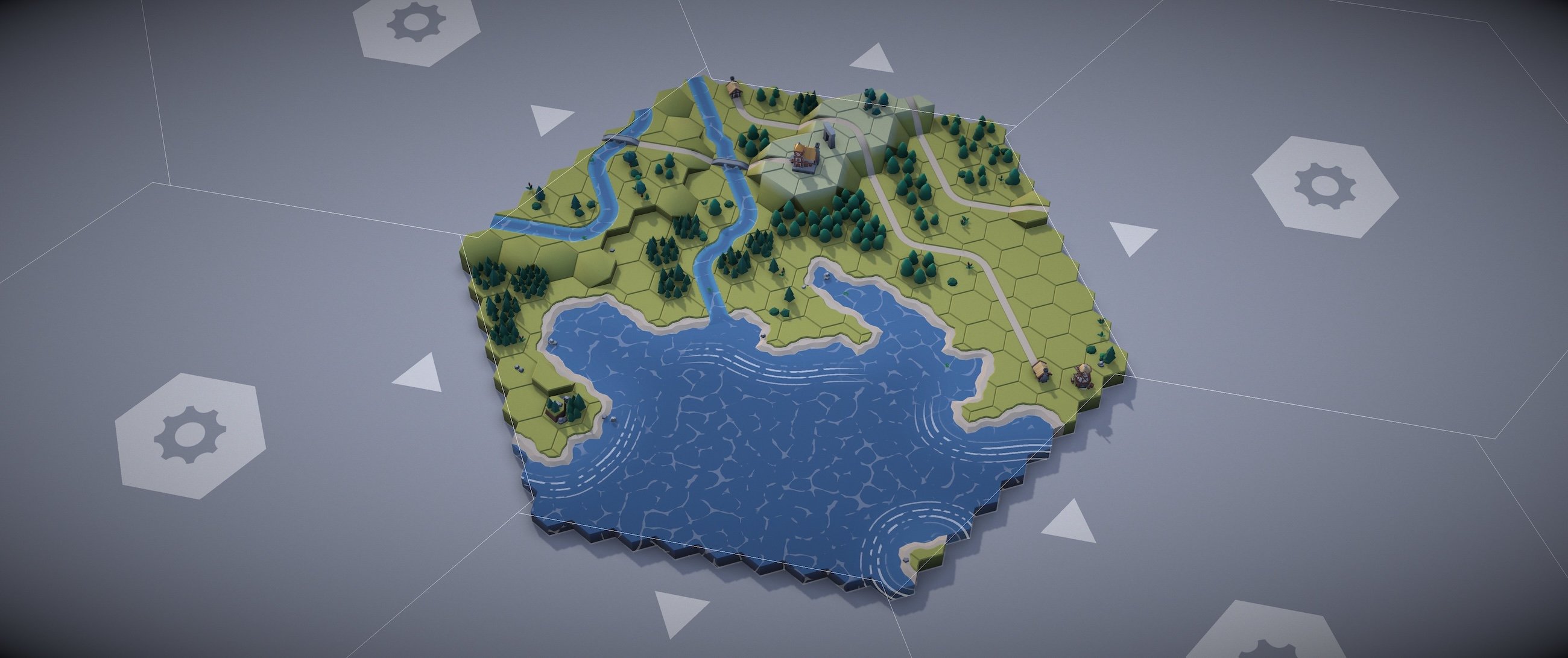
At its core, WFC operates on a simple principle: start with chaos, then gradually reduce possibilities until a complete, coherent structure emerges. Imagine each cell in a grid as a quantum particle that exists in multiple possible states simultaneously. The algorithm's job is to 'collapse' these superpositions into definite states.
The process begins with every cell containing all possible tiles - a state of maximum entropy. The algorithm then identifies the cell with the fewest remaining options (lowest entropy), randomly selects one valid state for it, and propagates the constraints to neighboring cells. This cascade effect continues until all cells are resolved or the algorithm hits an unsolvable contradiction.
This approach has been successfully applied to everything from dungeon generation to image synthesis, but its most compelling use case might be in map generation. As Maxim Gumin's original implementation demonstrates, WFC can create remarkably coherent and natural-looking structures.
The Hexagonal Challenge
While square grid implementations of WFC are well-documented, hexagonal grids present a significantly more complex problem. The additional edges (six instead of four) create 50% more constraints per tile, leading to a combinatorial explosion that makes the algorithm much more likely to fail.
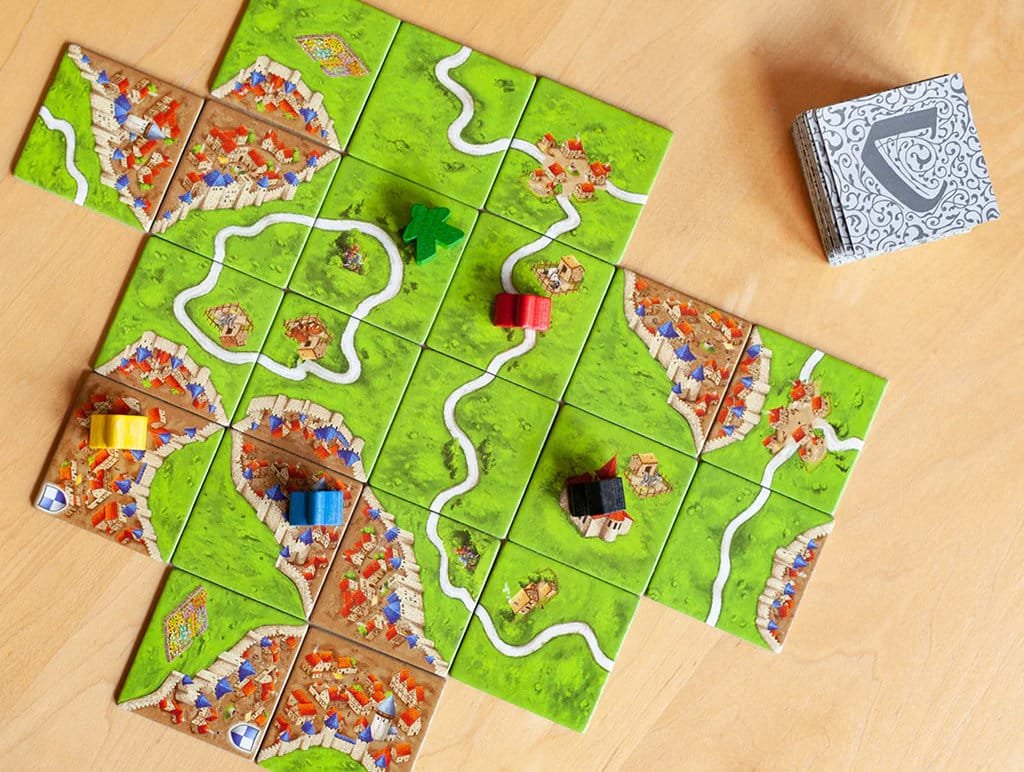
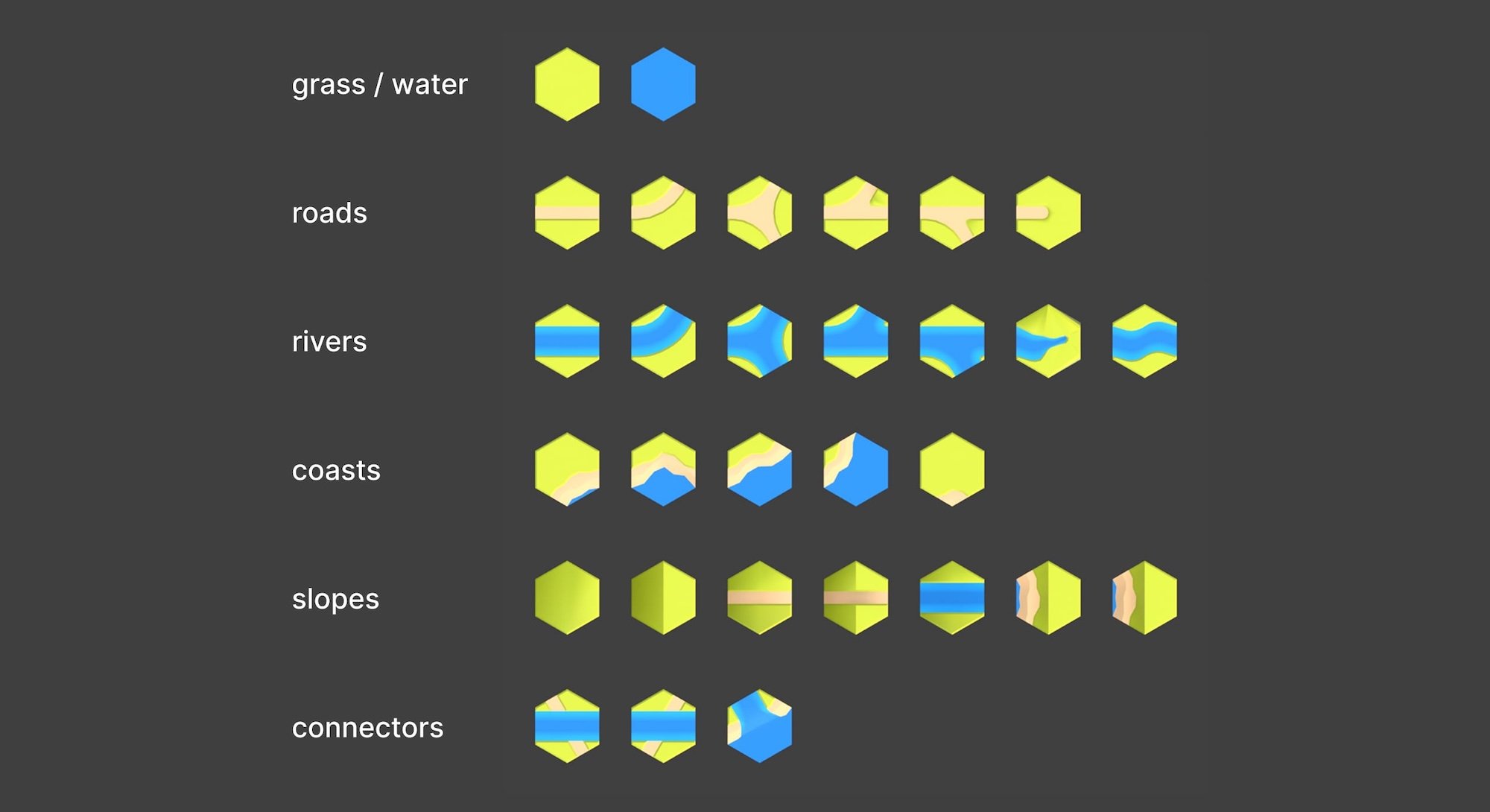
"Square WFC is well-trodden territory. Hex WFC is... less so," explains Felix Turner, who built a sophisticated hex map generator using this technique. "Each tile in the set has a definition which describes the terrain type of each of its 6 edges, plus a weight used for favoring some tiles over others. 30 tile types, each with 6 rotations and 5 elevation levels. That's 900 possible states per cell."
This complexity has led some developers to question whether hexagonal WFC is practical for production use. The computational overhead and failure rate can be prohibitive, especially for large maps. However, as Turner's implementation shows, with careful engineering and innovative solutions, these challenges can be overcome.
Tile Definitions and Constraint Propagation
The foundation of any WFC implementation is the tile definition system. Each tile must specify its edge types and how they relate to neighboring tiles. For a hexagonal map generator, this means defining six edge types per tile, each corresponding to one of the six possible directions.
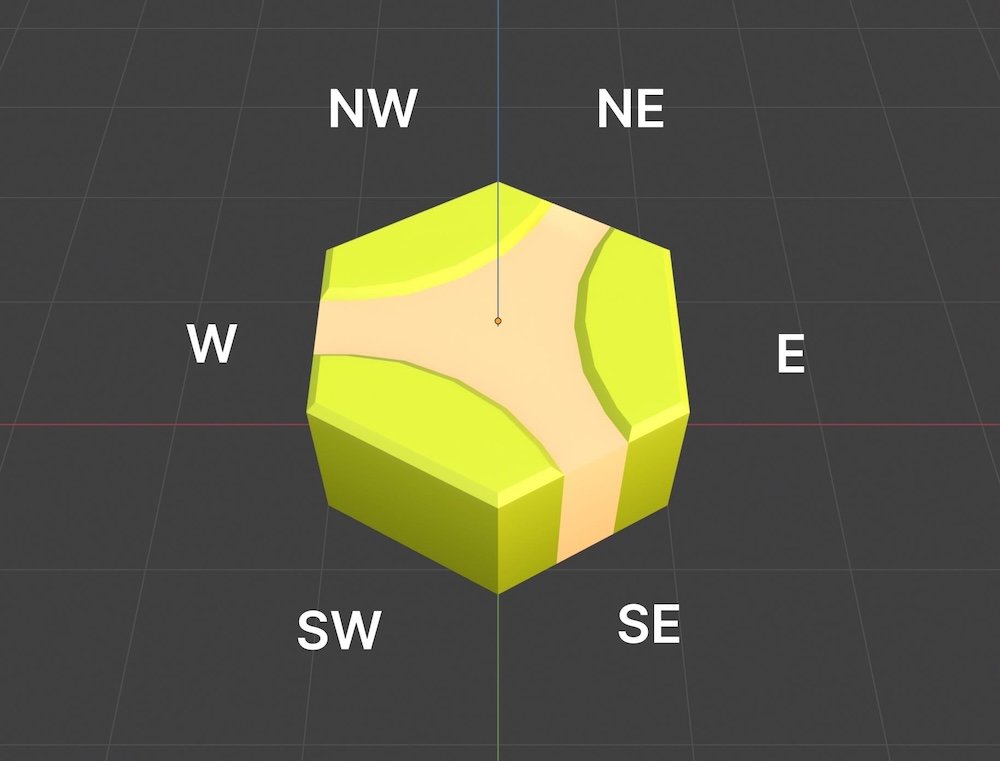
"For example this 3-way junction has 3 road edges and 3 grass edges. Tile definition: { name: 'ROAD_D', mesh: 'hex_road_D', edges: { NE: 'road', E: 'grass', SE: 'road', SW: 'grass', W: 'road', NW: 'grass' }, weight: 2 }" Turner explains. "Each tile defines 6 edge types. Matching edges is the only rule."
This elegant simplicity hides significant complexity. The constraint propagation system must efficiently track which tiles are compatible with each other, and the algorithm must handle the cascading effects of each decision. When a cell is collapsed, it may eliminate hundreds of possibilities across the grid as incompatible neighboring tiles are pruned.
Scaling Up: The Multi-Grid Solution
One of the biggest challenges with WFC is scaling to large maps. A small grid might solve reliably, but as the grid size increases, the probability of encountering unsolvable contradictions grows exponentially.
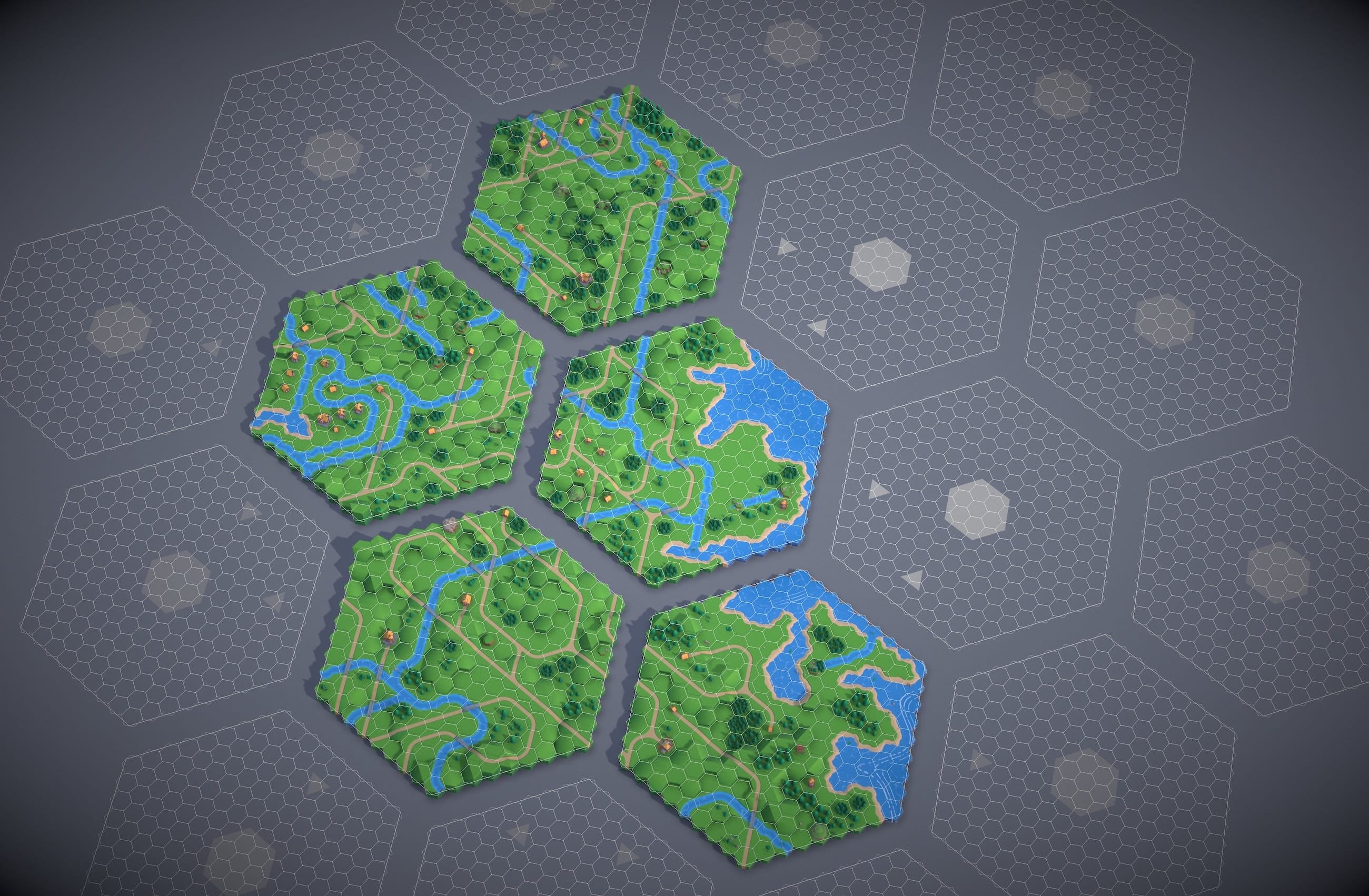
"WFC is reliable for small grids. But as the grid gets bigger, the chance of painting yourself into a dead end goes up fast. A 217-cell hex grid almost never fails. A 4123-cell grid fails regularly," Turner notes.
His solution was modular WFC: splitting the map into 19 hexagonal grids arranged in two rings around a center. Each grid is solved independently but must match the border tiles of neighboring grids. This approach reduces the complexity of each individual solve while maintaining the coherence of the overall map.
However, this introduces a new problem: incompatible constraints at grid boundaries. "Those border tiles become fixed constraints. And sometimes those constraints are simply incompatible. No amount of backtracking inside the current grid can fix a problem that was baked in by a neighbor," Turner explains.
The Recovery System: When WFC Fails
A fundamental truth about WFC is that it fails. Frequently. The algorithm's reliance on random decisions means it will inevitably paint itself into corners where no valid solution exists.
"The textbook solution is backtracking — undo your last decision and try a different tile. My solver tracks every possibility it removes during propagation (a 'trail' of deltas), so it can rewind cheaply without copying the entire grid state. It'll try up to 500 backtracks before giving up," Turner shares.
But backtracking alone isn't sufficient for complex multi-grid implementations. Turner developed a layered recovery system:
- Unfixing: Convert problematic neighbor constraints back into solvable cells
- Local-WFC: Run a mini-WFC on a small region around the problem area
- Drop and hide: Last resort - place mountain tiles to cover seams
"Local-WFC was the breakthrough. Instead of trying to solve the impossible, go back and change the problem," Turner notes.
Elevation and the Third Dimension
Adding elevation to a WFC map transforms a 2D constraint problem into a 3D one, significantly increasing complexity. "This map isn't flat — it has 5 levels of elevation. Ocean and Grass start at level 0, but slopes and cliffs can move up or down a level. Low slopes go up 1 level, high slopes go up 2 levels," Turner explains.
The challenge is ensuring that tiles at different elevations connect properly. "A road tile at level 3 needs to connect to another road tile at level 3, or a slope tile that transitions between levels. Get it wrong and you end up with roads that dead-end into cliff faces or rivers flowing uphill into the sky."
This complexity has led some developers to question whether WFC is the right approach for 3D terrain generation. The algorithm's strength lies in local constraint satisfaction, but 3D terrain requires consideration of global topology and drainage patterns that WFC doesn't inherently understand.
When Not to Use WFC: Alternative Approaches
While WFC excels at certain types of generation, it's not a silver bullet. Turner discovered this when attempting to use WFC for tree and building placement.
"Early on, I tried using WFC for tree and building placement. Bad idea. WFC is great at local edge matching but terrible at large-scale patterns. You'd get trees scattered randomly instead of clustered into forests, or buildings spread evenly instead of gathered into villages," he admits.
The solution was a hybrid approach combining WFC with Perlin noise. "The solution: good old Perlin noise. A global noise field determines tree density and building placement, completely separate from WFC. Areas where the noise is above a threshold get trees; slightly different noise drives buildings. This gives you organic clustering — forests, clearings, villages — that WFC could never produce."
This hybrid approach represents a broader pattern in procedural generation: using different algorithms for different purposes. WFC for terrain structure, noise for organic clustering, rule-based systems for specific placement logic.
Community Reception and Practical Applications
The reception to WFC in the developer community has been largely enthusiastic but tempered by realistic expectations. Many developers have been impressed by the algorithm's ability to generate coherent structures without hand-crafted rules, but they also recognize its limitations.
"The community seems to have settled into a nuanced understanding," observes Turner. "People are excited about what WFC can do, but they're also aware that it's not suitable for every problem. There's a growing recognition that procedural generation is about choosing the right tool for the job, not forcing every problem into WFC's constraint-based framework."
Practical applications are emerging across different domains. In game development, studios are using WFC for level design, texture synthesis, and architectural generation. In creative tools, it's being applied to pattern generation and procedural art. Even in urban planning, researchers are exploring WFC for generating realistic city layouts.
Technical Implementation and Performance Considerations
For developers considering implementing WFC, the technical challenges are significant. Turner's implementation, built with Three.js WebGPU and TSL shaders, demonstrates several important optimization techniques.
"The complete map has thousands of tiles and decorations. Drawing each one individually would kill the frame rate. The solution is two-fold: BatchedMesh — each hex grid gets 2 BatchedMeshes: one for tiles, one for decorations. The beauty of a BatchedMesh is that each mesh can have separate geometry and transforms, but they all render in a single draw call," Turner explains.
His implementation also uses a single shared material for all meshes, minimizing shader state switches. "One Shared Material — every mesh in the scene shares a single material. The Mesh UVs map into a small palette texture, so they all pull their color from the same image, like a shared paint-by-numbers sheet. One material means zero shader state switches between draw calls, so the GPU can blast through 38 BatchedMeshes without stalling."
These optimizations allow his implementation to render over 4,100 cells at 60fps on both desktop and mobile devices — a significant achievement for a complex procedural system.
The Future of Procedural Generation with WFC
As WFC continues to evolve, several interesting trends are emerging. Researchers are exploring ways to incorporate global constraints into the algorithm, addressing its tendency to create locally-coherent but globally-inconsistent structures. Others are working on hybrid approaches that combine WFC with machine learning techniques to generate more varied and interesting content.
"The algorithm is still in its early days," suggests Turner. "We're just scratching the surface of what's possible. As developers gain more experience with WFC and build more sophisticated implementations, I expect we'll see increasingly impressive applications across different domains."
For game developers in particular, WFC offers a powerful middle ground between completely random generation and hand-crafted design. It provides structure and coherence while still offering the infinite replayability that procedural generation promises.
Conclusion: Finding the Right Tool
Wave Function Collapse represents a significant advancement in procedural content generation, offering a unique approach to creating structured, coherent content. However, it's not a replacement for other techniques but rather another tool in the procedural generation toolbox.
As Turner's implementation demonstrates, WFC can create stunningly detailed and coherent maps when properly implemented. But his experience also highlights the importance of recognizing when to use alternative approaches, particularly for tasks requiring large-scale patterns or organic clustering.
The most successful procedural systems, like the one Turner built, tend to be hybrids that combine WFC with other techniques - noise functions for organic placement, rule-based systems for specific elements, and hand-crafted assets for visual polish. This pragmatic approach, using the right tool for each job, represents the future of procedural content generation.
Comments
Please log in or register to join the discussion