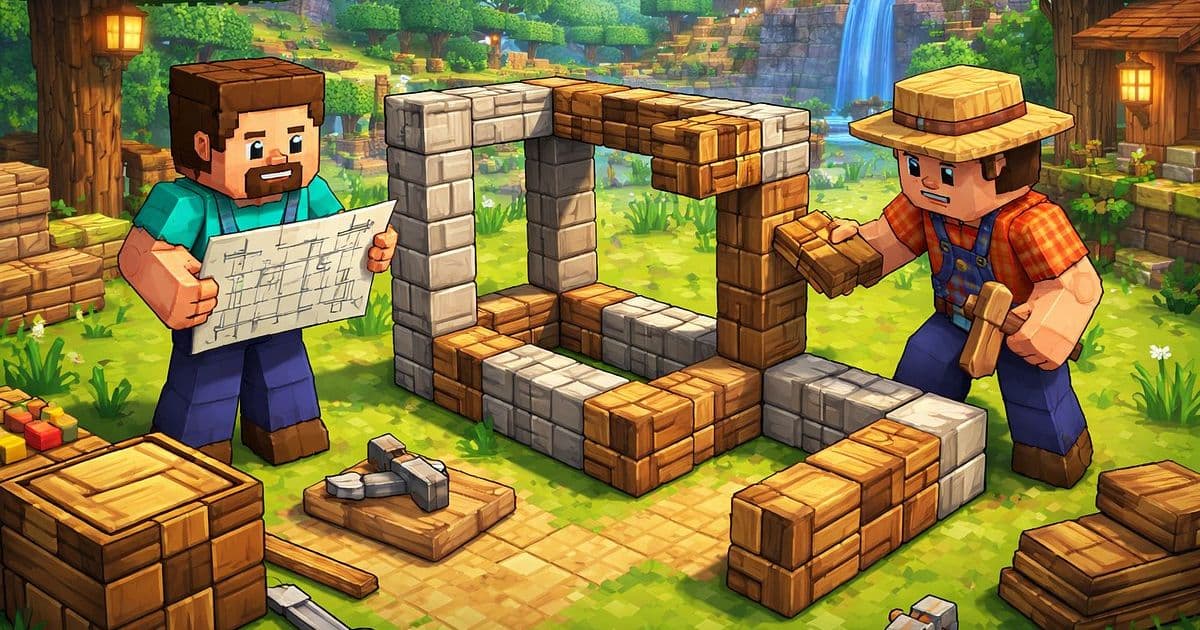
The growing library of Minecraft Terraform primitives reveals a critical shift in infrastructure design: from creating isolated resources to engineering how modules connect and extend. The new Frame module demonstrates how connection-oriented primitives, inspired by Japanese woodworking joints, can establish clean input-output boundaries for composable cloud architecture.
The Minecraft Terraform primitives library is evolving beyond simple resource creation. As the collection grows, the fundamental challenge shifts from building individual shapes to designing how those shapes relate to one another. This mirrors a broader pattern in infrastructure-as-code: the initial focus on creating standalone resources eventually gives way to the more complex task of orchestrating how those resources interact, connect, and extend one another.
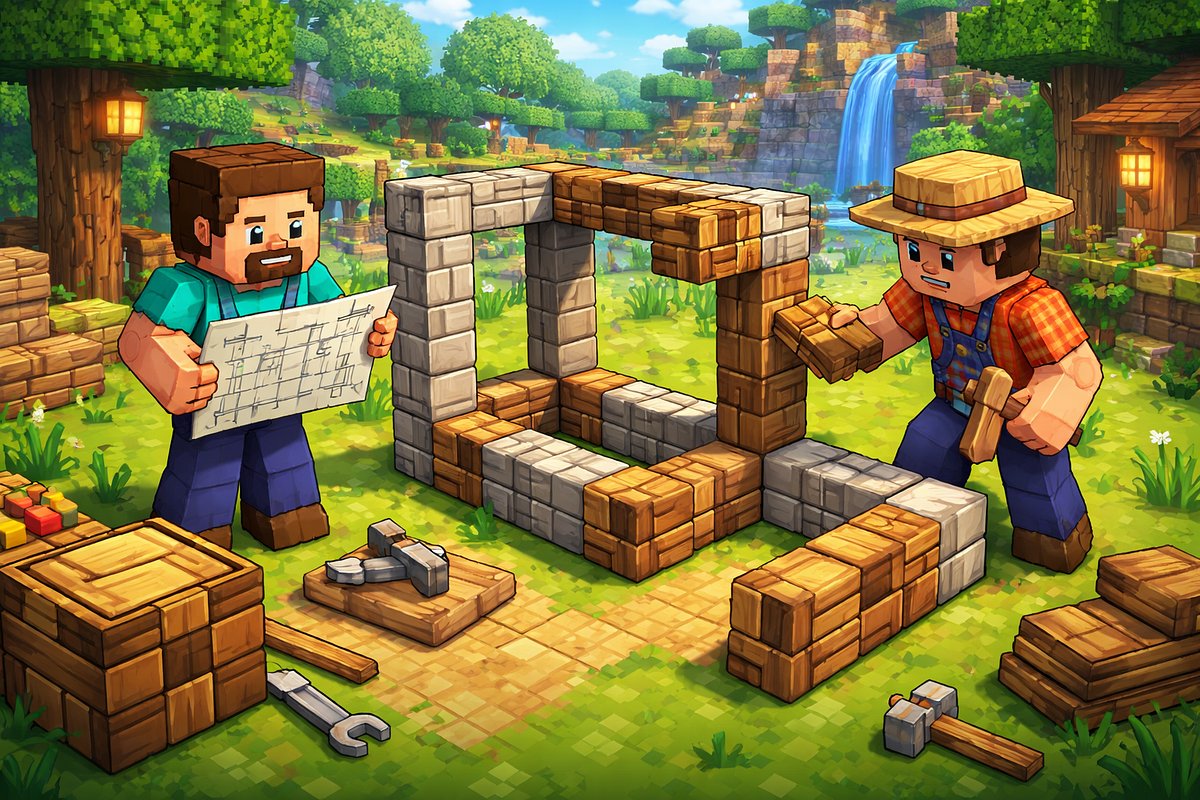
Once the Vector module established a common directional and spatial language, it became possible to think less about isolated resources and more about how modules meet, connect, and extend. The Frame module emerges from this shift in thinking. It is not just a hollow cuboid; it is an exploration of a design pattern centered on clean input–output boundaries between Terraform modules, inspired by the precision and intentionality of Japanese woodworking joints. Rather than relying on monolithic, solid structures, this approach favors explicit connection points, predictable geometry, and modules that are designed from the outset to be composed.
Frames as Connection-Oriented Primitives
The Frame primitive represents a rectangular outline in three dimensions. Unlike a solid Cuboid, it forms only the edges of a box, leaving the interior empty. That hollowness is intentional. It forces the module to define its value not by volume, but by structure and boundaries. Much like the Vector and Cuboid modules, the Frame accepts a direction and a material, along with the standard spatial dimensions of height, width, and depth. These inputs define the shape, but the real design focus lies in what the module exposes once it is rendered.
The Frame's output isn't just the four vertical edges and eight corner blocks. It exposes connection points—specifically, the faces where other modules can attach. This creates a predictable interface. A module that needs to attach to the Frame knows exactly where and how to connect, because the Frame's geometry is standardized and its connection points are explicitly defined.
This is where the Japanese woodworking analogy becomes instructive. Traditional joinery techniques like shiguchi (visible joints) or sashimono (hidden joints) create connections that are both strong and intentional. The joint itself becomes a design element, not just a means to hold pieces together. Similarly, a Frame module doesn't just contain resources; it defines the terms of engagement for other modules. The connection points are the "joints" of the infrastructure design.
The Input-Output Boundary Problem
In traditional Terraform module design, inputs and outputs often become entangled. A module might accept a long list of parameters and return an equally complex set of attributes. This creates tight coupling: any change to the module's internals risks breaking consumers, and any change to consumer requirements risks breaking the module.
The Frame module addresses this by creating a clean separation between what it needs to function and what it provides to others. Its inputs are purely geometric and material: dimensions, direction, and block type. Its outputs are connection points and structural metadata. This separation is deliberate. It means the Frame module doesn't need to know what will attach to it, and the attaching module doesn't need to know how the Frame was constructed.
Consider a practical example. You might have a Frame that defines the boundary of a virtual network. The Frame's inputs are the network range (width, depth, height in CIDR notation), the direction (which subnet is "up" or "down"), and the material (the cloud provider's network resource type). Its outputs might include the four subnet boundaries (the edges) and eight connection points (the corners where routing tables or security groups can attach).
A separate module for a web server cluster could then attach to one of the Frame's edges. The web server module doesn't need to know the exact CIDR range of the Frame; it only needs to know which edge to attach to and what material to use. The Frame module doesn't need to know how many web servers will run; it only needs to provide a clean attachment point.
This decoupling is powerful because it allows both modules to evolve independently. The Frame module can optimize its internal implementation—perhaps switching from AWS VPC to Google Cloud VPC—without breaking the web server module, as long as the connection interface remains stable. The web server module can change its instance type or scaling policy without affecting the Frame, as long as it continues to attach at the same connection point.
Composability Through Predictable Geometry
The Frame's geometric predictability is its superpower. Because every Frame exposes the same four faces and eight corners, a library of attachment modules can be built that work with any Frame, regardless of its specific dimensions or material. This is analogous to how standardized lumber dimensions enable carpenters to build with any 2x4, regardless of its origin.
In the Minecraft Terraform library, this means you can have a "Web Server" module that attaches to any Frame's "front" face, a "Database" module that attaches to any Frame's "back" face, and a "Load Balancer" module that attaches to any Frame's "top" face. The specific Frame instance might be a small development network or a large production network, but the attachment logic remains consistent.
This composability extends beyond simple attachments. Frames can nest within other Frames. A large Frame representing a multi-region architecture can contain smaller Frames representing regional deployments. Each regional Frame can then contain Frames for specific availability zones. The connection points at each level allow for both horizontal and vertical composition.
The nesting capability is particularly valuable for multi-cloud strategies. A top-level Frame could represent the entire cloud-agnostic infrastructure, with child Frames for AWS, Azure, and GCP. Each cloud-specific Frame would expose connection points for region-specific resources. This creates a clear hierarchy that maps to organizational or architectural boundaries.
Trade-offs and Considerations
This approach isn't without trade-offs. The Frame module introduces additional abstraction compared to directly creating resources. For simple, one-off deployments, this abstraction might add unnecessary complexity. The value emerges in larger, more complex systems where the benefits of composability outweigh the overhead of the abstraction layer.
Another consideration is the learning curve. Developers accustomed to monolithic modules must shift their thinking to connection-oriented design. This requires understanding not just what a module does, but how it connects to others. The mental model is different, and teams may need time to adapt.
Performance is another factor. Each Frame module creates multiple Terraform resources (the edges and corners), and each attachment module creates additional resources. In very large deployments, this could lead to a proliferation of resources that might be less efficient than a more consolidated approach. However, the trade-off is flexibility and maintainability, which often matter more in production systems.
Broader Implications for Infrastructure Design
The Frame module pattern has implications beyond Minecraft or Terraform. It represents a shift from resource-centric to connection-centric infrastructure design. This aligns with broader trends in cloud architecture, where services are increasingly designed as composable building blocks rather than monolithic platforms.
Consider how major cloud providers structure their services. AWS Lambda functions can be attached to API Gateway endpoints. Azure Functions can be triggered by Event Grid events. Google Cloud Functions can be connected to Pub/Sub topics. These are all examples of connection-oriented primitives: each service defines clear input and output boundaries, allowing them to be composed into larger systems.
The Frame module brings this same thinking to infrastructure-as-code. Instead of writing a single Terraform configuration that defines an entire application stack, you can compose smaller, focused modules that each handle a specific aspect of the architecture. The Frame provides the structural backbone, and attachment modules add specific functionality.
This approach also facilitates testing and validation. Because each module has a clean interface, it can be tested in isolation. The Frame module can be tested to ensure it exposes the correct connection points. Attachment modules can be tested to ensure they connect correctly. The composition can be tested to ensure the integrated system behaves as expected.
Implementation in Practice
For teams looking to adopt this pattern, the first step is to identify the natural boundaries in their existing infrastructure. What are the logical "frames" that define the structure of their systems? These might be network boundaries, security domains, or deployment environments.
Next, design the connection points. What are the common ways that resources attach to these boundaries? In a network context, this might be ingress/egress points. In a security context, it might be policy attachment points. In a deployment context, it might be environment boundaries.
Then, implement the Frame module to expose these connection points consistently. The module should accept parameters that define its geometry and material, and return outputs that represent the connection points. The implementation should be as simple as possible while still providing the necessary flexibility.
Finally, build attachment modules that consume these connection points. These modules should be designed to work with any Frame instance, relying only on the connection interface, not the internal implementation.
The Future of Composable Infrastructure
The Frame module represents an early exploration of connection-oriented primitives in infrastructure-as-code. As the concept matures, we can expect to see more sophisticated patterns emerge. Future modules might include more complex connection geometries, dynamic attachment points, or even self-organizing systems that automatically connect based on semantic relationships.
The broader trend is toward infrastructure that is more composable, more predictable, and more aligned with how we think about system architecture. Just as Japanese woodworking joints create structures that are both strong and beautiful, connection-oriented infrastructure modules can create systems that are both robust and elegant.
The Minecraft Terraform library provides a unique sandbox for exploring these ideas. Its constrained environment and visual feedback make abstract concepts tangible. But the principles it teaches—clean interfaces, predictable geometry, and intentional connection points—apply equally to real-world cloud infrastructure.
As organizations continue to adopt multi-cloud strategies and cloud-native architectures, the ability to compose infrastructure from well-defined, reusable modules becomes increasingly valuable. The Frame module offers one blueprint for how to achieve that composability, not through complex orchestration or sophisticated tooling, but through careful attention to the fundamental design of how modules connect.
The real lesson from Minecraft isn't about blocks or voxels. It's about thinking in terms of relationships rather than objects, connections rather than containers. That shift in perspective is what will define the next generation of infrastructure-as-code.
Related Resources
For those interested in exploring these concepts further, the Minecraft Terraform primitives library provides a practical implementation of these ideas. The library includes the Vector, Cuboid, and Frame modules, along with examples of how they can be composed into larger systems.
The Terraform documentation on module composition offers additional guidance on building modular infrastructure. For teams working with multi-cloud architectures, the Cloud Native Computing Foundation provides resources on cloud-native design patterns that complement this approach.
Japanese woodworking techniques, which inspired the Frame module's design philosophy, are documented in resources like The Complete Japanese Joinery and online resources from the Japan Woodworking Association. While these may seem unrelated to cloud infrastructure, the principles of intentional connection and clean interfaces translate surprisingly well to software architecture.
The Frame module is more than a Terraform primitive. It's a statement about how we should think about building systems: not as collections of isolated components, but as networks of well-defined connections. As the Minecraft Terraform library grows, it will continue to teach us lessons about composable design that extend far beyond the blocky world of Minecraft and into the complex, distributed systems we build every day.
Comments
Please log in or register to join the discussion