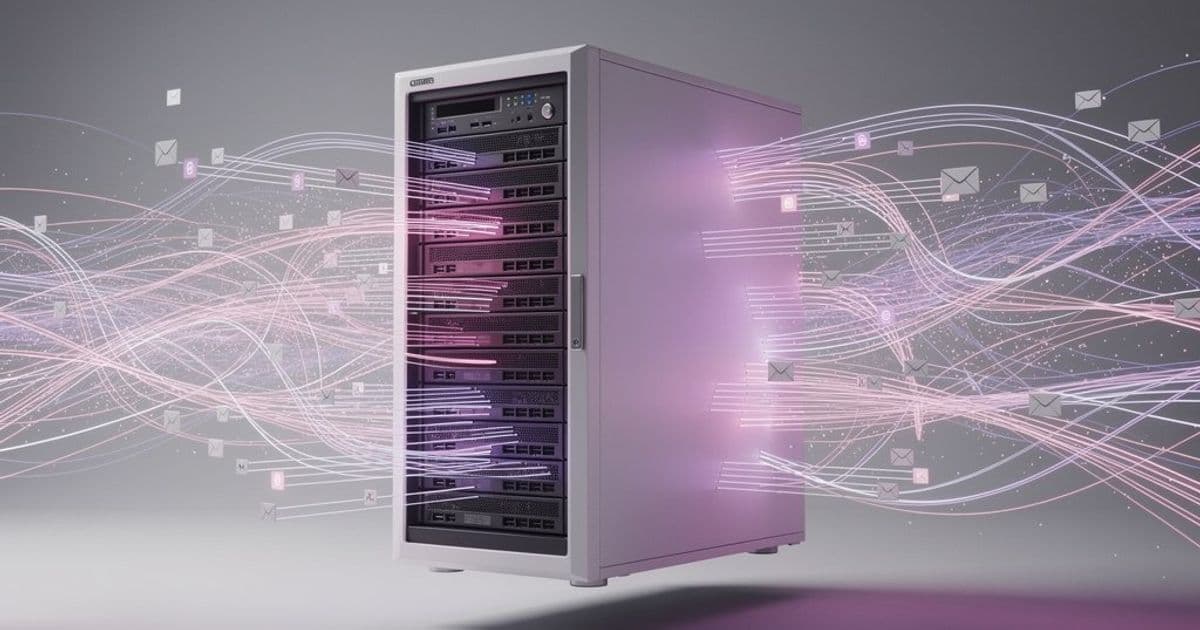
Building temporary email services requires handling extreme concurrency, unpredictable traffic spikes, and malicious inputs—challenges where Go's design fundamentally simplifies implementation.

Temporary email services like Box-Mail.org face architectural challenges that transcend typical CRUD applications. While the user-facing functionality appears simple—disposable inboxes that forward messages—the infrastructure demands extreme concurrency handling, unpredictable traffic spikes, and robust security against malicious inputs. Traditional web frameworks often buckle under these conditions, but Go's deliberate design choices make it uniquely suited for this workload.
The Concurrency Bottleneck Challenge
At scale, temporary email services must simultaneously manage:
- Thousands of persistent SMTP connections awaiting incoming messages
- Real-time mailbox watchers polling for new content
- Sudden traffic surges from bot activity or viral adoption
- Resource-intensive attachments and malformed MIME payloads
Managing these concurrent operations efficiently becomes the core challenge. Thread-based concurrency models require careful tuning of thread pools and risk deadlocks, while callback-driven async models introduce complex error-handling pyramids. Both approaches demand significant developer effort to prevent resource exhaustion during traffic spikes.
How Go Changes the Equation
Go addresses these challenges through integrated language features:
Goroutine Simplicity
Thegokeyword spawns lightweight concurrent operations managed by the runtime scheduler. One goroutine per SMTP connection becomes trivial—no thread pool configuration or callback hell. The runtime efficiently multiplexes goroutines onto OS threads, handling thousands of simultaneous connections with minimal memory overhead.Predictable Memory Management
Garbage collection pauses are shorter and more predictable than JVM equivalents. Combined with built-in profiling via pprof, developers can pinpoint memory leaks from malicious emails (like intentionally oversized attachments) before they cause outages. Explicit memory control via buffers andio.LimitReaderprevents resource exhaustion attacks.Compiled Binary Advantages
Single-binary deployment eliminates dependency conflicts and reduces attack surfaces. Near-instant startup enables:- Rapid autoscaling response to traffic spikes
- Immediate recovery after crashes without JVM warm-up delays
- Smaller container images for reduced cloud costs
Trade-offs and Considerations
While ideal for I/O-bound tasks like email routing, Go's trade-offs include:
- Less expressive for complex business logic compared to dynamic languages
- CPU-bound tasks may require CGO interop or careful optimization
- Error handling via explicit returns increases verbosity
These limitations rarely impact network services where I/O dominates. For Box-Mail.org, Go's concurrency primitives and runtime efficiency outweighed these constraints, transforming an infrastructure nightmare into a stable system handling 50K+ daily emails.
Conclusion
Go's design prioritizes the exact challenges inherent in temporary email services: massive concurrency, predictable resource management, and rapid scaling. By eliminating thread management complexity and providing robust tooling for profiling and deployment, it enables small teams to build resilient infrastructure. For similar high-concurrency network services—whether message queues, API gateways, or real-time proxies—Go warrants serious consideration.
Explore the implementation at Box-Mail.org.
Comments
Please log in or register to join the discussion