
Traditional password audits focusing solely on complexity requirements often overlook the accounts attackers prioritize, including orphaned accounts, service accounts, and credentials exposed in breaches. Security experts explain how to make password audits more effective by aligning them with real-world attacker behavior.
Password audits have become a standard component of most security programs, helping organizations demonstrate compliance and reduce obvious risks. However, a growing body of evidence suggests that the accounts highlighted in typical audit reports often aren't the ones attackers actually target. Most password audits concentrate on signals like complexity and expiry policies, while missing potential risks like over-privileged users, forgotten access, service accounts, or credentials already exposed in breaches.
Strength without Context Doesn't Stop Attacks
Password audits typically begin with strength rules: minimum length, complexity requirements, rotation policies, and checks against common weak choices. But if that's where they end, these audits miss critical vulnerabilities that attackers look for:
- Reused passwords
- Credentials exposed in previous breaches
- Predictable patterns tied to the organization or industry
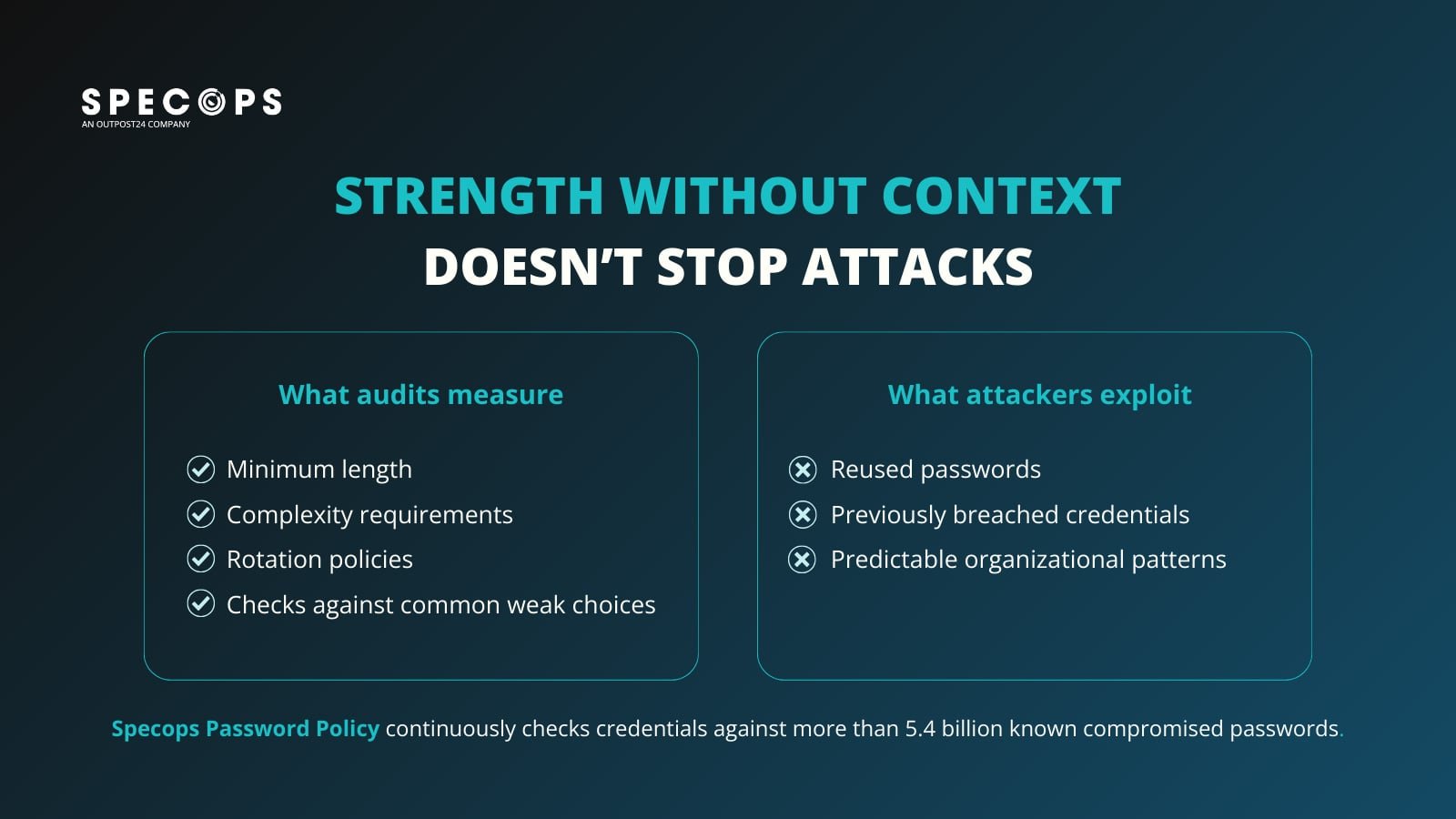
A password can meet every compliance requirement and still be easily guessable in context. For example, an employee at a hospital using something like Healthcare123! may technically satisfy complexity rules, but attackers can easily crack it using a targeted wordlist. Even worse, a password can appear "strong" while already being compromised. If it's been leaked in a breach elsewhere, attackers can simply log in with it.
One study highlights this risk, where 83% of 800 million known compromised passwords otherwise satisfied regulatory requirements. Without breached password screening, audits create a gap where accounts look secure on paper but remain easy to compromise. This is especially true for high-value accounts, where one successful login can open the door to far wider access.
"Modern password security can't rely on outdated compliance models," says security researcher Dr. Elena Vance. "Attackers have evolved their techniques, and our security measures must evolve as well. What we need is risk-based prioritization that focuses on the actual threats rather than checkbox exercises."
Orphaned Accounts: The Invisible Security Gap
Typically, password audits assume that the accounts that matter are those on the current employee list. However, in many environments, not every active account belongs to an active employee. Attackers know this, which is why "orphaned" accounts are such an attractive target.
Accounts belonging to former employees, contractors, test accounts, or shadow IT accounts operating outside normal identity processes are all-too common in enterprise environments. Orphaned accounts can sit quietly for months or years without anyone paying attention. They also tend to have weaker controls, such as outdated passwords or missing multi-factor authentication (MFA) enforcement.
"I've seen organizations pass security audits with flying colors while having dozens of dormant accounts from former contractors with administrative privileges," notes cybersecurity consultant Marcus Chen. "These accounts represent a significant blind spot that auditors often miss but attackers actively seek out."
The Overlooked Risk of Service Accounts
Service accounts are frequently overlooked in user-focused password audits, which is a critical issue as these accounts often have excessive permissions alongside passwords that never expire. From an attacker's point of view, compromising a service account can provide long-term access without the visibility or scrutiny that comes with a privileged user login.
The result is that organizations may pass a password audit while some of the riskiest accounts remain effectively unmanaged. Service accounts often have elevated privileges that can give attackers deep access to critical systems and data.
"Service accounts are like the keys to the kingdom in many environments," explains security architect Sarah Johnson. "They're designed to provide automated processes with necessary permissions, but too often they're given far more access than needed. A comprehensive audit should specifically target these accounts and ensure they follow the principle of least privilege."
Point-in-Time Audits vs. Continuous Threats
An audit delivers a snapshot of password hygiene at the moment the audit ran. But credential-based attacks are continuous, and the risk can change overnight. One of the most common examples is credential stuffing. Attackers take usernames and passwords exposed in one breach and try them across other services, betting on password reuse.
That means an account can be perfectly compliant today and compromised tomorrow, simply because the same credentials were leaked elsewhere. This is especially relevant for larger organizations or those with external-facing login portals. Attackers don't need to break password rules if they can just reuse credentials that already exist in criminal marketplaces.
Making Password Audits More Effective
If the goal is to reduce the likelihood of compromise, not just pass an assessment, audits need to reflect how attackers actually operate. At a minimum, password audits should:
- Check passwords against known breach data, not just complexity rules
- Prioritize high-value and privileged accounts, rather than treating all users equally
- Include orphaned and dormant accounts, not just active employees
- Explicitly cover service accounts, especially those with elevated permissions
- Incorporate continuous monitoring, rather than relying on periodic snapshots
- Consider MFA resilience, particularly for sensitive systems
"The most effective password audits don't just look at whether a password meets complexity requirements," says security analyst David Torres. "They assess the actual risk posed by each account, considering factors like privilege level, activity patterns, and whether the credentials have appeared in breach data. This risk-based approach allows security teams to focus their limited resources on the accounts that matter most to attackers."
Tools like Specops Password Auditor help organizations assess their password health by running a read-only scan of their Active Directory and flagging vulnerabilities like inactive privileged admin accounts or compromised passwords. Specops Password Policy offers continuous monitoring against a database of more than 5.4 billion compromised passwords and allows organizations to create unlimited custom block lists of terms unique to their environment.
As Verizon's Data Breach Investigation Report found, stolen credentials are involved in 44.7% of breaches. This statistic underscores why organizations need to move beyond basic password audits and implement more comprehensive security measures that address how attackers actually operate.
For organizations looking to improve their password security posture, experts recommend starting with a comprehensive assessment of current password policies and account management practices, followed by implementing continuous monitoring and regular access reviews to maintain security over time.
Comments
Please log in or register to join the discussion