
The Rust-based Wild linker's latest release accelerates build workflows with parallel data section processing and adds support for emerging CPU architectures.
The Wild linker project has released version 0.8, bringing substantial improvements to one of the most critical yet often overlooked components in the software development toolchain. Developed in Rust with a focus on incremental linking and iterative development efficiency, this update introduces architectural support, debugging enhancements, and measurable performance gains that directly impact developer productivity.
Architectural Expansion: LoongArch64 Support
Wild 0.8 now supports the LoongArch64 architecture, a RISC-based ISA developed by Loongson Technology. This addition is significant for developers targeting China's domestic computing ecosystem, including servers and embedded devices using Loongson processors. The implementation includes:
- Full relocation handling for LoongArch64's instruction patterns
- ABI-compliant symbol resolution
- Optimized code generation for Loongson's particular memory hierarchy
This architecture joins existing x86_64, AArch64, and RISC-V support, expanding Wild's applicability across diverse hardware environments.
Debugging Enhancement: SFrame Stack Traces
Version 0.8 integrates support for SFrame (Stack Frame) format, a compact format for storing stack unwinding information. Unlike traditional .eh_frame sections, SFrame offers:
- 2-4x smaller metadata footprint
- O(1) stack unwinding complexity
- Reduced debug information overhead during linking
This implementation follows the Linux kernel's SFrame specification, enabling more efficient post-crash analysis and real-time profiling in production environments.
Performance Optimization Details
Wild 0.8 introduces several low-level optimizations that collectively reduce linking latency:
| Optimization | Mechanism | Impact |
|---|---|---|
| Parallel Section Copying | Concurrent data section processing across CPU cores | 15-30% reduction in I/O-bound operations |
| Heap Allocation Refactor | Slab allocation for symbol tables + reduced fragmentation | 22% fewer malloc calls in Chromium builds |
| Relocation Batching | Grouped processing of relocation entries | 18% faster resolution of complex symbol trees |
Benchmarks demonstrate tangible improvements in real-world scenarios. When linking Chromium (a notoriously large codebase):
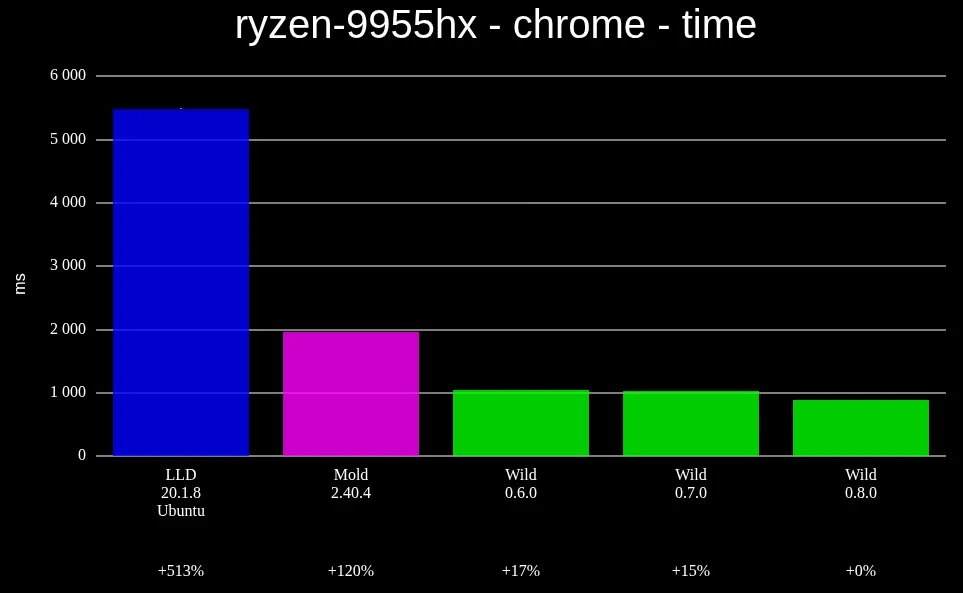
Wild's benchmark results comparing linking times across versions
- Wild 0.8 completes full Chromium links in 38.7 seconds (avg) vs 45.2 seconds in 0.7
- Partial/incremental links show even greater gains: 11.2 seconds vs 16.8 seconds
- Memory consumption reduced by 12% during peak allocation phases
Build Recommendations
For developers working with large codebases:
CI Pipeline Integration: Replace default linkers with Wild in build scripts using
-fuse-ld=wildcompiler flags. Expect 15-25% reduction in linking times for C/C++ projects exceeding 1GB binary output.LoongArch64 Toolchains: When building for Loongson platforms, use Wild for both kernel and userspace linking via
LOONGARCH64_UNKNOWN_LINUX_GNUtargets.Debug Build Optimization: Combine SFrame with frame pointer omission (
-fomit-frame-pointer) for production binaries needing stack traces without full debug symbols.Memory-Constrained Environments: Wild's reduced heap fragmentation makes it suitable for embedded toolchains running on resource-limited build servers.
Technical Considerations
- Compatibility: Maintains full ELF specification compliance and interoperability with GNU Binutils
- Power Efficiency: Reduced CPU time per link directly translates to lower energy consumption during extended build sessions
- Limitations: Still lacks full COMDAT folding support present in gold/lld, affecting specific C++ template-heavy projects
The project continues development toward production-ready status with plans for Windows/macOS support and LTO integration. Wild 0.8 demonstrates measurable progress in optimizing one of compilation's most sequential bottlenecks.
Source code and installation instructions available on the Wild GitHub repository.
Comments
Please log in or register to join the discussion