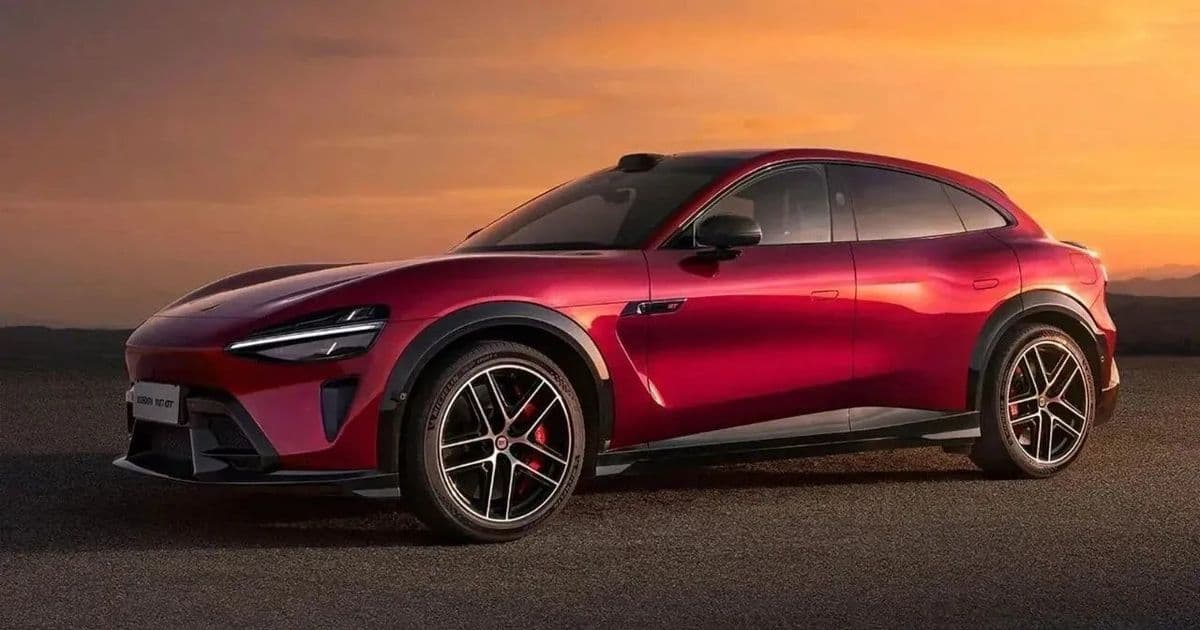
The Xiaomi YU7 GT has been photographed on public roads in a cherry‑red finish, confirming that its final road‑testing phase is almost complete. While the specs announced at the Beijing Auto Show sound impressive – 1,003 PS, 300 km/h top speed, 705 km CLTC range – the real story lies in the engineering trade‑offs, production timeline, and how the car fits into Xiaomi’s broader hardware strategy.
Xiaomi’s first high‑performance electric sedan, the YU7 GT, has been caught on camera driving without the usual camouflage panels. The cherry‑red prototype was photographed on public roads, with only the wheels still wrapped in a neutral cover. This visual confirmation lines up with the company’s statement that the model will launch by the end of May 2026.
What’s being claimed?
- Power: 1,003 PS (≈740 kW) from a dual‑motor layout (288 kW front, 450 kW rear).
- Top speed: 300 km/h (some variants limited to 270 km/h).
- Range: 705 km under the CLTC cycle.
- Dimensions: 5,015 mm length, 2,007 mm width, 1,597 mm height, 3,000 mm wheelbase.
- Weight: 2,460 kg curb, 2,910 kg gross.
- Design cue: “War‑horse stance” inspired by the Nürburgring, with a long hood and a wide‑track body.
These numbers were first revealed at the Beijing International Auto Show on April 24, where Xiaomi’s founder Lei Jun presented the car as a “pure‑blood GT”. The vehicle also appeared in the MIIT product catalog in February, confirming that the powertrain has already passed regulatory clearance.
What’s actually new?
1. Dual‑motor architecture
The YU7 GT uses a 288 kW front motor and a 450 kW rear motor. In practice, this means the rear axle will dominate acceleration, while the front motor can assist for stability and efficiency at lower speeds. The combined output of 1,003 PS is competitive with the top tier of current Chinese EVs, but it is not unprecedented – the Nio EP9 and Porsche Taycan Turbo S have delivered similar or higher peak power.
2. Battery and range claims
A 705 km CLTC range suggests a battery pack in the 110–120 kWh range, assuming a modest 15 kWh/100 km consumption under the CLTC test. Real‑world WLTP or EPA numbers will likely be 15‑20 % lower, putting the usable range closer to 580–600 km. The article does not disclose the cell chemistry or cooling architecture, which are crucial for achieving both high power and high energy density.
3. Chassis and handling focus
Xiaomi says the car is being tuned on the Nürburgring for “German‑tuned” handling. That typically involves a stiff suspension, active dampers, and a rear‑biased weight distribution. However, the curb weight of 2,460 kg is heavy for a sedan, so achieving “sharp cornering” will depend heavily on chassis software – torque vectoring, brake‑by‑wire, and predictive stability control. No details on these systems have been released yet.
4. Production timeline
The uncamouflaged sightings imply that the prototype has cleared most of the validation phase. The remaining wheel covers suggest that final aerodynamic testing is still ongoing. A May launch is aggressive; historically, Xiaomi’s previous EV, the SU7, slipped its announced timeline by several months. Supply‑chain constraints for high‑power inverters and large‑format cells could still cause delays.
Limitations and open questions
- Weight vs efficiency: At 2,460 kg, the YU7 GT is heavier than many European sport sedans. The high power may offset the weight for acceleration, but it will hurt efficiency, especially in city driving.
- Thermal management: Sustaining 1,003 PS for more than a few seconds requires a robust cooling system. Without data on coolant flow rates or heat‑pipe design, it is unclear whether the car can maintain peak power for extended track runs.
- Software maturity: Xiaomi’s experience in automotive software is still developing. The performance of torque‑vectoring and predictive stability systems will be a make‑or‑break factor for the promised “sharp cornering”.
- Charging infrastructure: No information has been given about the car’s charging rate. If the battery is indeed ~115 kWh, a 350 kW DC fast‑charge capability would be essential to keep long‑distance trips practical.
- Market positioning: Priced competitively against established brands like Tesla, Nio, and BYD will be challenging given the high‑performance target and the cost of a large battery pack.
Bottom line
The cherry‑red YU7 GT prototype confirms that Xiaomi is moving from concept to production, but the headline numbers hide a series of engineering compromises. The dual‑motor layout and high power output are impressive on paper, yet the vehicle’s weight, likely battery size, and the need for sophisticated chassis software will determine whether it can deliver the promised 300 km/h top speed and 705 km range in everyday use. Potential buyers should watch for real‑world efficiency figures, charging speeds, and the final price before getting excited about the “pure‑blood GT” label.
For more on Xiaomi’s EV roadmap, see the original MIIT filing and the Beijing Auto Show press release.
Comments
Please log in or register to join the discussion