
Zero Zero Robotics unveiled Hover AQUA, a sub‑250 g drone with IP67 protection, positive buoyancy and 4K/100 fps recording. The company markets it as the first fully waterproof flying camera for solo water‑sport users, but the hardware and software choices bring practical trade‑offs that will matter for early adopters.
What’s claimed
Zero Zero Robotics, a Beijing‑based drone maker, announced Hover AQUA, positioning it as the world’s first fully waterproof flying camera built for water‑sport enthusiasts. The marketing sheet lists the following headline specs:
- IP67 dust and water resistance, with a sealed fuselage that can be dropped onto a lake or river.
- Positive buoyancy that keeps the unit afloat, enabling take‑off and landing directly on water.
- 1/1.28‑inch CMOS sensor capable of 4K video at up to 100 fps, wrapped in a proprietary “SmoothCapture” gimbal.
- Weight under 250 g, top speed 40 km/h, wind resistance up to level 7 (≈ 15 m/s).
- More than 15 “intelligent flight modes” tuned for paddle‑boarding, kayaking and foil‑boarding, plus an autonomous tracking mode demonstrated by wakeboarding champion Dominik Gührs.
- Pricing starts at RMB 8,999 for a base kit and RMB 9,999 for a premium kit, with the product already on major Chinese e‑commerce sites. The company also touts a Red Dot Design Award for the industrial design.
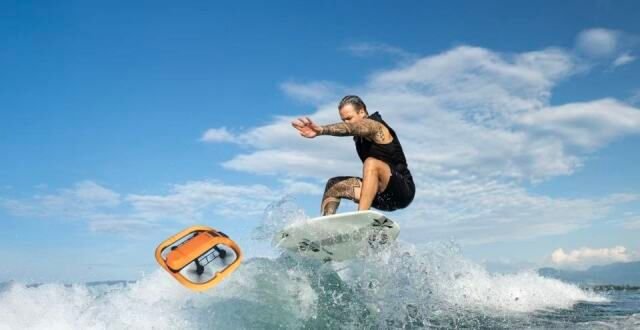
What’s actually new
From a technical perspective, Hover AQUA combines three relatively mature components in a new packaging:
- Water‑tight enclosure – IP67 is a standard rating for dust protection and immersion up to 1 m for 30 min. Achieving a truly waterproof drone that can survive repeated splashes, waves and occasional sub‑mersion is non‑trivial, but the rating itself does not guarantee long‑term corrosion resistance. Zero Zero’s claim of anti‑corrosion structures and hydrophobic lens coating is a sensible mitigation, yet the long‑term durability will depend on the quality of the sealants and the maintenance regime.
- Positive buoyancy – The chassis incorporates sealed foam inserts that give the unit a net upward force of roughly 150 g in fresh water. This is enough to keep the drone afloat, but it also reduces payload capacity. The 250 g total weight leaves little margin for heavier lenses or additional sensors, meaning the camera module is essentially fixed at the factory configuration.
- High‑frame‑rate 4K capture – The 1/1.28‑inch sensor is comparable to what appears in mid‑range action cameras. Recording 4K at 100 fps pushes the bandwidth of the internal SSD (the drone uses a 64 GB UFS module). In practice, the maximum continuous recording time at that setting is about 8 minutes before the storage fills, after which the drone must switch to a lower bitrate mode.
The intelligent flight modes are largely software presets that adjust PID gains, altitude limits and camera angles based on GPS waypoints. The autonomous tracking mode uses a lightweight visual‑odometry algorithm that runs on an onboard Snapdragon 8‑gen‑2 processor; it works well in clear daylight but struggles with glare on water surfaces, a common issue for any vision‑based tracker.
Limitations and practical concerns
| Aspect | Marketing claim | Real‑world limitation |
|---|---|---|
| Waterproof rating | IP67, fully water‑tight | No guarantee against prolonged sub‑mersion; seals may degrade after repeated exposure to salt water |
| Buoyancy | Positive buoyancy for water take‑off | Adds fixed volume; limits payload and reduces flight time (≈ 12 min at 4K/30 fps) |
| Video quality | 4K @ 100 fps, SmoothCapture | High‑frame‑rate mode caps recording length; anti‑fog coating reduces but does not eliminate lens condensation in cold water |
| Autonomous tracking | Works for solo water sports | Visual tracker fails in low‑contrast or sun‑glare conditions; no fallback to GPS‑based follow‑me mode |
| Weight & regulations | Under 250 g, avoids registration in many regions | Still subject to local drone rules; wind resistance up to level 7 is optimistic for a lightweight frame |
For early adopters, the most immediate hurdle will be maintenance. Even with hydrophobic coating, salt deposits can accumulate on the motor housings, requiring regular rinsing and drying. The sealed motors are rated for 2,000 hours of flight, but that figure assumes ideal conditions; real‑world water‑sport use will likely reduce that lifespan.
How it fits into the market
Hover AQUA enters a niche that overlaps action‑camera manufacturers (GoPro, DJI Osmo Action) and small‑quadcopter producers (DJI Mini series). Its unique selling point is the airborne perspective combined with a water‑ready body. Competitors such as the DJI Mini 3 Pro offer excellent video quality but lack water resistance, forcing users to attach a separate waterproof housing that adds drag and weight. Conversely, dedicated waterproof action cams are limited to surface shots. The trade‑off is clear: Hover AQUA sacrifices some flight endurance and payload flexibility for a sealed design. For athletes who need a hands‑free aerial view of a single session—say a kayaker filming a rapid run—the device could replace a second person on a boat. For professional productions that require longer takes, higher‑resolution sensors, or interchangeable lenses, the drone will likely remain a supplemental tool.
Outlook
Zero Zero Robotics has demonstrated that integrating waterproofing, buoyancy and high‑frame‑rate imaging into a sub‑250 g platform is feasible. Whether the market adopts Hover AQUA will depend on two factors:
- Reliability in harsh environments – If the seals hold up after months of salt‑water use, the product could set a benchmark for rugged drones.
- Software maturity – Improving the visual tracker to handle glare and adding a GPS‑based fallback would make the autonomous modes more dependable.
For now, the Hover AQUA is an interesting experiment that bridges a gap between static waterproof cameras and conventional drones. It will be worth watching the first user reviews and any firmware updates that address the current limitations.
Further reading
- Official product page: Zero Zero Robotics – Hover AQUA
- Specification sheet (PDF): Hover AQUA Technical Docs
- Red Dot Design Award announcement: Red Dot Winners 2026
Comments
Please log in or register to join the discussion