AMD CEO Lisa Su, an MIT alumna, addressed the 2026 graduates, urging them to tackle the toughest challenges with purpose, ethical judgment, and interdisciplinary collaboration. Her speech highlighted the role of AI, semiconductor innovation, and MIT’s hands‑on learning philosophy as a foundation for future societal impact.
MIT Class of 2026 urged to “run toward the hardest problems”
Lisa Su ’90, SM ’91, PhD ’94 – chair and CEO of Advanced Micro Devices – stood on Killian Court and reminded the new graduates that the most demanding problems are the best teachers. Her message blended personal anecdotes, a realistic view of AI’s limits, and a clear call for engineers to pair technical skill with purpose and ethical judgment.

From MIT classrooms to the semiconductor frontier
Su’s career began in MIT’s Electrical Engineering and Computer Science department, where she took the notoriously rigorous 6.001 and 6.002 introductory courses. “Within two weeks I realized there were a lot of people at MIT who were very, very good at math,” she recalled, laughing at the memory. The experience taught her two things that still guide her leadership:
- Confidence in the unknown – the ability to admit you don’t have an answer and then figure it out.
- Hands‑on iteration – building, testing, and persisting through multiple failed experiments.
These lessons echo the institute’s “mens et manus” (mind and hand) ethos, which Su says “captures exactly what makes MIT so special.” Her PhD advisor, Dimitri Antoniadis, was the mentor who showed her how to translate theory into silicon, a skill she later applied at Texas Instruments, IBM, Freescale, and ultimately AMD.
Technical approach: AI as an accelerator, not a decision‑maker
During the address Su highlighted artificial intelligence as a multiplier for discovery:
- Data synthesis – AI can ingest massive datasets from genomics, climate models, or materials simulations and surface patterns that would take humans years to uncover.
- Design automation – In semiconductor design, generative AI assists in layout optimization, reducing design‑cycle time from months to weeks.
- Cross‑domain insight – By linking seemingly unrelated research areas, AI can suggest novel drug targets or energy‑storage materials.
She cautioned, however, that AI cannot choose which problems deserve attention. “For everything AI can do, AI cannot decide which problems are worth solving. It can’t make the hard judgments when the data is not there.” The responsibility for defining societal priorities, evaluating risk, and ensuring equitable outcomes remains squarely on human engineers.
Real‑world applicability: From chips to climate solutions
Su illustrated how AMD’s recent product roadmap reflects the “hard‑problem” mindset:
- High‑performance computing (HPC) GPUs now power climate‑model simulations that resolve regional weather patterns at kilometer scales.
- Energy‑efficient CPUs enable edge devices to run AI inference locally, reducing data‑center bandwidth and associated carbon emissions.
- Custom accelerators for medical imaging accelerate reconstruction algorithms, shortening scan times and improving patient comfort.
These examples show how a single semiconductor company can influence multiple sectors—energy, health, and climate—when engineers deliberately target the toughest challenges.
Institutional values: Excellence, curiosity, and ethical action
MIT President Sally Kornbluth followed Su’s remarks with a charge that reinforced three core values:
- Excellence – maintain the highest standards of intellectual rigor.
- Curiosity – treat scientific inquiry as “rocket fuel” for societal progress.
- Ethical commitment – act with integrity, consider the broader human impact, and avoid shortcuts that compromise trust.
Kornbluth also highlighted MIT’s merit‑based admissions policies, underscoring that the institute’s strength comes from admitting those whose curiosity never sleeps, regardless of background.
What it means for the next generation of engineers
The combined messages from Su and Kornbluth translate into a practical roadmap for the Class of 2026:
- Identify a hard problem – whether it is scaling quantum computers, closing the carbon loop, or making AI trustworthy.
- Build interdisciplinary teams – leverage MIT’s culture of collaboration across the five schools and the Schwarzman College of Computing.
- Iterate relentlessly – expect failure, learn from it, and let each cycle improve the design.
- Embed ethics early – incorporate fairness, transparency, and sustainability metrics into every prototype.
- Scale impact – use the global reach of platforms like AMD’s ecosystem or open‑source AI frameworks to amplify solutions.
A moment captured
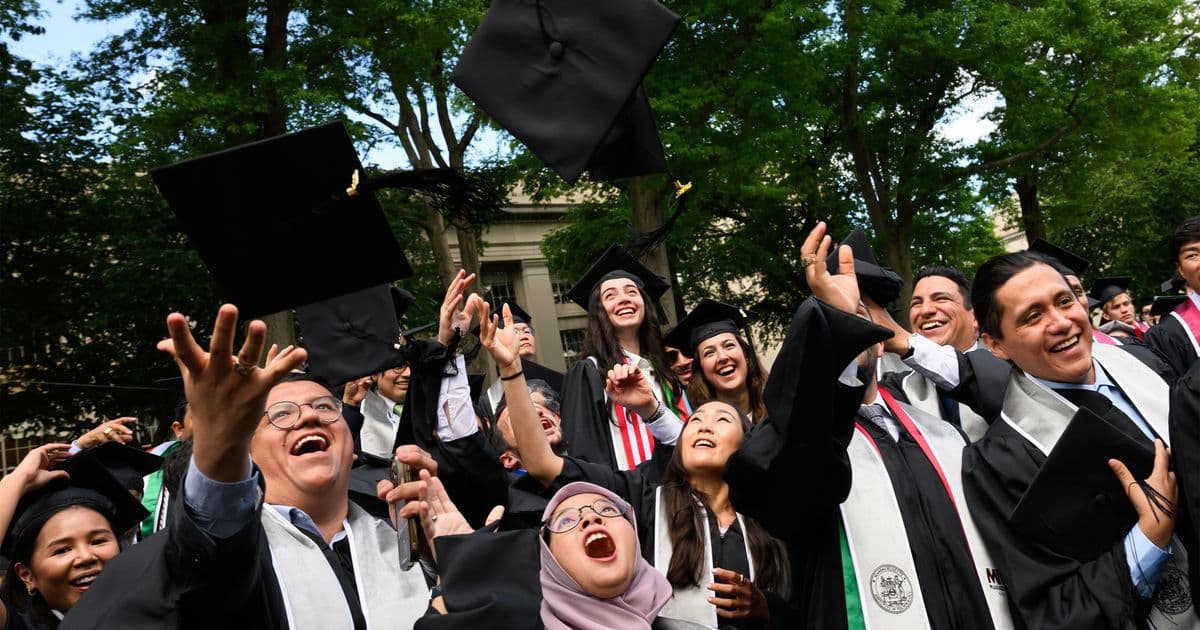
The ceremony concluded with the traditional singing of “In Praise of MIT” and “Take Me Back to Tech,” while graduates tossed their caps into a brightening sky. The image of the crowd, caps soaring under the cleared clouds, symbolized the optimism Su asked them to carry forward.

Key takeaways
- Hard problems are the best training ground for future leaders.
- AI amplifies human capability but does not replace human judgment.
- MIT’s blend of deep theory and hands‑on experimentation remains a proven formula for tackling society’s biggest challenges.
The Class of 2026 leaves MIT equipped not only with degrees but with a clear directive: run toward the hardest problems, apply purpose, judgment, and courage, and shape a future that reflects both technical brilliance and ethical responsibility.
Comments
Please log in or register to join the discussion