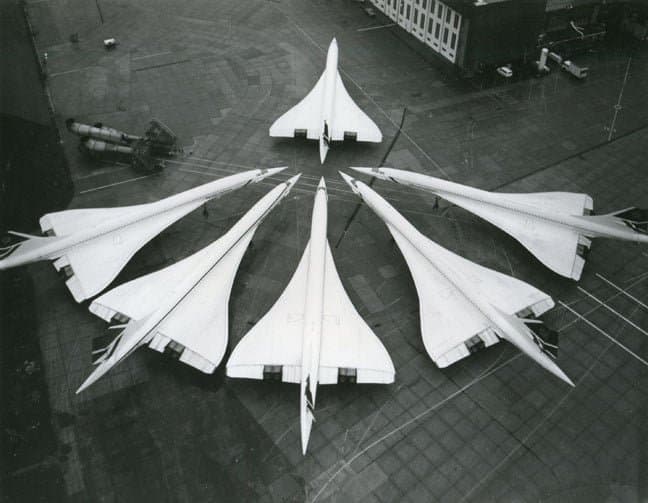
On January 21, 1976, Concorde began commercial service, achieving a technical marvel that outpaced sound but ultimately lost to the financial realities of aviation. The aircraft's story is a masterclass in engineering excellence meeting hard economic constraints.
Fifty years ago today, two Concorde aircraft broke the sound barrier on commercial routes, one from London to Bahrain and another from Paris to Rio de Janeiro. The Tupolev Tu-144 had technically beaten Concorde to supersonic passenger flights by a year, but the Anglo-French aircraft became the first to establish regular scheduled service. What followed was 27 years of a technological marvel that proved the physics of supersonic travel were solved, but the economics were not.
The Engineering Feat
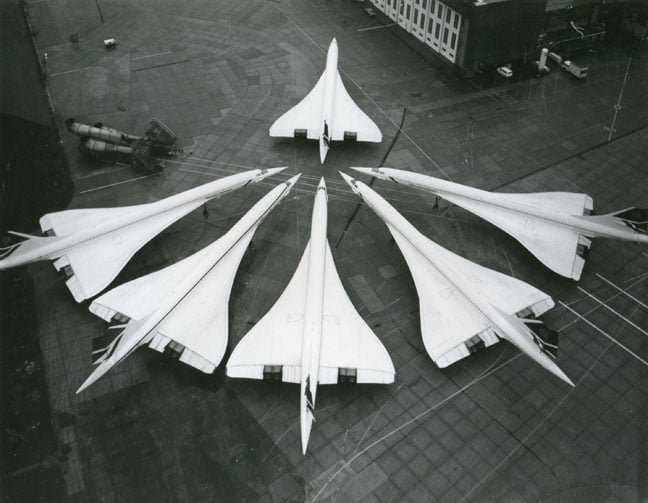
Concorde's design represented a convergence of extreme engineering constraints. The aircraft cruised at Mach 2.04 (1,354 mph) at 60,000 feet, where the air is thin and drag is reduced. The delta wing design, powered by four Rolls-Royce/Snecma Olympus 593 turbojets with afterburners, allowed the aircraft to achieve and maintain supersonic flight. The airframe, primarily aluminum alloy, had to withstand temperatures of 127°C (260°F) at the nose and leading edges due to air friction at supersonic speeds.
The fuel system was particularly sophisticated. The aircraft carried 119,000 liters of fuel, which served not only as propulsion but also as a heat sink for the air conditioning and hydraulic systems. The fuel was circulated through the wings and fuselage to dissipate the intense heat generated by supersonic flight. This design required precise thermal management and complex plumbing throughout the airframe.
The cockpit featured a sophisticated flight control system with a fly-by-wire design that managed the aircraft's stability across the entire flight envelope, from subsonic to supersonic speeds. The system automatically adjusted the aircraft's center of gravity by transferring fuel between tanks to maintain optimal balance during acceleration and deceleration through the sound barrier.
Performance Data and Limitations
Concorde's operational specifications were impressive:
| Parameter | Value | Context |
|---|---|---|
| Maximum Cruise Speed | Mach 2.04 (1,354 mph) | 2x speed of conventional jets |
| Cruise Altitude | 60,000 feet | Above conventional traffic |
| Range | 4,140 nautical miles | Limited to transatlantic routes |
| Passenger Capacity | 92-100 | Half of a Boeing 747 |
| Fuel Consumption | 6,500 liters/hour | ~5x a Boeing 747 at cruise |
| Takeoff Speed | 250 mph | Required afterburners |
| Landing Speed | 170 mph | High for a passenger aircraft |
The aircraft's range limitation was particularly significant. While it could cross the Atlantic, it couldn't fly from London to Los Angeles or Paris to Tokyo without refueling. This restricted its market to primarily transatlantic routes and occasional flights to the Middle East and South America.
The Economic Reality
The fundamental problem was simple mathematics. A Boeing 747-100, introduced in 1970, could carry 366 passengers in a typical three-class configuration. Even at Mach 0.85 (567 mph), it could complete a transatlantic crossing in about 7-8 hours. Concorde, with half the passenger capacity, could do it in 3.5 hours but consumed significantly more fuel per passenger-mile.
The 1973 oil crisis was a turning point. Jet fuel prices increased from $0.11 per gallon in 1970 to $0.35 per gallon by 1974. For an aircraft that already consumed fuel at a premium rate, this was devastating. The economics of supersonic travel became even more precarious as airlines focused on efficiency rather than speed.
Concorde's ticket prices reflected this reality. In 1976, a round-trip London-New York ticket cost $1,200 (equivalent to about $6,500 today). While this attracted wealthy passengers and celebrities, it limited the total addressable market. The aircraft could never achieve the economies of scale that made conventional jets profitable.
Technical Challenges and Solutions
The sonic boom was the most visible limitation. At supersonic speeds, Concorde generated a shockwave that measured approximately 105-110 dB on the ground—equivalent to a rock concert. This led to overland speed restrictions, confining supersonic flight to oceanic routes. The aircraft was banned from US airspace until 1976, and even then, only over water approaches were permitted.
Noise at airports was another issue. The afterburners required for takeoff produced 119 dB of noise, exceeding many airport noise regulations. This limited airport compatibility and required special operational procedures.
The aircraft's high operating costs were driven by several factors:
Maintenance Complexity: The thermal cycling from subsonic to supersonic flight and back created stress on the airframe. The titanium components in the engine nacelles and fuel system required specialized inspection and replacement schedules.
Limited Parts Supply: After production ended in 1979, the supply chain for spare parts became increasingly difficult to maintain. Airbus ceased support for the aircraft in 2003, making continued operation impractical.
Crew Requirements: Concorde required a flight crew of three (two pilots and a flight engineer) plus a cabin crew of 5-6 for 92-100 passengers, compared to 2-3 pilots and 8-10 cabin crew for a 747 carrying 366 passengers.
The Crash and Retirement
The fatal accident on July 25, 2000, when Air France Flight 4590 crashed after hitting debris on takeoff from Paris, killed 113 people. While the investigation found the cause was runway debris (a titanium strip from a Continental Airlines DC-10) rather than a design flaw, the public perception was damaged. Passenger numbers dropped significantly after the crash.
The September 11, 2001 attacks further depressed air travel demand, particularly in the premium transatlantic market that Concorde served. Combined with rising maintenance costs and Airbus's decision to end support, the economic case for continued operation collapsed.
British Airways retired its Concorde fleet on October 24, 2003, and Air France had already ceased operations in May 2003. The aircraft had flown commercial service for 27 years and 10 months.
Modern Supersonic Efforts
The dream of supersonic passenger travel hasn't died. Several companies are developing new supersonic aircraft with modern technology:
Boom Supersonic is developing the Overture, a Mach 1.7 aircraft designed to carry 64-80 passengers with a range of 4,250 nautical miles. The company claims it will be economically viable by using modern composite materials and efficient turbofan engines. Their XB-1 demonstrator successfully completed its first supersonic flight in March 2024.
NASA's X-59 QueSST (Quiet SuperSonic Technology) is testing a shape that reduces the sonic boom to a quiet "thump" rather than a loud boom. The goal is to enable overland supersonic flight by meeting noise regulations.
Spike Aerospace is developing the S-512, a business jet capable of Mach 1.6 with a range of 6,200 nautical miles, targeting the private aviation market.
Exosonic is working on a supersonic airliner with a focus on low sonic boom and sustainable aviation fuel compatibility.
Lessons from Concorde
Concorde's story offers several technical and business lessons:
Technology alone doesn't guarantee commercial success. The aircraft was technically brilliant but economically marginal from the start.
Infrastructure matters. Supersonic travel requires compatible airports, air traffic control procedures, and regulatory frameworks.
Market size is critical. The premium market is limited, and without achieving economies of scale, costs remain high.
Environmental concerns are now paramount. Concorde's high fuel consumption and noise pollution would face even greater scrutiny today.
Maintenance and support are long-term commitments. The end of parts supply ultimately grounded the fleet.
The Future of Supersonic Travel
Modern efforts face different challenges than Concorde. Environmental regulations are stricter, and climate change concerns make high fuel consumption problematic. However, new materials, engine technology, and aerodynamic designs offer potential improvements.
The key question is whether the premium market has grown enough to support supersonic operations. Business aviation has expanded significantly, and there may be a viable market for supersonic business jets before commercial airliners.
For now, Concorde remains a museum piece—a testament to what engineering can achieve, but also a reminder that technical excellence must align with economic reality. The aircraft that once made the world feel smaller by halving flight times now serves as a static display, inspiring engineers and aviation enthusiasts while reminding us that the fastest path isn't always the most sustainable.
The Sinsheim Museum in Germany offers visitors the unique opportunity to see both a Concorde and a Tupolev Tu-144 side by side—a physical comparison of two competing approaches to the same supersonic challenge. For those interested in the technical details, the Concorde's official technical specifications provide a deep dive into the engineering decisions that made the aircraft possible.
As we mark 50 years since Concorde's first scheduled flight, the question remains: will we see supersonic passenger travel return? The technology exists, but the economics and environmental considerations still present significant hurdles that no amount of engineering brilliance alone can overcome.
Comments
Please log in or register to join the discussion