
Agent Trace emerges as a critical specification for tracking AI-generated code contributions in version-controlled repositories, addressing the growing need for transparency in human-AI collaborative development workflows.
In the rapidly evolving landscape of AI-assisted software development, a fundamental challenge has emerged: how do we distinguish between human-authored code and AI-generated contributions? As AI coding systems become increasingly sophisticated and integrated into development workflows, the lines of authorship blur, creating a need for systematic attribution mechanisms. Agent Trace, currently at version 0.1.0 and in RFC status as of January 2026, presents itself as a vendor-neutral solution to this pressing problem.

The Genesis of Attribution
The motivation behind Agent Trace stems from a simple yet profound observation: as AI agents write more code, it becomes increasingly important to understand what came from AI versus humans. This attribution encompasses not only the models used but also the related agent conversations that prompted specific code changes. In development environments where both humans and AI systems contribute to the same codebase, maintaining clarity about provenance becomes essential for accountability, maintenance, and understanding development patterns.
Agent Trace defines an open, interoperable standard for recording this attribution data, addressing what has become a critical gap in our tooling for AI-assisted development. The specification acknowledges that different tools and platforms approach AI-assisted coding differently, yet all need a common language for describing code contributions.
Architectural Philosophy
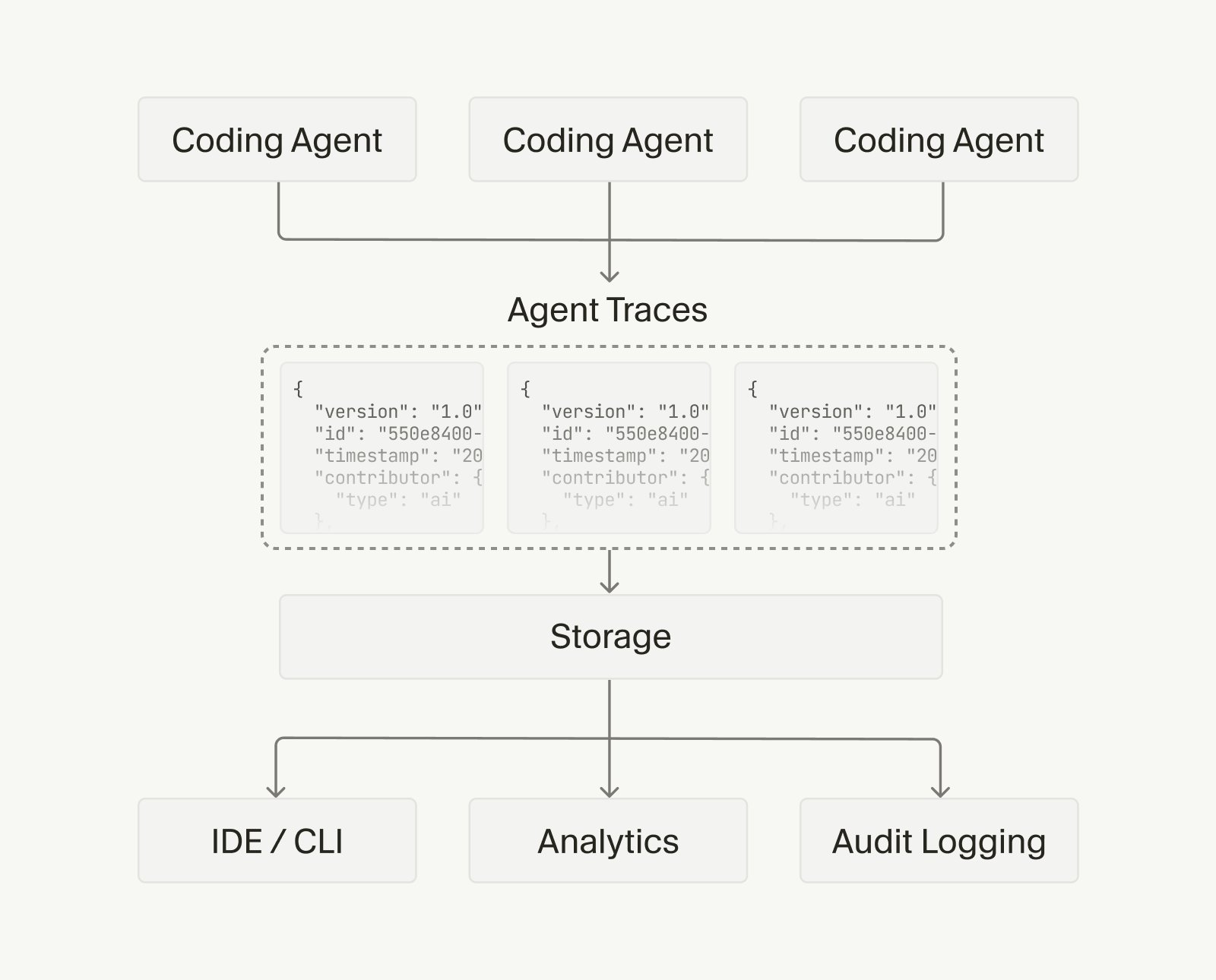
At its core, Agent Trace is a data specification rather than a product. This deliberate design choice allows for maximum flexibility in implementation while establishing a common format for attribution data. The specification is intentionally unopinionated about storage mechanisms, leaving implementation details to individual tools and platforms. This approach enables adoption across various development environments without requiring fundamental changes to existing workflows.
The architecture centers around the concept of "trace records"—structured metadata that describes code contributions. These records can be stored in multiple ways: as separate files, git notes, database entries, or any other implementation-defined mechanism. This flexibility ensures that Agent Trace can integrate with existing version control systems and development tools without imposing rigid constraints.
Technical Specification Deep Dive
Core Schema Components
The fundamental unit of Agent Trace is the Trace Record, which follows a detailed JSON schema. Each record contains several essential elements:
- Version: The Agent Trace specification version (e.g., '1.0')
- ID: A unique identifier for the trace record
- Timestamp: When the trace was recorded
- VCS Information: Details about the version control system
- Tool Information: The tool that generated the trace
- Files: Array of files with attributed ranges
- Metadata: Additional implementation-specific or vendor-specific data
Granular Attribution
One of Agent Trace's most significant features is its support for fine-grained attribution at the file and line level. The specification allows for precise tracking of which lines of code were generated by which AI models or human contributors. This granularity is achieved through the concept of "ranges," which define specific line numbers within files that can be attributed to particular conversations or contributors.
For example, a trace record might indicate that lines 42-67 of src/utils/parser.ts were generated by an AI conversation using Claude Opus, while lines 10-25 of src/utils/helpers.ts came from a different conversation using GPT-4o. This level of detail enables developers to understand the provenance of specific code segments.
Contributor Typology
Agent Trace establishes a clear taxonomy for contributors:
- Human: Code authored directly by a human developer
- AI: Code generated by AI
- Mixed: Human-edited AI output or AI-edited human code
- Unknown: Origin cannot be determined
This categorization provides a systematic way to classify code contributions while acknowledging the nuanced reality of human-AI collaboration. The "mixed" category, in particular, recognizes that the boundary between human and AI contributions is often not binary.
Version Control Integration
The specification demonstrates thoughtful consideration for different version control systems, supporting Git, Jujutsu, Mercurial, and SVN. Each system has its own approach to identifying revisions, and Agent Trace accommodates these differences while maintaining a consistent interface.
Notably, the specification addresses the challenge of tracking code across version control operations like rebases and merges. By supporting Jujutsu's change ID system (which remains stable across amend/rebase operations), Agent Trace provides a mechanism for maintaining attribution even when code moves through version control history.
Content Hashes and Line Tracking
A particularly innovative aspect of Agent Trace is its support for content hashes at the range level. These hashes allow for tracking attribution even when code moves within or between files, addressing a common challenge in maintaining accurate attribution over time.
The specification also clarifies that line numbers in a trace refer to positions at the recorded revision, not current positions. To determine the ownership of a specific line of code in the current state, developers would use VCS blame to find the revision that last touched that line, then look up the trace for that revision and file.
Extensibility and Future-Proofing
Agent Trace is designed with extensibility in mind, using a versioning scheme where major versions indicate breaking changes to required fields, and minor versions indicate additive changes (new optional fields). The metadata field allows for implementation or vendor-specific data, with the recommendation to use reverse-domain notation (e.g., dev.cursor, com.github.copilot) to avoid key collisions.
This extensibility ensures that the specification can evolve alongside the rapidly changing landscape of AI-assisted development while maintaining backward compatibility where possible.
Practical Implementation Considerations
The reference implementation provided with the specification demonstrates how Agent Trace can be integrated with coding agents. It includes a storage layer for reading and writing trace records and a hook integration for automatic trace capture on file changes. While the reference implementation is designed for tools like Cursor or Claude Code, the patterns described are applicable to any AI coding agent.
The specification also addresses practical questions about implementation, such as how to handle rebases or merge commits, acknowledging that different open source implementations may emerge and influence the specification's future evolution.
Implications for Software Development
The introduction of Agent Trace has several significant implications for the future of software development:
Transparency and Accountability
By providing a systematic way to attribute code contributions, Agent Trace enables greater transparency in development processes. Teams can understand which parts of their code were AI-generated, which models were used, and trace back to specific conversations that produced code changes. This transparency is essential for maintaining accountability in increasingly complex development environments.
Enhanced Collaboration
Agent Trace has the potential to improve collaboration between developers and AI systems by maintaining context about how decisions were made and what inputs led to specific outputs. When developers can see the provenance of AI-generated code, they can better understand, modify, and integrate it into their work.
Quality Assessment and Improvement
While Agent Trace doesn't directly address quality assessment, the attribution data it provides can indirectly support quality improvement efforts. Teams can analyze patterns in AI contributions, assess which models perform better for certain tasks, and potentially refine prompts based on successful interactions.
Legal and Ethical Considerations
Although Agent Trace explicitly doesn't address legal ownership or copyright, it provides a foundation for addressing ethical considerations around AI-generated code. The specification enables transparency about AI involvement, which is increasingly important as questions about intellectual property and attribution in AI-assisted development arise.
Challenges and Limitations
Despite its strengths, Agent Trace faces several challenges:
Adoption Hurdles: Widespread adoption across tools and workflows is necessary for the specification to achieve its full potential.
Implementation Complexity: The detailed schema might be complex to implement correctly, particularly for smaller tools or platforms.
Performance Considerations: Storing and querying attribution data could impact performance, especially in large repositories with frequent changes.
Evolving Landscape: The field of AI-assisted development is evolving rapidly, and the specification will need to adapt to new models, workflows, and use cases.
Scope Limitations: By design, Agent Trace doesn't address legal ownership, training data provenance, or quality assessment, leaving room for complementary specifications.
The Road Ahead
Agent Trace represents an important step toward establishing standards for AI-assisted development. As the specification evolves, we might see enhanced support for additional version control systems, new metadata fields for more detailed attribution, and tooling for visualizing and analyzing attribution data.
The specification's acceptance and adoption will depend on how effectively it addresses the real-world needs of developers working with AI systems. If successful, Agent Trace could become an essential component of the AI-assisted development ecosystem, providing the foundation for more transparent, accountable, and effective collaboration between humans and AI in software creation.
In a development landscape increasingly shaped by AI, Agent Trace offers not just a technical specification, but a framework for understanding and managing the complex interplay between human creativity and machine assistance. As we stand at the beginning of this new era, establishing clear attribution mechanisms may prove as important as the AI systems themselves in shaping the future of software development.
Comments
Please log in or register to join the discussion