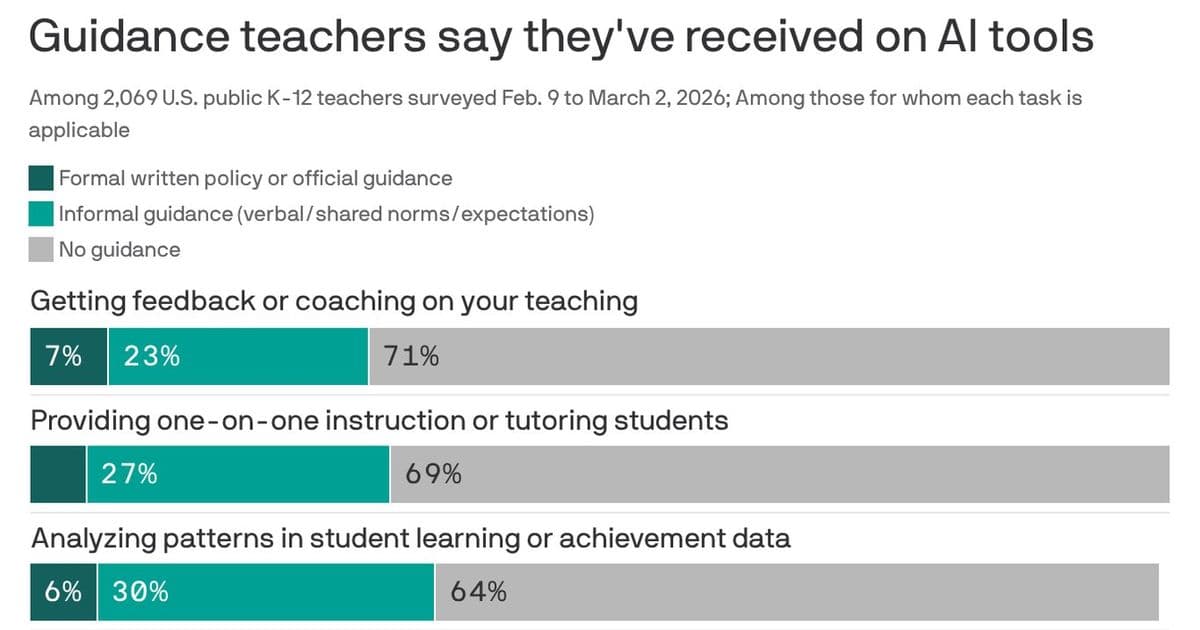
As artificial intelligence rapidly infiltrates educational settings, schools are deploying AI tools without providing adequate training or guidance for educators, creating a significant implementation gap that could hinder both teacher effectiveness and student outcomes.
The education technology landscape is undergoing seismic shifts as artificial intelligence tools flood into classrooms at an unprecedented pace. According to recent market research, the global AI in education market reached $2 billion in 2022 and is projected to grow at a compound annual growth rate of 45% through 2030, reaching $20 billion by decade's end. This explosive growth has left many educational institutions struggling to keep pace with implementation challenges, particularly in preparing teachers to effectively leverage these powerful new tools.
In classrooms across the United States, AI-powered platforms are becoming commonplace. Companies like Khan Academy have introduced AI tutors that personalize learning paths for individual students, while automated grading systems from providers such as Gradescope promise to reduce teacher workload. Meanwhile, adaptive learning platforms from DreamBox Learning and Knewton adjust content difficulty in real-time based on student performance. The proliferation of these tools has been remarkable - a recent survey by Education Week found that 61% of K-12 school districts now use some form of AI-powered educational technology, up from just 38% two years prior.
Despite this rapid adoption, teacher preparation has lagged significantly. A comprehensive study by the Center for Reinventing Public Education revealed that only 29% of teacher preparation programs currently offer dedicated coursework on AI in education. This gap creates a concerning disconnect between the tools being deployed and the educators expected to utilize them effectively. "We're asking teachers to integrate complex AI systems without providing them with the foundational knowledge to understand how these tools work, their limitations, or how to evaluate their effectiveness," noted Dr. Jennifer Roberts, an education technology researcher at Stanford University.
The consequences of this implementation gap are becoming apparent. In a recent survey of 1,200 teachers conducted by the National Education Association, 73% reported feeling unprepared to use AI tools in their classrooms, while 68% expressed concerns about over-reliance on technology that could diminish their professional autonomy. Teachers have identified specific challenges: difficulty verifying AI-generated content accuracy, concerns about data privacy, and the time required to learn new systems while maintaining existing teaching responsibilities.
The market dynamics driving this situation are complex. Venture capital investment in educational AI reached $1.3 billion in the first quarter of 2023 alone, with investors prioritizing rapid deployment over implementation support. "The business model for many EdTech companies favors quick sales cycles with extensive features, but limited professional development components," explains Michael Hanson, an analyst with the investment firm GSV Advisors. "This creates misaligned incentives between what schools need and what vendors provide."
School districts face budgetary constraints that exacerbate the problem. While the average annual per-student technology expenditure has increased from $200 to $350 over the past five years, only 12% of this budget is typically allocated to teacher training and support. "Schools are making significant investments in hardware and software, but treating professional development as an afterthought," observes Dr. Sarah Chen, superintendent of the Jefferson County School District. "This approach undermines the potential return on these substantial investments."
Some forward-thinking institutions are beginning to address this gap. The Denver Public Schools system has implemented a comprehensive AI literacy program for all educators, including both technical training and pedagogical strategies for classroom integration. Similarly, Arizona State University has established an AI Teaching Fellows program that trains faculty to become campus experts in educational AI implementation. These initiatives demonstrate the potential for systemic change when adequate resources are committed to teacher preparation.
The corporate sector is also beginning to recognize the issue. Technology companies like Google and Microsoft have recently expanded their professional development offerings for educational AI, providing free training resources for teachers. Additionally, non-profit organizations such as ISTE (International Society for Technology in Education) have developed AI teaching standards to guide educator preparation programs.
Looking ahead, the education sector faces critical decisions about AI integration. Without significant improvements in teacher preparation and support, the substantial investments in educational AI may fail to deliver expected returns. The most successful implementations will likely be those that balance technological innovation with human expertise, recognizing that effective AI implementation requires both technical infrastructure and pedagogical knowledge.
As AI continues to transform educational landscapes, addressing the teacher preparation gap must become a priority. The future of education depends not just on sophisticated technology, but on the educators who can thoughtfully integrate these tools into their teaching practice. Without this balance, the promise of AI-enhanced learning may remain unrealized, leaving both teachers and students ill-equipped to navigate the educational challenges of the 21st century.
Comments
Please log in or register to join the discussion