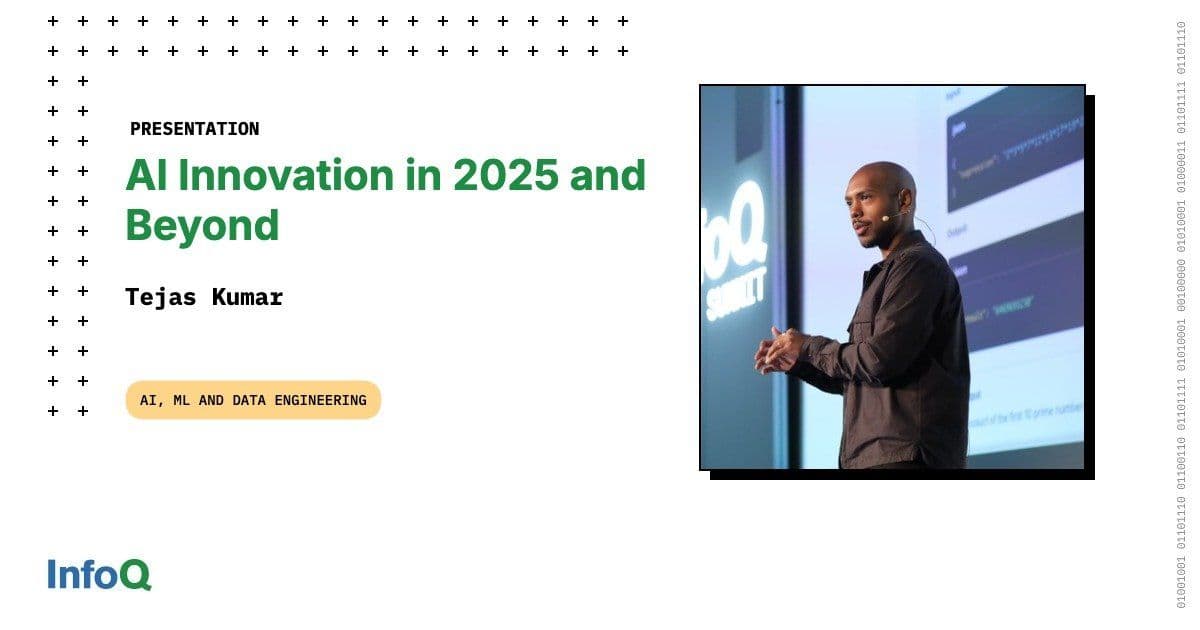
Tejas Kumar explores AI's evolution from Markov chains to agents, demonstrating practical implementations of RAG, MCP, and agentic workflows that eliminate traditional web UX.
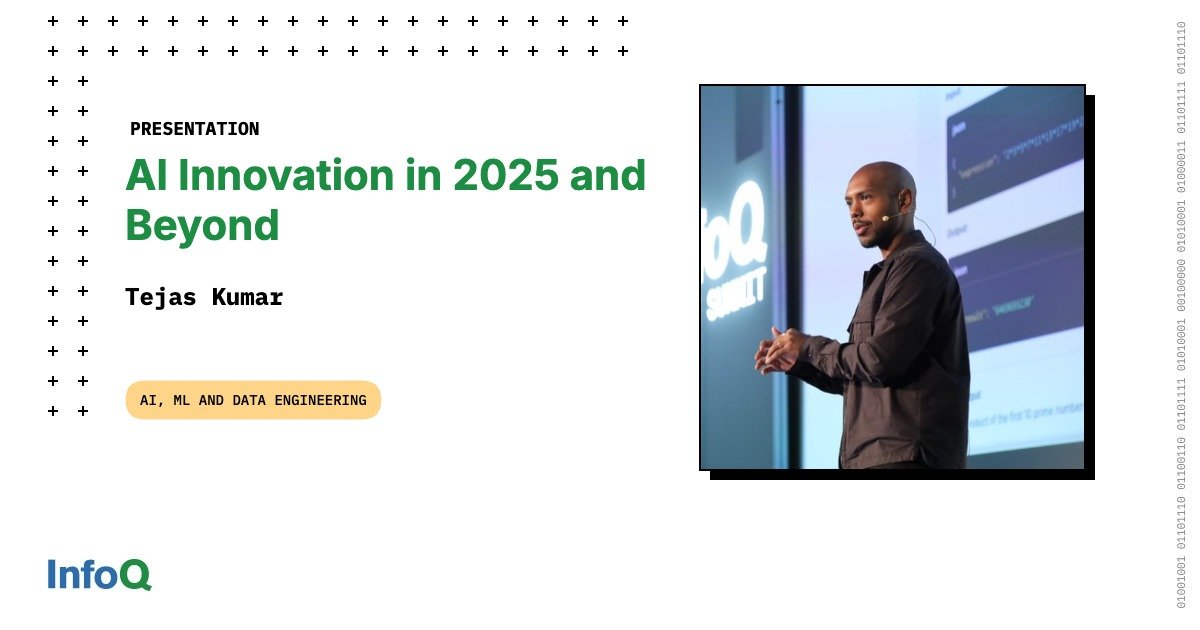
Tejas Kumar explains the trajectory of AI innovation, moving beyond the hype of 2024's RAG into the "year of agents" in 2025. He shares how technologies like the Model Context Protocol (MCP) will dismantle traditional web UX, allowing developers to build tool-based ecosystems where AI handles everything from shopping to calendar management, prioritizing human life over digital navigation.
AI's Historical Foundation
Artificial intelligence isn't new—it traces back to 1906 when Andrey Markov developed statistical models to predict word sequences in poetry. This became Markov chains, which we use today in iPhone keyboard suggestions and weather forecasting. The concept evolved through rule-based AI in games like Pac-Man (1980) and backpropagation algorithms in 1974 that enabled deep learning.
In 2017, Google Brain's "Attention Is All You Need" paper introduced transformers, the architecture behind ChatGPT. However, ChatGPT's success wasn't just about the model—it was the chat UI that made AI accessible to 100 million weekly users.
The Three AI Problems of 2022
Early ChatGPT faced three critical limitations:
- Hallucinations - Making up incorrect information
- Knowledge cutoff - Training data frozen around 2021
- Finite context - Limited token windows (100K-200K words)
RAG: The 2024 Solution
Retrieval-Augmented Generation (RAG) solved these problems by fetching real-time data from databases or websites and injecting it into prompts. For example, asking "What movies are playing today?" would retrieve current listings from Rotten Tomatoes and provide accurate answers without hallucinations.
RAG works by:
- Fetching relevant data from external sources
- Combining it with user queries
- Passing the combined prompt to language models
- Using vector search for semantic similarity when dealing with large contexts
2025: The Year of AI Agents
Agents represent the next evolution—language models with agency. An agent can:
- Identify needed tools (like a calculator for arithmetic)
- Generate appropriate inputs for those tools
- Process outputs and deliver results
Practical agent demonstrations included:
- Browsing Rotten Tomatoes for movie listings
- Managing Google Calendar appointments
- Performing web searches and arithmetic calculations
Agentic RAG and Tool Integration
Agentic RAG differs from classic RAG because the machine makes decisions. Tools are described to agents ("use this to browse the internet for answers"), and agents determine which tools to use and when.
Langflow, an open-source visual tool, enables building these agent workflows and exposing them as APIs or MCP servers.
The Future: Model Context Protocol (MCP)
MCP represents a paradigm shift where AI clients (like ChatGPT or Claude) connect to external servers to access tools and context. This eliminates the need for traditional web interfaces:
- MCP clients register with MCP servers
- Servers provide tools, prompts, and conversation history
- Users interact through natural language instead of clicking through websites
Dismantling Traditional Web UX
MCP enables a future where users never leave their "home" (AI client) to accomplish tasks:
- Current web: Navigate to amazon.com, deal with cookie banners, JavaScript requirements, accessibility issues
- MCP future: Simply say "buy this item" and the agent handles everything
OpenAI's DevDay showcased this vision, embedding interactive Zillow maps directly in ChatGPT, allowing property searches without leaving the AI interface.
Practical Implementation
Developers can:
- Build agent workflows with Langflow (langflow.org/desktop)
- Expose tools via MCP servers
- Integrate with existing AI clients
- Create tool-based ecosystems that prioritize user experience over traditional UI
The Human Impact
The ultimate goal is freeing humans from digital navigation to focus on living: spending time with family, pursuing hobbies, and avoiding spam-filled email inboxes. As Tejas puts it: "What do I do while my agent does my shopping? I live my life."
This represents a fundamental shift from building better websites to building better tools that AI agents can use, ultimately making the web itself obsolete for many daily tasks.
Comments
Please log in or register to join the discussion