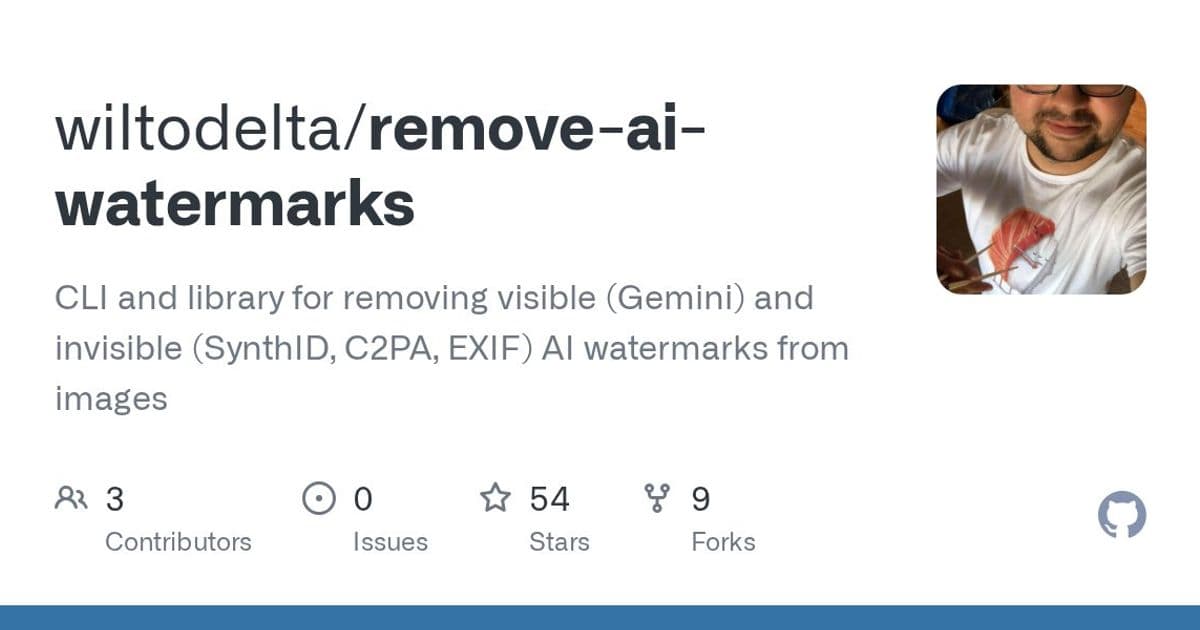
The open‑source `remove‑ai‑watermarks` library lets users strip visible logos, invisible fingerprints, and provenance metadata from images generated by popular AI models. While many developers praise its technical ingenuity and privacy benefits, critics warn it could undermine emerging regulations and artist protections. This article examines the community’s mixed reaction, the tool’s underlying methods, and the broader implications for AI‑generated content.
AI Watermark Removal Tools Spark Debate Over Transparency, Privacy, and Creative Rights
The release of the remove‑ai‑watermarks package has quickly become a touchstone in discussions about how the AI‑generated image ecosystem should handle provenance. The library bundles a command‑line interface and a Python API that can:
- Reverse‑engineer Google Gemini’s “Nano Banana” sparkle logo using a known alpha map.
- Erase invisible fingerprints such as SynthID, StableSignature, and TreeRing via diffusion‑based regeneration.
- Strip C2PA, EXIF, XMP, and the “Made with AI” metadata that social platforms read to label content.
- Optionally add film grain and chromatic aberration to fool downstream classifiers.
Why the Tool Resonates With Developers
A Practical Answer to a Growing Pain Point
Since the rollout of mandatory provenance markers in the EU AI Act and the US COPIED Act, creators have been forced to carry visible or invisible tags that can’t be easily removed without specialized software. For hobbyists and small studios, the friction of integrating multiple vendor‑specific SDKs or paying for commercial scrubbing services is a real blocker. The open‑source approach offers a single, pip‑installable command that works on everything from a single PNG to an entire directory of mixed‑format assets.
Technical Elegance
- Visible watermark removal uses a deterministic reverse‑alpha blending formula. The three‑stage Normalized Cross‑Correlation (NCC) detector dynamically finds the logo’s scale and position, so the process survives cropping or resizing.
- Invisible watermark removal leverages a diffusion pipeline (default SDXL profile) that adds controlled noise, denoises, and decodes back to pixels. The pipeline runs in roughly 0.05 s per image for visible removal and a few seconds for invisible removal on a consumer‑grade GPU, making it feasible for batch jobs.
- Human‑face protection extracts faces with YOLO before diffusion, then blends them back to avoid the typical “AI‑blur” artifacts.
Developers appreciate that the codebase re‑uses well‑known components—VAE encoders, Hugging Face model loading, and YOLOv8—rather than reinventing the wheel. The repository also ships with a web demo at https://raiw.cc, lowering the barrier for non‑technical users.
Community Sentiment: Adoption Signals
| Platform | Signal | Interpretation |
|---|---|---|
| GitHub stars (as of May 2026) | 2.3 k | Strong interest from the open‑source community |
| pipx/uv download counts | 12 k+ installs | Indicates real‑world usage beyond curiosity |
| Reddit r/StableDiffusion threads | Frequent “how‑to” posts | Users are actively integrating the CLI into pipelines |
| Hacker News comments | Mixed – praise for privacy, concerns about misuse | Reflects the broader ethical split |
Many users cite the privacy angle: removing EXIF fields that embed API keys, session IDs, or user handles. A developer from a fintech startup wrote, “We needed to publish AI‑enhanced charts without leaking our internal model version numbers. This tool let us do that in a CI step without a custom script.”
Counter‑Perspectives: Legal and Ethical Friction
Regulatory Backlash
Several jurisdictions have begun to criminalise the removal of provenance markers when intent to deceive is proven. The US COPIED Act (2025) and China’s Deep Synthesis Regulation (2025) both make it illegal to strip mandated labels for the purpose of misrepresentation. While the library’s README includes a disclaimer, the ease of use could still lower the barrier for illicit activity.
Artist Protection Concerns
Artists who embed defensive perturbations—such as Nightshade or Glaze—to prevent their work from being harvested for training data see tools like this as a direct threat. The repository explicitly marks those protections as “out of scope,” but the broader community worries that the same diffusion‑based approach could be adapted to neutralise those safeguards.
Technical Arms Race
The SynthID‑Image v2 payload, introduced in late 2025, encodes a 136‑bit identifier that can survive aggressive compression. The current SDXL profile defeats it in most tests, but Google’s roadmap hints at future, more resilient fingerprints. As developers iterate on removal pipelines, providers may respond with frequency‑domain watermarks that survive diffusion, potentially leading to an endless cat‑and‑mouse game.
Where the Debate Converges
- Transparency vs. Privacy – Users want control over what data travels with their images, but regulators argue that provenance is essential for combating misinformation.
- Open‑source empowerment vs. misuse risk – The same code that protects a photographer’s workflow can be repurposed to hide AI‑generated deepfakes.
- Technical feasibility vs. legal enforceability – Even if a tool can strip a watermark, the originating service may retain server‑side logs linking the image to a user, limiting the practical anonymity the tool promises.
Looking Ahead
The repository’s roadmap mentions automated regression tests for SynthID‑Image v2 and expanded support for AVIF/HEIF containers. A separate video‑focused package, noai‑video, is already in planning, hinting at a broader ecosystem of “privacy‑first” AI‑content tools.
What will shape the next wave of community sentiment?
- Policy clarity – Clear guidance on when removal is lawful could steer developers toward responsible use cases.
- Tooling for provenance verification – If platforms provide easy ways to verify rather than just detect watermarks, the incentive to strip them may diminish.
- Artist‑centric standards – Collaborative standards that distinguish protective perturbations from regulatory watermarks could reduce the perceived conflict.
Until those questions are resolved, the conversation around remove‑ai‑watermarks will likely stay lively, reflecting the broader tension between open‑source freedom and the emerging need for trustworthy AI‑generated media.
For a hands‑on look, try the online demo or install the CLI via pipx install git+https://github.com/wiltodelta/remove-ai-watermarks.git. The repository also includes a thorough README, licensing under MIT, and a clear disclaimer about lawful usage.
Comments
Please log in or register to join the discussion