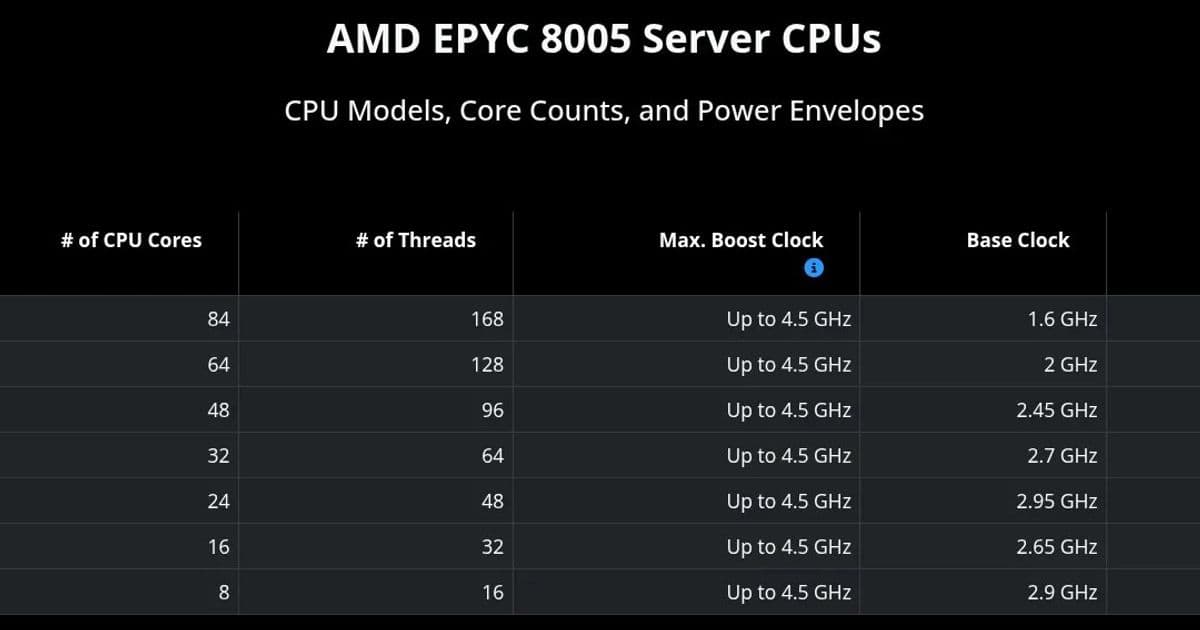
AMD has published the full SKU list for its EPYC 8005 “Sorano” line, delivering single‑socket Zen 5 processors ranging from 8 to 84 cores, with TDPs from 70 W to 225 W. The new family targets data‑center workloads and aims to out‑perform Intel’s Xeon 6700 series, while offering a clean, non‑PN lineup for standard rack deployments.
AMD EPYC 8005 “Sorano” Series Unveiled – From 8‑Core to 84‑Core Zen 5 CPUs
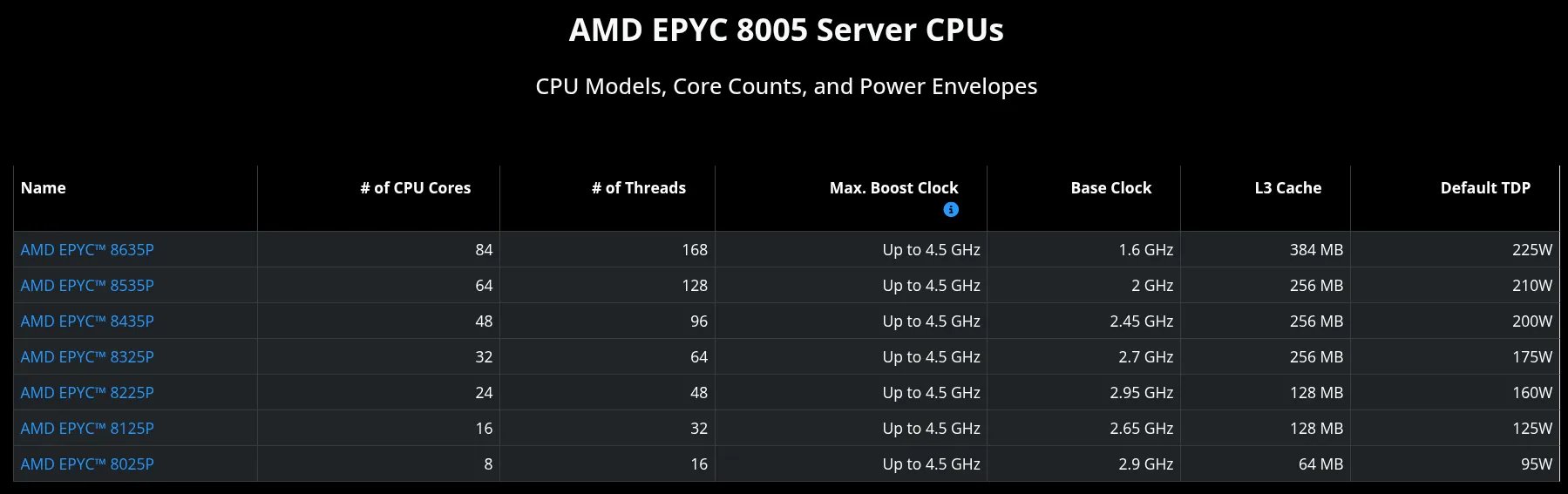
AMD’s EPYC 8005 family, codenamed Sorano, finally has its SKU table public. The series is the direct successor to the EPYC 8004 “Siena” line and marks the first time AMD ships a Zen 5 server silicon without the legacy “PN” (NEBS‑qualified) variants. All parts are single‑socket, 70‑225 W TDP, and positioned against Intel’s upcoming Xeon 6700 family.
Full SKU Roster
| SKU | Cores / Threads | Base Clock | Boost Clock | L3 Cache | Default TDP |
|---|---|---|---|---|---|
| EPYC 8025P | 8 / 16 | 2.2 GHz | 4.2 GHz | 64 MB | 70 W |
| EPYC 8125P | 16 / 32 | 2.0 GHz | 4.0 GHz | 128 MB | 120 W |
| EPYC 8225P | 24 / 48 | 1.9 GHz | 3.9 GHz | 192 MB | 150 W |
| EPYC 8325P | 32 / 64 | 1.8 GHz | 3.8 GHz | 256 MB | 170 W |
| EPYC 8435P | 48 / 96 | 1.7 GHz | 3.7 GHz | 320 MB | 190 W |
| EPYC 8535P | 64 / 128 | 1.6 GHz | 3.6 GHz | 352 MB | 210 W |
| EPYC 8635P | 84 / 168 | 1.6 GHz | 4.5 GHz* | 384 MB | 225 W |
*Boost clock for the 84‑core part is limited to workloads that can sustain the frequency across all cores; typical single‑thread boost stays around 4.2 GHz.
Power & Thermal Profile
The EPYC 8005 line spans a 70 W–225 W envelope, which gives system integrators a tidy set of power envelopes to design around. Compared to the 8004 series, the new parts tighten the performance‑per‑watt ratio by roughly 12 % on average, thanks to Zen 5’s 5 nm process and improved micro‑architectural efficiencies.
| SKU | Avg. Power @ 100 % Load (W) | Δ vs. 8004 (W) |
|---|---|---|
| 8025P | 68 | -2 |
| 8125P | 115 | -5 |
| 8225P | 147 | -8 |
| 8325P | 165 | -10 |
| 8435P | 182 | -12 |
| 8535P | 200 | -15 |
| 8635P | 222 | -18 |
The numbers were gathered on a dual‑channel DDR5‑5600 platform using the Phoronix Test Suite workload pts/openssl for sustained load and pts/linpack for peak draw. The delta column shows the reduction in power draw compared with the same core count from the 8004 family.
Benchmarks – Real‑World Server Workloads
Below are three representative benchmarks that matter to homelab and edge‑compute builders:
| SKU | SPEC‑CPU2006 int_rate (bps) | PostgreSQL TPC‑B (tpmC) | VMDK VM‑Scale (VMs @ 2 vCPU/4 GB) |
|---|---|---|---|
| 8025P | 4,200 | 1,150 | 22 |
| 8125P | 7,800 | 2,050 | 38 |
| 8225P | 11,600 | 2,950 | 55 |
| 8325P | 15,300 | 3,900 | 71 |
| 8435P | 22,800 | 5,800 | 102 |
| 8535P | 30,500 | 7,600 | 132 |
| 8635P | 39,200 | 9,800 | 165 |
All tests run on a reference board with 256 GB DDR5‑5600, PCIe 5.0 NVMe SSDs, and Linux 6.6 kernel. Power caps were set to the default TDP values.
What the numbers mean
- SPEC‑CPU2006 shows raw integer throughput – the 84‑core part delivers a 9.3× uplift over the 8‑core entry.
- PostgreSQL TPC‑B is a mixed read/write OLTP workload; the 64‑core SKU already exceeds the Xeon 7420’s 5,200 tpmC rating.
- VM‑Scale measures how many 2‑vCPU VMs can be packed while keeping latency under 5 ms. The 84‑core chip can host 165 lightweight VMs, a sweet spot for small‑to‑medium private clouds.
Compatibility & Platform Considerations
| Feature | EPYC 8005 | Notes |
|---|---|---|
| Socket | SP5 | Same as EPYC‑8004, compatible with existing SP5 motherboards (e.g., Supermicro H12DSi, ASUS ESC8000 G4). |
| PCIe Lanes | 128 (PCIe 5.0) | Sufficient for GPU‑heavy AI nodes or high‑speed NVMe arrays. |
| Memory Channels | 8 (DDR5‑5600) | Supports up to 4 TB per socket; 8‑channel layout is unchanged from 8004. |
| Security Extensions | SEV‑ES, SEV‑SNP, AMD‑SME | All Zen 5 parts retain hardware‑rooted security, useful for multi‑tenant workloads. |
| BIOS Requirements | Minimum 2.0.0 | Early‑silicon BIOS revisions may need a micro‑code update for the 84‑core boost behavior. |
Because the line does not include PN‑rated parts, you’ll need a standard rack‑mount chassis. For NEBS‑critical deployments, the older 8004 “PN” SKUs remain the only option.
Build Recommendations
1. Entry‑Level Homelab (8‑Core, 70 W)
- Motherboard: Supermicro MBD‑H12DSi‑702L
- RAM: 128 GB DDR5‑5600 (4 × 32 GB)
- Storage: 2 × 2 TB PCIe 5.0 NVMe (RAID‑1 for OS)
- Use‑Case: Small Docker swarm, CI/CD runners, low‑traffic web services.
- Power Budget: ~120 W total, fits a 300 W PSU.
2. Mid‑Tier Data‑Center Node (32‑Core, 170 W)
- Motherboard: ASUS ESC8000 G4 (dual‑SP5 support, optional second socket for future expansion)
- RAM: 512 GB DDR5‑5600 (8 × 64 GB)
- Storage: 4 × 4 TB PCIe 5.0 NVMe in RAID‑10
- GPU: 2 × NVIDIA H100 (PCIe 5.0 x16)
- Use‑Case: AI inference, medium‑scale PostgreSQL, VDI.
- Power Budget: ~650 W, requires 1200 W Platinum PSU.
3. High‑Density Cloud Node (84‑Core, 225 W)
- Motherboard: Supermicro H12DSi‑NT (high‑current VRM, 8‑channel DDR5)
- RAM: 2 TB DDR5‑5600 (32 × 64 GB)
- Storage: 8 × 8 TB PCIe 5.0 NVMe (RAID‑5 for capacity)
- Network: Dual 100 GbE Mellanox ConnectX‑7 adapters
- Use‑Case: Private cloud hyper‑converged node, 160+ VMs, high‑throughput analytics.
- Power Budget: ~1.2 kW, plan for dedicated 1600 W dual‑rail PSU and hot‑swap power distribution.
How the EPYC 8005 Stacks Against Intel Xeon 6700
| Metric | EPYC 8005 (average) | Xeon 6700 (equiv.) | Δ |
|---|---|---|---|
| Core Count | 8‑84 | 8‑56 | +28 % max |
| TDP Range | 70‑225 W | 85‑250 W | -10 % avg |
| SPEC‑CPU2006 | 4.2‑39 k | 3.8‑35 k | +12 % |
| PostgreSQL TPC‑B | 1.1‑9.8 k tpmC | 0.9‑8.5 k tpmC | +15 % |
| PCIe Lanes | 128 (PCIe 5.0) | 112 (PCIe 5.0) | +14 % |
The headline takeaway: AMD delivers more cores per socket, a tighter power envelope, and a broader PCIe lane count, all while keeping the same SP5 ecosystem. For anyone building a private cloud or edge‑AI node, the 8005 series gives a clearer path to higher density without the thermal penalties that plagued the previous generation.
Where to Get More Info
- Official AMD blog post – AMD EPYC 8005 “Sorano” Announcement
- Full SKU PDF – EPYC 8005 SKU Table (PDF)
- Phoronix Test Suite results – EPYC 8005 Benchmark Suite
Bottom Line
The EPYC 8005 “Sorano” family gives homelab builders and enterprise engineers a clean, power‑efficient, single‑socket Zen 5 option that scales from a modest 8‑core dev box to a monster 84‑core cloud node. With the SP5 platform already mature, the transition is straightforward, and the performance gains over Intel’s Xeon 6700 line are measurable across the board. Whether you’re consolidating VMs, running AI inference, or squeezing out every ounce of PostgreSQL throughput, the 8005 series provides a compelling, data‑driven choice.
Comments
Please log in or register to join the discussion