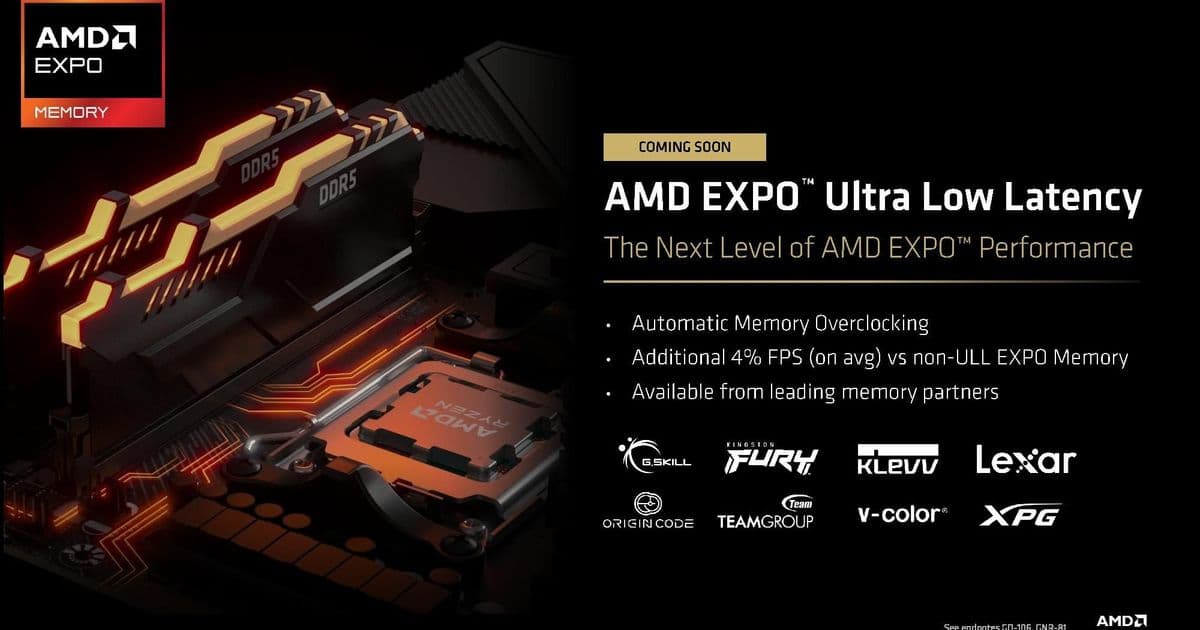
MSI, Asus, and Gigabyte have started rolling EXPO Ultra Low Latency support down to X670, B650, and even budget A620 boards, bringing AMD's certified memory subtiming profiles to AM5 owners who don't want to tune by hand. The payoff is modest but real: up to 4% more gaming FPS on non-X3D chips, provided you own a compatible kit with the tweaks baked into its SPD.
AMD's EXPO Ultra Low Latency (ULL) feature, announced at Computex this month, is no longer confined to the newest hardware. The first wave of 600-series motherboards has begun receiving the profile through fresh AGESA 1.3.0.1b BIOS releases, extending a memory tuning option that previously shipped mainly on 800-series boards down to the platform most AM5 users actually own.
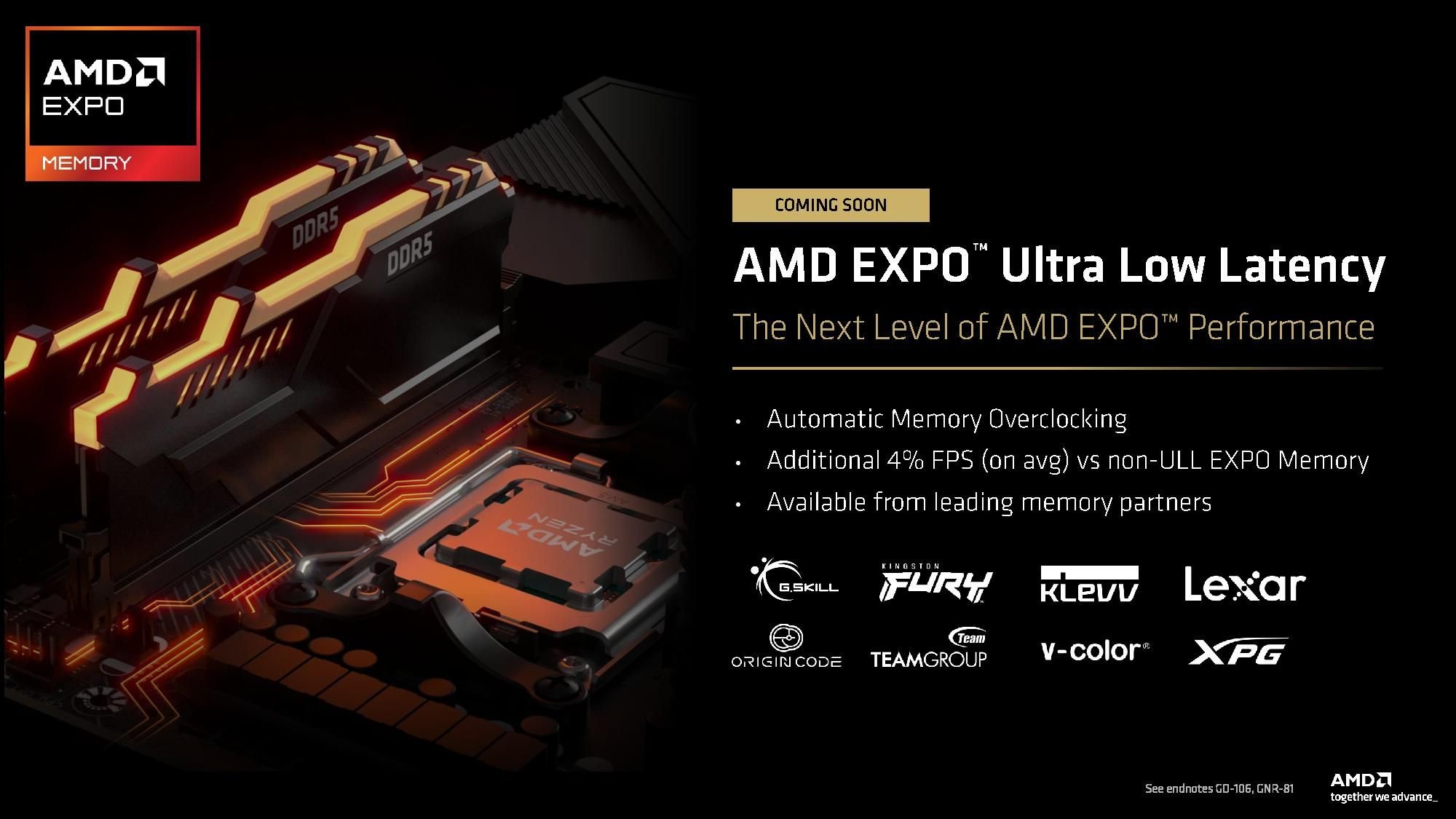
The underlying microcode, part of the EXPO 1.2 update, has been visible in BIOS releases since April, and 800-series boards have carried ULL for a while. What changed over the past two weeks is the backport. Vendors are now folding the same certification into X670, X670E, B650, and even entry-level A620 firmware, closing the gap between the halo chipsets and the mainstream silicon that ships in far higher volume.
What ULL actually does
EXPO Ultra Low Latency targets a specific weakness of the AM5 platform: the latency penalty that AMD's memory controller and Infinity Fabric topology add on top of the raw DRAM timings. By tightening a set of memory subtimings beyond the standard EXPO profile, ULL trims the round-trip cost of memory accesses. AMD quotes gaming uplifts of up to 4% on CPUs without 3D V-Cache.
The benefit narrows on X3D parts. Chips like the Ryzen 7 7800X3D and 9800X3D carry a large stacked SRAM cache, and that extra on-die memory absorbs many requests that would otherwise hit DRAM. The result is reduced sensitivity to finer memory adjustments, so an X3D owner will see less from ULL than someone running a standard eight-core part. The feature also helps most when a kit forces a 2:1 clock ratio between the memory controller (UCLK) and the DRAM (MEMCLK), a regime common on high-frequency kits above roughly 6,400 MT/s, though even a baseline 6,000 MT/s CL30 configuration can pick up a few points.
There is an important hardware caveat. ULL is not purely a firmware switch. The optimized subtimings are written into the physical SPD of compatible memory, so you need a new ULL-rated kit to get the one-click profile. A BIOS update alone will not retrofit the feature onto existing sticks. In practice, AMD is codifying tuning that overclockers have done manually for years into an official certification, which means the determined can still replicate the subtimings entry by entry on older kits, at the usual risk of instability. Given current DRAM pricing, that manual route may appeal to anyone unwilling to buy new memory.
Where each vendor stands
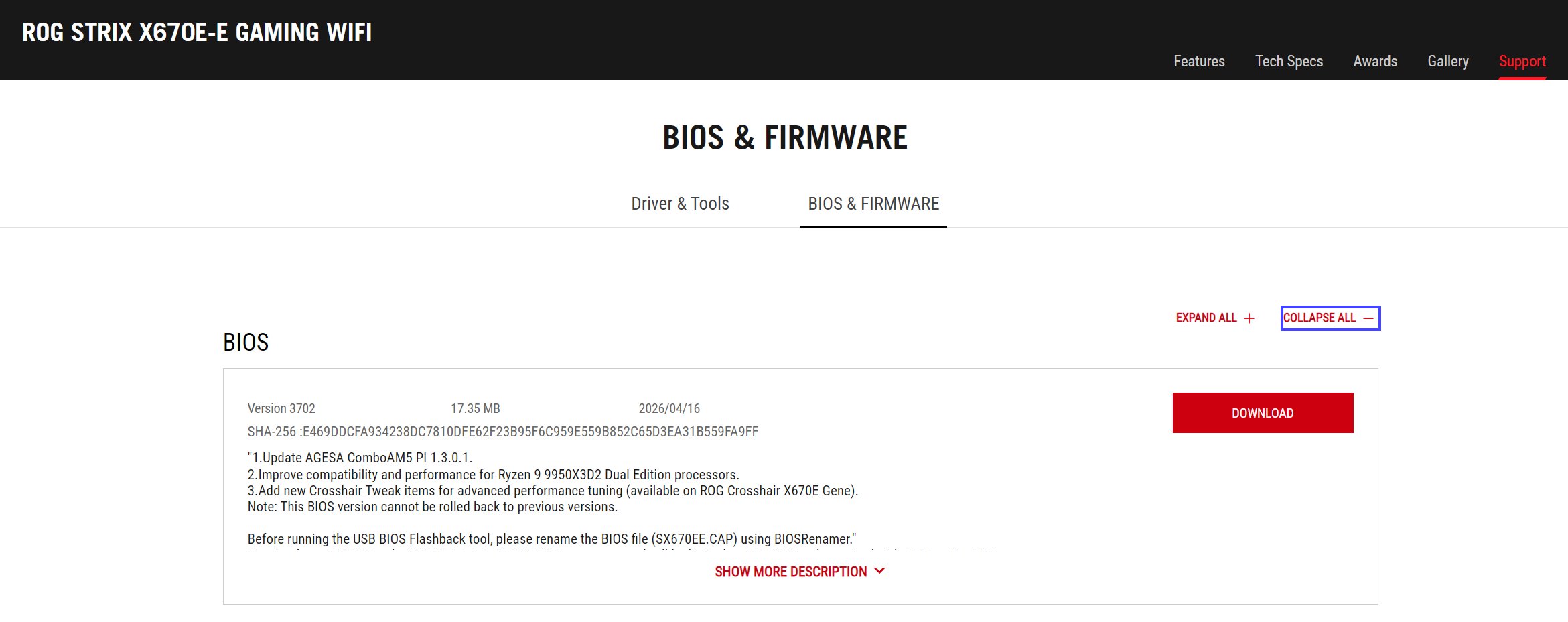
Asus has pushed AGESA 1.3.0.1b beta BIOSes to a broad slice of its X670 stack, including the X670E Hero, X670E Gene, X670 Extreme, X670E-A Gaming Wi-Fi, X670E-E Gaming Wi-Fi, X670E-F Gaming Wi-Fi, and X670 Creator Wi-Fi. The X670E-I Gaming Wi-Fi, X670E-Plus, and X670-E Plus Wi-Fi are still waiting. These are beta releases and carry the usual caveat that they are not aimed at typical users. Asus B650 boards have not yet moved to 1.3.0.1b; a manual sweep of those support pages shows them sitting on older 1.3.0.0 or 1.3.0.1 builds with no explicit ULL mention.
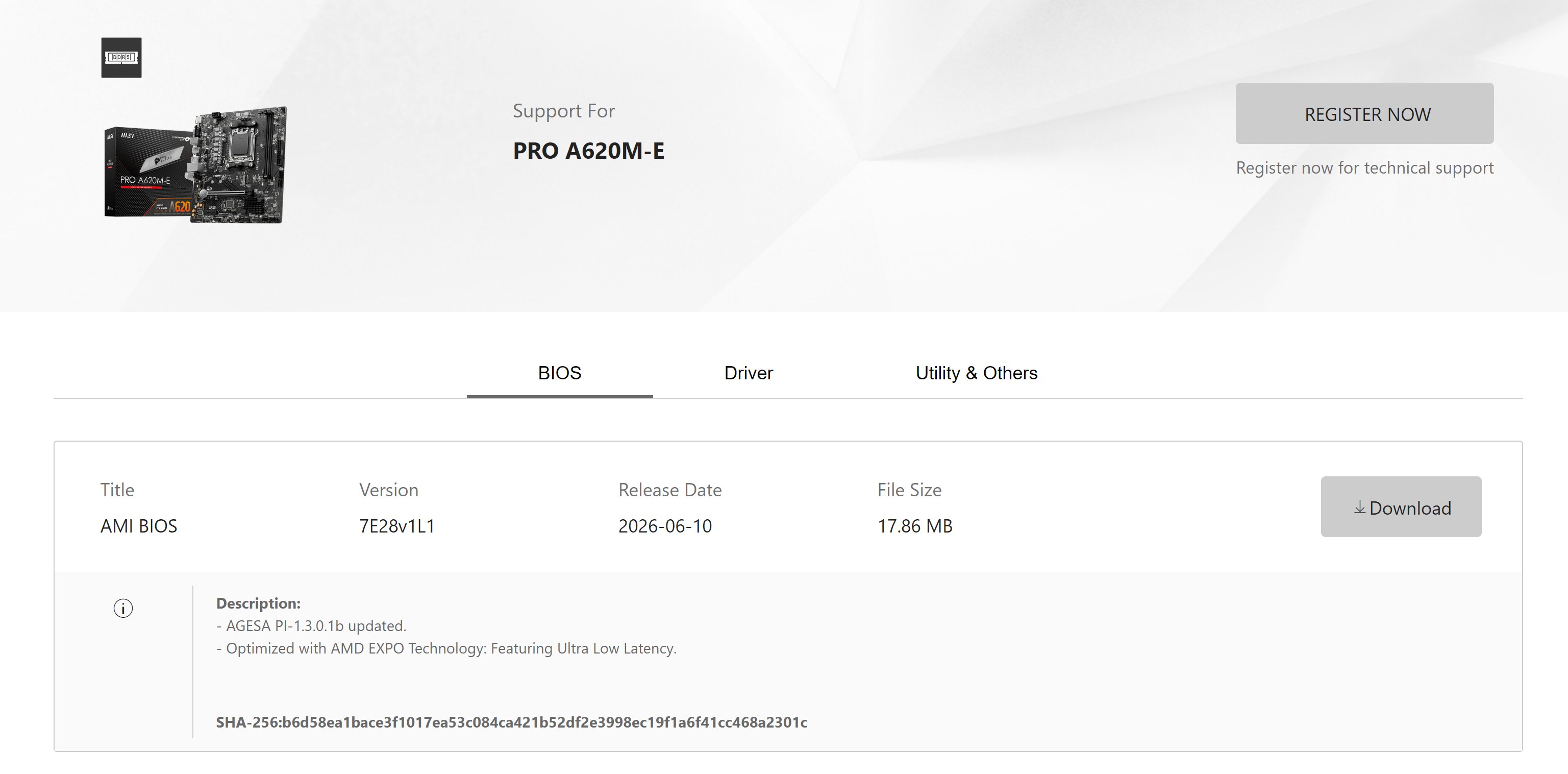
MSI has the widest deployment so far. Its X670E boards moved to 1.3.0.1b with EXPO ULL called out directly in the release notes, while non-E X670 models picked up Ultra Low Latency through 1.3.0.1 BIOSes in the same window. Some boards got there earlier than most people noticed: the MAG X670-E Tomahawk Wi-Fi quietly added ULL on May 27th with its 1.3.0.1 update. MSI has also refreshed its B650 lineup with 1.3.0.1b this week, with ULL listed for every model checked, down to the budget A620 tier.
Gigabyte follows the same pattern, with its full B650 and X670/X670E range carrying the latest AGESA and Ultra Low Latency confirmed in the patch notes.
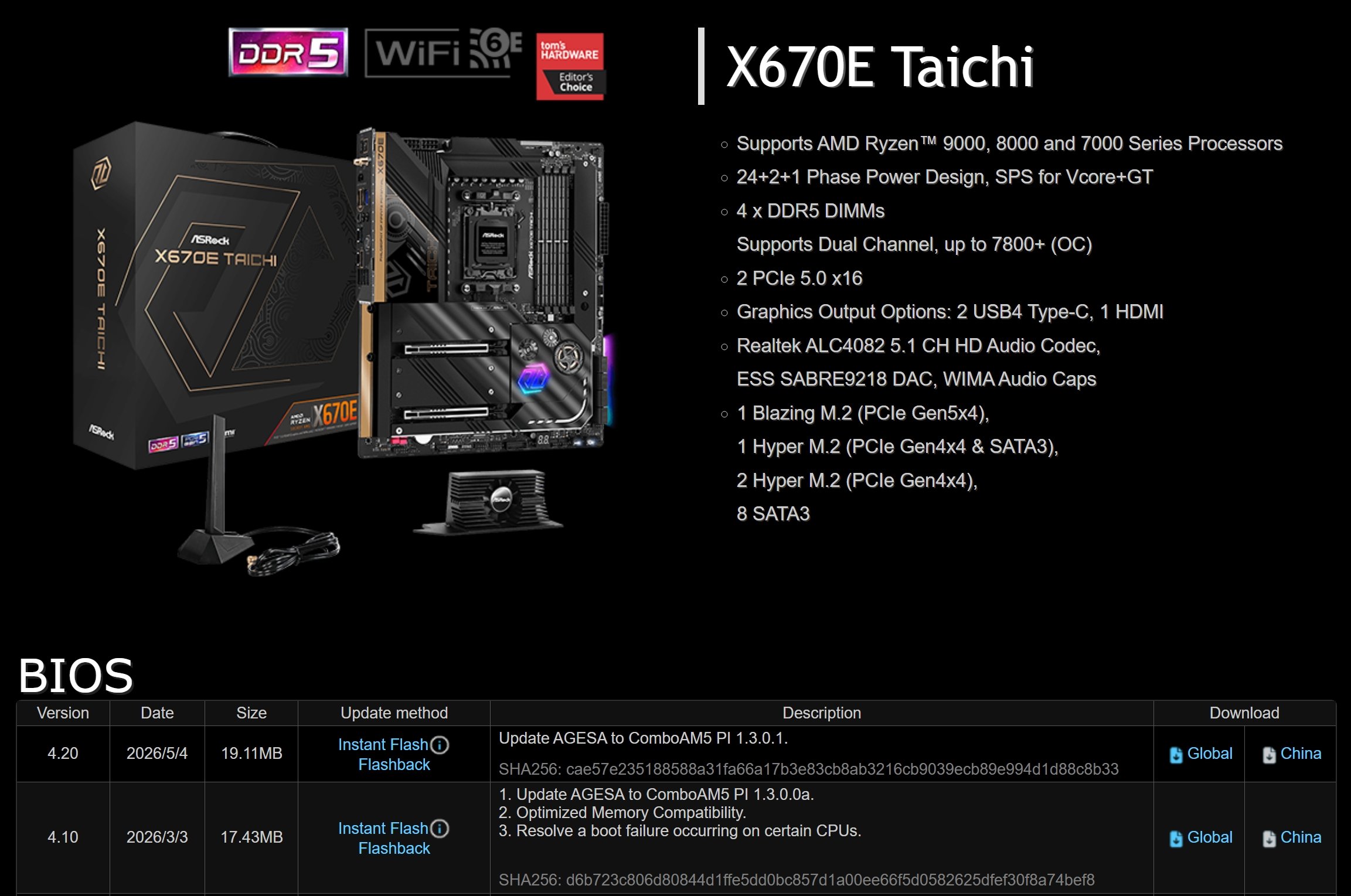
ASRock is the outlier. None of its boards, not even the flagship X870E models, have reached 1.3.0.1b; they remain on 1.3.0.1. The release notes there only cite "Optimized Memory Compatibility," and the February and March dates on those builds make it unlikely that phrasing refers to EXPO ULL.
Why the rollout matters
For buyers, the practical takeaway is that EXPO ULL is becoming a standard platform feature rather than an 800-series exclusive, which removes one reason to pay up for a newer chipset purely for memory tuning headroom. A 4% gaming gain is not large in isolation, but it is essentially free performance for non-X3D owners who already plan to buy a ULL-compatible kit, and it requires no manual overclocking knowledge.
The gating factor remains memory availability. Because the optimizations live in the SPD, the value of these BIOS updates is unlocked only once ULL-certified kits are sitting in systems. Until that inventory is broad and affordable, the firmware groundwork laid this month is a readiness step more than an immediate upgrade. AMD's documentation on EXPO and platform memory support is available at amd.com, and motherboard owners should pull BIOS files directly from their vendor's support page rather than third-party mirrors, particularly while many of these releases remain in beta.
Comments
Please log in or register to join the discussion