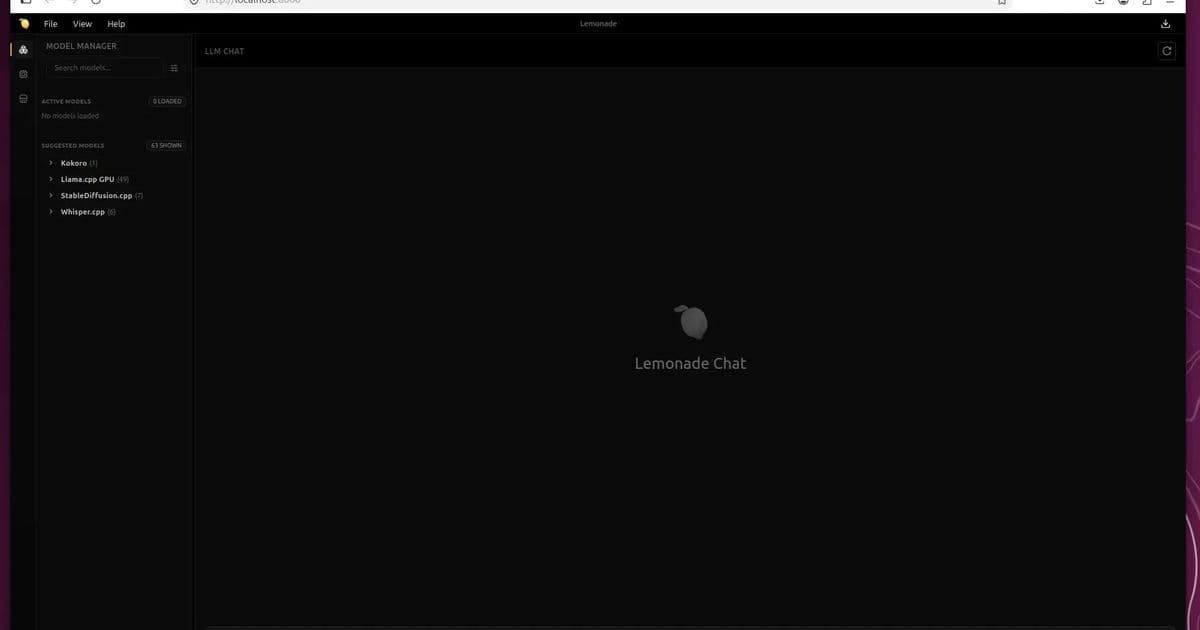
AMD's Lemonade local AI server now offers embeddable release artifacts, making it easier for developers to integrate AI capabilities into their applications without requiring separate installations.
AMD is making it significantly easier for developers to embed AI capabilities into their applications through the Lemonade local AI server. The latest Lemonade 10.2 release introduces embeddable artifacts that allow developers to bundle the AI stack directly into their apps, eliminating the need for separate installations or additional dependencies.
What's New in Lemonade 10.2
The embeddable version of Lemonade contains only the essential components needed for AI functionality: the Lemond daemon, Lemonade CLI, and associated resource files. This stripped-down package excludes the web app, Electron components, and other code that isn't necessary for embedded use cases.
According to AMD's documentation, "Embeddable Lemonade is a binary version of Lemonade that you can bundle into your own app to give it a portable, auto-optimizing, multi-modal local AI stack. This lets users focus on your app, with zero Lemonade installers, branding, or telemetry."
Key Features and Capabilities
Hardware Support
Lemonade continues to support a wide range of hardware for AI workloads:
- Ryzen AI NPUs on Linux platforms
- AMD Radeon GPUs for accelerated AI processing
- Common x86_64 CPUs for baseline performance
- Microsoft Windows support for cross-platform compatibility
Model Support
The embeddable version maintains full support for various AI models across different hardware types, including:
- LLMs (Large Language Models) optimized for GPUs, NPUs, and CPUs
- Qwen image models for visual AI tasks
- GGUF and RAI models with improved automatic downloading capabilities
- OpenCode integration for code-related AI tasks
Developer Benefits
The new embeddable artifacts offer several advantages for application developers:
- Simplified Integration: Developers can bundle Lemonade directly into their applications without requiring users to install separate software
- Zero Branding: The embedded version removes all Lemonade branding and telemetry, allowing developers to maintain their app's identity
- Cross-Platform Compatibility: Available for both Linux and Windows, supporting a wide range of deployment scenarios
- Auto-Optimization: The system automatically optimizes AI workloads based on available hardware
Technical Implementation
The embeddable Lemonade release artifacts are designed to be straightforward to integrate. Developers can include the binary version of Lemonade in their application package, and the system handles the rest. The documentation provides detailed guidance on runtime integration, backend configuration, and model support.
Open Source Foundation
Lemonade remains open-source under the Apache 2.0 license, ensuring transparency and community involvement in its development. AMD engineers continue to be heavily involved in the project, driving rapid advancement of the local AI server capabilities.
Getting Started
Developers interested in embedding Lemonade into their applications can access the new embeddable artifacts and documentation through the official GitHub repository. The release includes comprehensive documentation covering embed use cases, runtime integration, and backend/model support.
Performance Considerations
While specific benchmark data isn't provided in the announcement, the embeddable version maintains the same hardware acceleration capabilities as the full Lemonade server. This means applications can leverage:
- NPU acceleration on Ryzen AI processors for efficient AI inference
- GPU acceleration on AMD Radeon cards for high-performance workloads
- CPU fallback for systems without dedicated AI hardware
Future Implications
The move to make Lemonade more embeddable represents a significant step toward broader adoption of local AI capabilities in desktop applications. By removing installation barriers and simplifying integration, AMD is positioning Lemonade as a viable option for developers looking to add AI features without relying on cloud services.
This approach also aligns with growing privacy concerns and the desire for offline AI capabilities, as all processing happens locally on the user's hardware without sending data to external servers.
Availability
Lemonade 10.2 with embeddable artifacts is available now through the official GitHub repository. Developers can download the appropriate binaries for their target platforms and begin integrating local AI capabilities into their applications immediately.
The continued development and improvement of Lemonade demonstrates AMD's commitment to providing accessible AI solutions for the Linux and Windows ecosystems, particularly for users with AMD hardware who want to leverage their system's AI capabilities without cloud dependencies.
Comments
Please log in or register to join the discussion