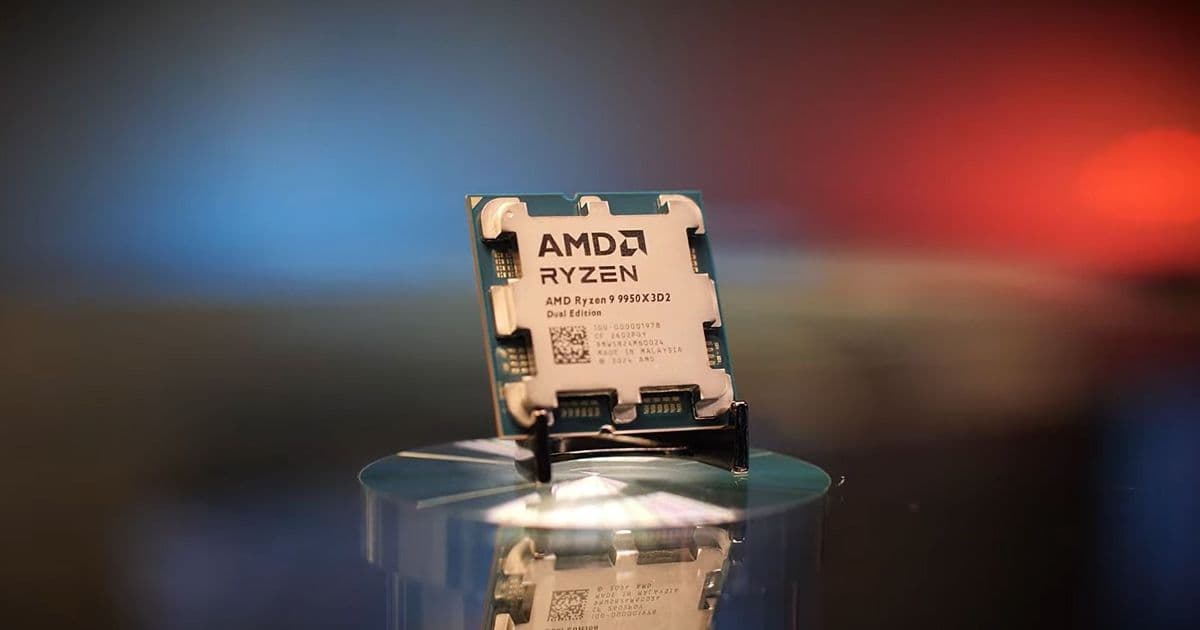
AMD has officially priced its first dual-cache X3D processor, the Ryzen 9 9950X3D2, at $899—$200 more than the standard X3D variant. The chip doubles the cache capacity to 208MB and targets professional workloads rather than gaming, marking a strategic shift in AMD's 3D V-Cache implementation.
AMD has officially announced the pricing for its Ryzen 9 9950X3D2 processor, setting the suggested retail price at $899. This makes the company's first dual-cache X3D CPU $200 more expensive than the original Ryzen 9 9950X3D, which launched at $699. The new processor is set to arrive at retailers on April 22 and will be compatible with existing AM5 socket motherboards, ensuring a straightforward upgrade path for current Ryzen 7000 series users.
The Ryzen 9 9950X3D2 represents a significant technical evolution in AMD's 3D V-Cache technology. Unlike previous X3D processors that featured stacked cache on only one of the chip's two CCDs (Core Complex Dies), the new implementation applies 3D V-Cache technology to both CCDs. This configuration doubles the cache capacity from 144MB to 208MB (16MB L2 cache per CCD plus 192MB of 3D V-Cache), potentially offering substantial performance improvements for certain workloads.
From a technical specifications perspective, the Ryzen 9 9950X3D2 maintains the same core configuration as its non-X3D counterpart: 16 cores and 32 threads with a base clock of 4.3GHz and a maximum boost clock of 5.6GHz. However, the thermal design power has increased to 200W, compared to 170W for the standard Ryzen 9 9950X3D and Ryzen 9 9950X, reflecting the additional power requirements of the doubled cache structure.
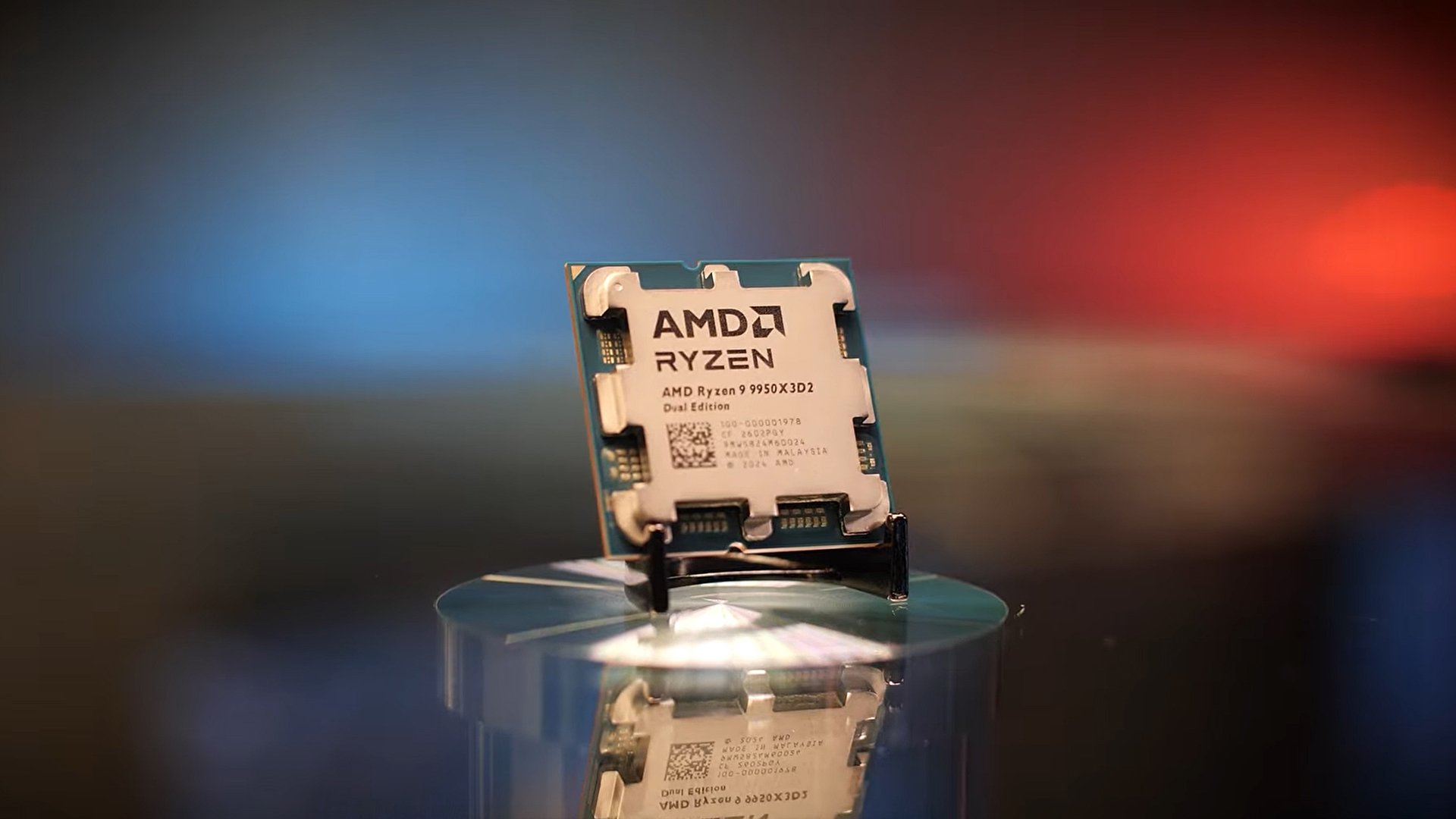
This dual-cache approach addresses a fundamental limitation AMD has faced with its X3D processors. Previous implementations like the Ryzen 9 9950X3D and Ryzen 9 9900X3D only featured 3D V-Cache on a single CCD primarily to avoid the latency penalties associated with inter-CCD communication. When data needs to be transferred between CCDs, it can cause significant latency spikes that would negate the benefits of additional cache for gaming workloads.
However, for professional applications that can better utilize the additional cache capacity across both CCDs, this limitation becomes less critical. AMD is positioning the Ryzen 9 9950X3D2 specifically as a workstation-level chip "built for developers and content creators tackling complex workloads and massive datasets." This strategic positioning represents a clear differentiation from AMD's gaming-focused X3D processors.
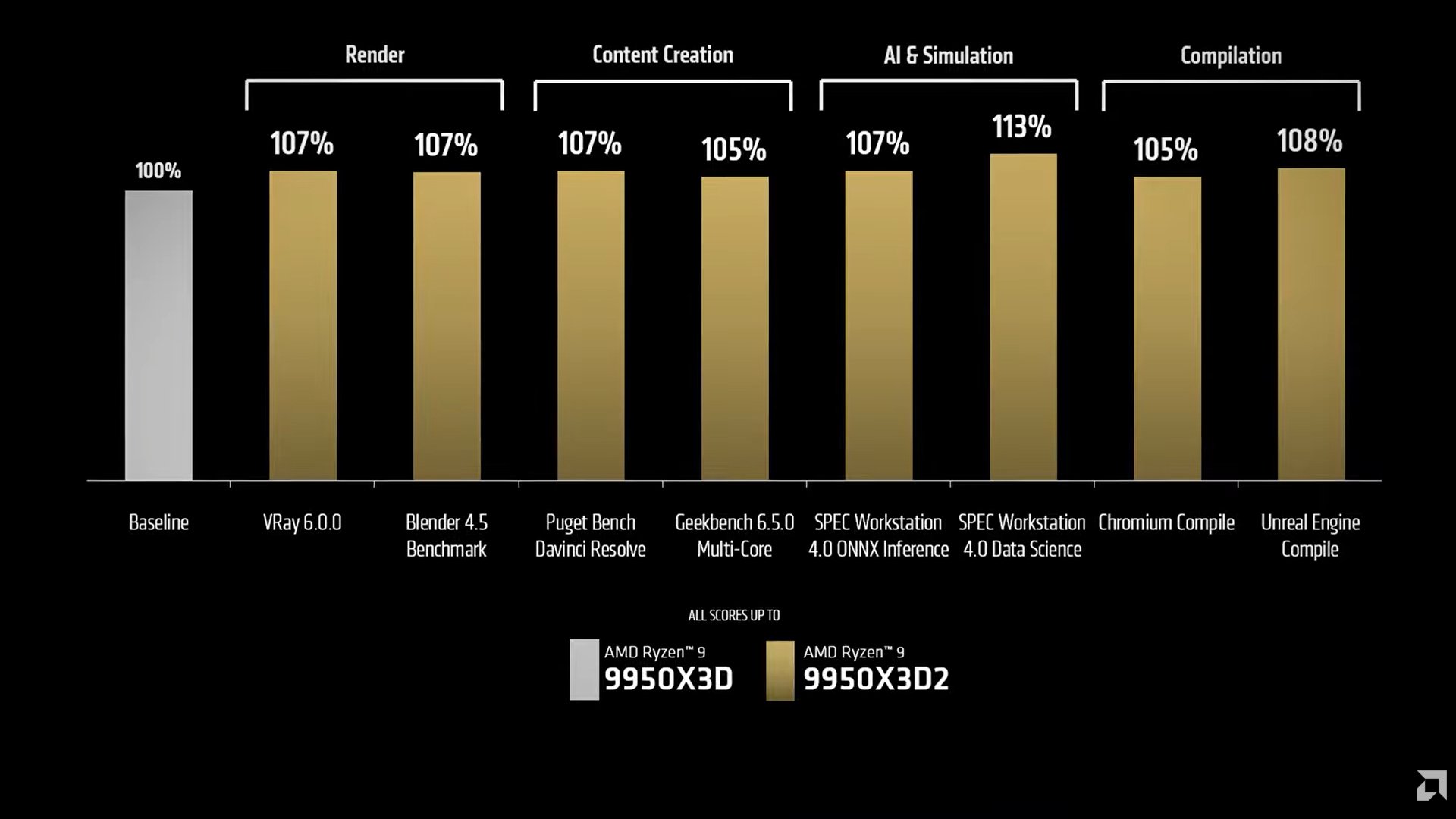
According to AMD's preliminary benchmarks, the Ryzen 9 9950X3D2 delivers up to a 13% improvement in data science workloads via SPECWorkstation 4, with approximately 5% to 8% gains in other professional applications. These performance improvements align with expectations for a doubled cache structure in memory-intensive workloads.
The increased cache capacity comes at a premium price point. At $899, the Ryzen 9 9950X3D2 is positioned as AMD's most expensive consumer processor, significantly higher than the Ryzen 9 9950X at $545 (or $599 MSRP) and even the Ryzen 9 9900X3D at $599. This pricing strategy reflects both the increased manufacturing complexity of dual-cache 3D V-Cache packaging and the target market of professionals who can potentially realize a return on investment through productivity gains.
From a supply chain perspective, the dual-cache implementation presents additional manufacturing challenges compared to single-cache X3D processors. The 3D V-Cache stacking process must be applied to both CCDs, increasing the complexity of the binning process and potentially affecting yields. These factors likely contribute to the higher price point and may limit initial availability.
For gaming performance, industry analysts expect minimal improvements over the standard Ryzen 9 9950X3D. The inter-CCD communication latency that AMD has avoided in gaming-focused X3D processors remains a fundamental limitation. Until AMD develops solutions to reduce inter-CCD latency or implements architectural changes to better handle cross-CCD data access, gaming workloads are unlikely to benefit significantly from the additional cache on the second CCD.
The Ryzen 9 9950X3D2 launch also comes at a time when Intel is preparing its next-generation processors, creating an interesting competitive dynamic in the high-end workstation CPU market. AMD's focus on cache-optimized solutions contrasts with Intel's traditional strength in single-threaded performance and clock speeds.
As the industry continues to push the boundaries of CPU performance through architectural innovations rather than process node improvements, the 3D V-Cache technology represents AMD's strategic approach to extracting additional performance from existing designs. The Ryzen 9 9950X3D2 expands this approach beyond the gaming market, targeting the growing segment of content creators and data professionals who can leverage large cache sizes for improved productivity.
With the official pricing now confirmed, attention turns to real-world performance validation. The Ryzen 9 9950X3D2 will be available starting April 22, and independent testing will provide clarity on its actual performance benefits across different workloads and its value proposition at the $899 price point.
Comments
Please log in or register to join the discussion