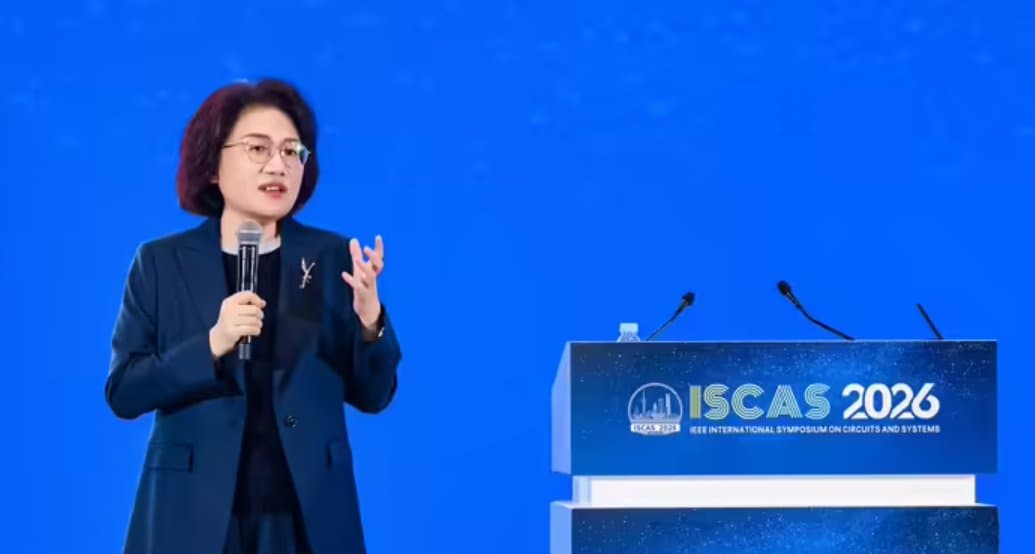
Huawei announces breakthrough logic folding technology for its upcoming Kirin chip, which will debut in the Mate 90 series this autumn, challenging Apple's upcoming iPhone 18 series with improved transistor density and energy efficiency.
Huuma is making a significant comeback in the semiconductor race with the introduction of its new Kirin chip featuring innovative logic folding technology. The company's board member and head of semiconductor business, He Tingbo, revealed this advancement at the 2026 International Symposium on Circuits and Systems (ISCAS 2026) in Shanghai, signaling Huawei's determination to compete at the highest levels of smartphone technology.
The new technology represents a departure from conventional chip design by implementing a dual-layer logic structure instead of traditional single-layer layouts. This approach allows for higher transistor density while improving energy efficiency, addressing two critical challenges in modern semiconductor design. The chip is expected to power Huawei's upcoming Mate 90 series, launching this September, positioning it as a direct competitor to Apple's iPhone 18 series.
Logic folding technology essentially stacks logical components in a more compact arrangement, reducing the physical footprint while maintaining or enhancing computational capabilities. This innovation comes at a crucial time for Huawei, which has faced significant challenges in accessing advanced semiconductor manufacturing due to international sanctions.
At the symposium, Huawei also presented the Tau (τ) Scaling Law, which has been colloquially referred to as "Her's Law" by peers and colleagues in honor of He Tingbo. This scaling framework could have applications beyond smartphones into AI computing and other high-performance computing domains. According to Huawei's roadmap, chips designed using this law are expected to achieve transistor densities equivalent to 14 Å (1.4 nm) processes by 2031.
The timing of this announcement coincides with Huawei's broader strategy to regain market share in the premium smartphone segment. After several years of limited access to cutting-edge chip manufacturing, the company appears to have found alternative approaches to maintain competitiveness.
Industry analysts view this development as significant not just for Huawei but for the broader semiconductor ecosystem. The logic folding approach could influence future chip design methodologies, potentially creating new pathways for performance improvements when traditional scaling approaches face physical limitations.
The Mate 90 series launch will be closely watched by competitors and industry observers alike. If Huawei delivers on the promised performance and efficiency gains, it could mark a turning point in the company's technological journey and reshape competitive dynamics in the global smartphone market.
For more technical details on the Tau Scaling Law and logic folding technology, interested readers can refer to the presentations from ISCAS 2026 and Huawei's upcoming technical white papers on the subject.
Comments
Please log in or register to join the discussion