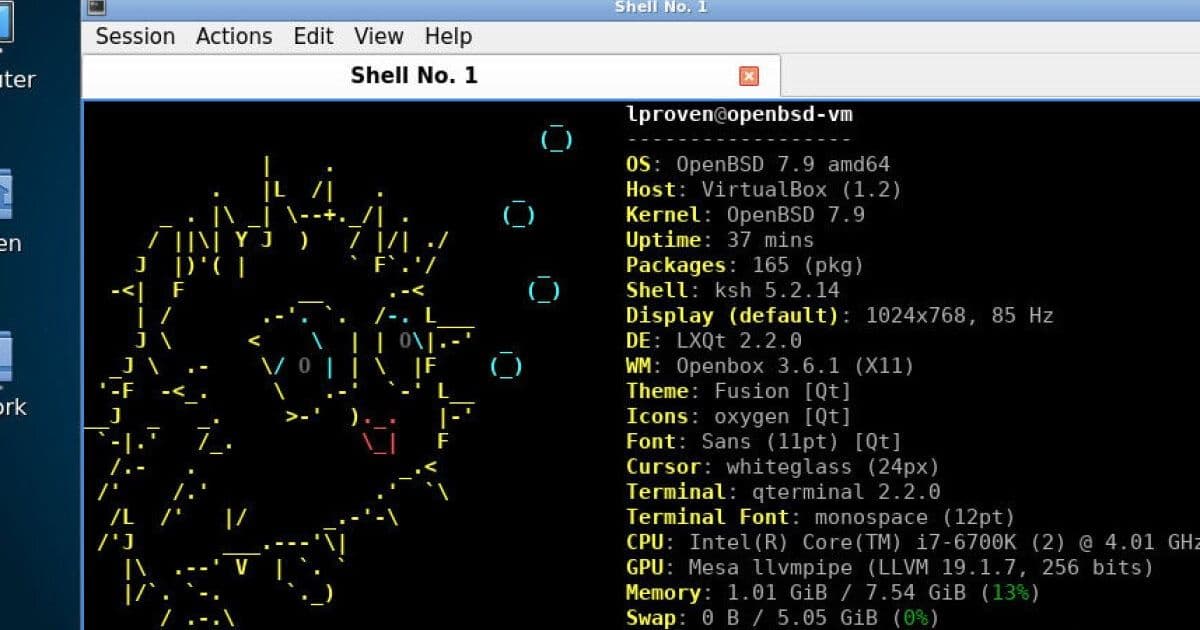
The 60th release of OpenBSD introduces significant improvements in hardware support, security features, and desktop capabilities while maintaining the project's commitment to security and simplicity.
OpenBSD 7.9 marks the project's 60th release, continuing its tradition of providing a secure, clean Unix-like operating system system. Released shortly after project lead Theo de Raadt's birthday, this version introduces several notable enhancements while maintaining the project's security-first philosophy.
Hardware Support and Performance Improvements
OpenBSD 7.9 brings significant hardware support improvements, particularly for modern systems. On x86-64 (amd64) machines, the operating system now supports up to 255 processor cores, a substantial increase from previous limitations. The release also addresses a critical bug affecting systems with more than 512GB of RAM, ensuring stability for high-memory configurations.
The disk partitioning capabilities have been expanded to support up to 52 partitions per disk. This limitation was imposed by the number of available letters in the Roman alphabet, which OpenBSD uses for partition labels. Internally, the system can handle up to 64 partitions, but the practical limit remains the 52-character label system.
A noteworthy improvement is the enhanced CPU scheduler, which now understands heterogeneous CPU cores with different performance levels. The scheduler assigns processes to four distinct performance levels denoted by the letters S-P-E-L (SMT, performance, efficient, and lethargic). This granular control improves power management efficiency, particularly important for mobile devices and servers.
Security Enhancements
OpenBSD continues to demonstrate its commitment to security with several improvements in version 7.9. The project recently addressed a 27-year-old TCP/IP vulnerability involving malformed Selective Acknowledgement options that could crash the kernel. While this vulnerability didn't allow unauthorized access, it represented a potential denial-of-service vector. The fix was implemented in OpenBSD 7.8 and is included in this release.
The project maintains its strict approach to potentially problematic technologies. Notably, OpenBSD still does not support Bluetooth at all, a deliberate choice to eliminate potential attack vectors. This ascetic approach to computing aligns with the project's philosophy of security through simplicity.
Regarding AI-assisted code, OpenBSD has taken a measured approach. While the project includes tmux, which recently incorporated LLM-assisted code for DECSET 2026 support, no directly AI-generated code has been committed to OpenBSD itself. According to Theo de Raadt, this is unlikely to change due to copyright concerns. The tmux changes were accepted because OpenBSD has included tmux in its base system since 2009.
New Features and Improvements
Version 7.9 introduces several new capabilities while maintaining the project's characteristic simplicity:
- Delayed Hibernation: A power management feature that prevents data loss by waking up a suspended laptop before the battery completely drains, then immediately hibernating the system to prevent corruption.
- RISC-V Support: Enhanced compatibility with RISC-V boards, expanding the operating system's hardware ecosystem.
- Wi-Fi 6: Basic support for Wi-Fi 6 standards, though the firmware must be downloaded separately during installation.
- Graphics Stack: Updated graphics driver stack from Linux kernel 6.18, improving hardware compatibility.
- Audio Stack: Further optimizations to the already-low-latency sound driver stack.
Desktop Experience
While not the primary focus of OpenBSD, the operating system continues to improve its desktop capabilities. Version 7.9 includes:
- GNOME 49
- KDE Plasma 6.6
- MATE 1.28
- Xfce 4.20
- LXQt 2.2
The project's X11 server, Xenocara, is based on X.org 7.7 and Xserver 21.1.21. While Wayland support exists for some desktops, the project maintains its own X11 implementation for maximum control and security.
Installation and Practical Considerations
Installing OpenBSD 7.9 remains a more complex process than many modern operating systems. The installation program creates nine separate partitions by default, a key security feature that also complicates installation. These partitions cannot be dynamically resized, requiring careful planning during installation.
The installer defaults to fetching installation files from the internet, which can be problematic if the necessary firmware (such as for Wi-Fi) isn't included on the ISO. In our testing, an Ethernet connection was required to complete installation on a Lenovo ThinkPad X220, even though the system recognized the Wi-Fi hardware.
Once installed, adding a desktop environment is straightforward via the package manager. For example, installing XFCE requires only the command pkg_add xfce. Configuring the display manager to launch a specific desktop environment requires creating a simple ~/.xsession file.
Compliance and Security Implications
Organizations considering OpenBSD for deployment should note several compliance-related aspects:
- Security Posture: OpenBSD's design philosophy aligns with regulatory requirements for secure systems, particularly those handling sensitive data.
- Simplicity as a Security Measure: The limited feature set reduces the attack surface, potentially simplifying compliance with security frameworks like NIST or ISO 27001.
- Transparency: The project's clear stance on technologies like Bluetooth and AI-assisted code provides organizations with predictable security boundaries.
For organizations evaluating OpenBSD, the delayed hibernation feature specifically addresses data protection concerns related to unexpected power loss, a requirement in many data protection regulations.
Conclusion
OpenBSD 7.9 continues the project's tradition of providing a secure, stable operating system with practical improvements for modern hardware. While the installation process remains more complex than mainstream alternatives, the resulting system offers exceptional security and reliability. For organizations prioritizing security over convenience, OpenBSD remains an excellent choice that aligns with regulatory requirements while providing the tools needed for secure computing environments.
The release is accompanied by a unique banner painting and theme tune—a swinging jazz instrumental called "Diamond in the Rough" by Bob Kitella, which reflects the project's philosophy of finding value in simplicity and security.
Comments
Please log in or register to join the discussion