AMD has moved its free Vivado Standard Edition to a Windows‑only Basic tier, reserving Linux support for paid Core and higher tiers. The change impacts students, hobbyists, and researchers who rely on Linux workflows. This article breaks down the announced licensing model, examines the practical implications, and highlights the limitations and community response.
AMD’s Vivado Licensing Shift: What Changes for Linux Users and Why It matters
What AMD announced
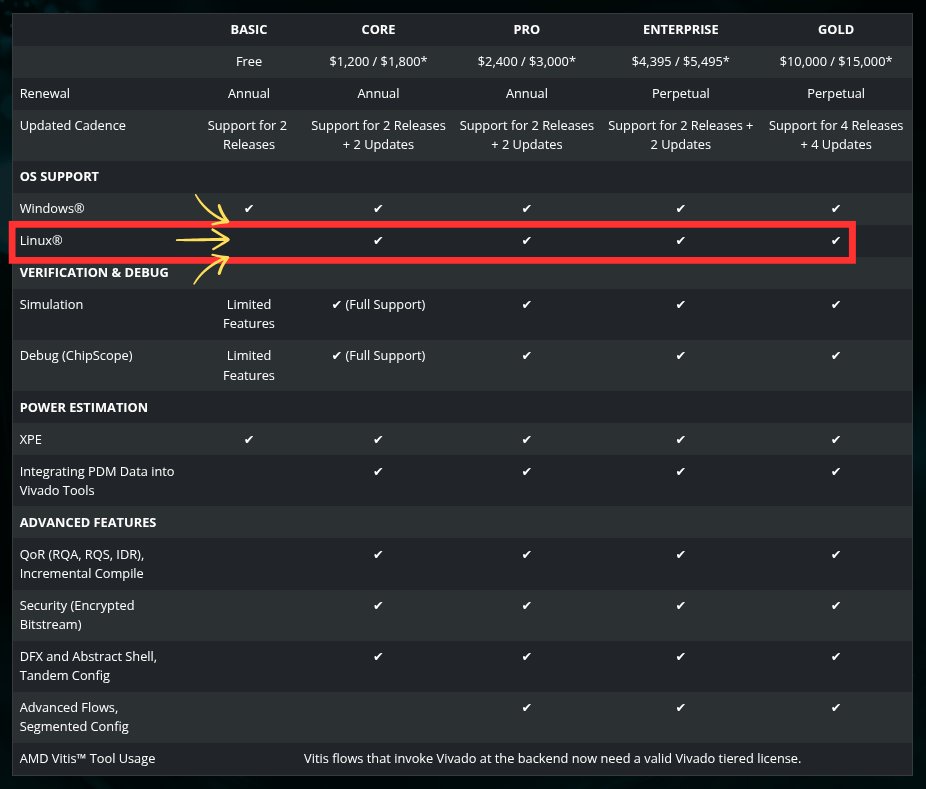
Starting with the 2026.1 release, AMD restructured the Vivado Design Suite into three tiers:
| Tier | Price (annual) | Supported devices | Supported OS |
|---|---|---|---|
| Basic | Free | Entry‑level UltraScale+ and lower | Windows only |
| Core | $1,200‑$1,800 | All production‑grade devices | Windows and Linux |
| Enterprise | Custom pricing | Full feature set, priority support | Windows and Linux |
The announcement appears on AMD’s Vivado licensing page and is framed as “more flexible licensing.” In practice, the only free tier that remains is now Windows‑only; Linux support is gated behind a paid subscription.
What’s actually new
- Removal of Linux from the free tier – Previously the Standard Edition (free) was available for both Windows and Linux. The new Basic tier retains the price point but drops Linux entirely.
- Annual renewal requirement – Even the free tier now requires users to log in and accept an annual license renewal, a step that was not present in earlier releases.
- Explicit pricing for Linux – The Core tier, which includes Linux, is priced between $1,200 and $1,800 per year, depending on the number of seats and support level.
- Legacy fallback – AMD suggests staying on Vivado 2025.2 if users cannot afford the paid tier. That version will lose official support once 2026.3 ships, meaning security patches and bug fixes will cease.
Why it matters for the Linux community
- Academic and hobbyist pipelines – Many university labs and independent developers run Vivado on Ubuntu or Fedora because it integrates well with open‑source toolchains (e.g., Yosys, nextpnr). Losing free Linux access forces them to either purchase a subscription or maintain an unsupported older version.
- Long‑term reproducibility – Research projects often need to reproduce results years later. Relying on a deprecated 2025.2 build complicates archiving and validation.
- Talent pipeline – Students who learn FPGA design on Linux are likely to carry those habits into industry roles. Restricting Linux could push them toward competing tools that remain free, such as Intel’s Quartus Prime Lite or open‑source alternatives.
Community reaction and AMD’s response
The change sparked a heated thread on AMD’s support forums. Moderator Anatoli Curran reminded participants to avoid “abusive language” before addressing the core issue. His reply emphasized that 70 % of Vivado users are on Windows, using that statistic to justify the Basic tier’s Windows‑only limitation. A follow‑up comment clarified that paid tiers support both platforms, but offered no concrete roadmap for making Linux free again.
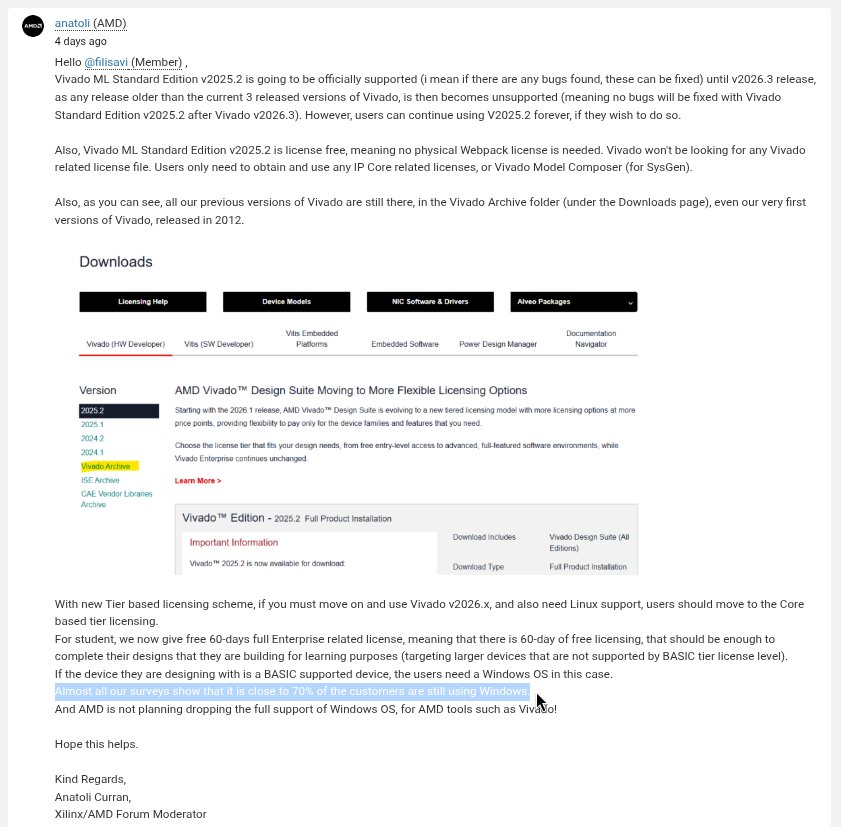
The tone of the moderation was perceived as dismissive, and several users pointed out the contradiction: if Windows dominates, why lock Linux behind a paywall when the Linux community historically contributed bug reports and patches that benefited the product overall?
Practical implications and workarounds
| Situation | Viable options |
|---|---|
| Student or hobbyist on Linux | • Use the last free Linux‑compatible release (2025.2) and accept the loss of official updates. • Switch to Intel’s free Quartus Prime Lite, which still supports Linux. • Explore open‑source FPGA toolchains (e.g., Symbiflow, LiteX). |
| Small startup needing Linux | • Purchase a Core tier subscription; the cost is comparable to many other commercial EDA tools. • Negotiate an academic‑type license if the company qualifies for research‑or‑development programs. |
| Enterprise with mixed OS | • Continue with Core/Enterprise tiers; the licensing model aligns with typical corporate budgeting cycles. |
Limitations of the new model
- No grace period for existing free users – AMD did not provide a transition window for those already using the free Linux edition. Users must decide immediately whether to downgrade to an older version or pay.
- Unclear licensing granularity – The pricing range ($1,200–$1,800) depends on seat count and support level, but AMD’s public documentation lacks a detailed matrix, making budgeting difficult.
- Potential compliance risk – Some academic labs may inadvertently continue using 2025.2 after its support end‑date, violating AMD’s license terms if they do not renew.
- Impact on third‑party ecosystems – Tools that integrate with Vivado (e.g., Xilinx’s Vitis flow, open‑source board support packages) may need to adjust their build scripts to detect the missing Linux binaries.
What could AMD do to ease the tension?
- Offer a free Linux tier for non‑commercial use – A “Community” tier that includes Linux but limits commercial deployment would mirror models used by other EDA vendors.
- Provide a longer support window for 2025.2 – Extending official patches for at least six months would give the community time to transition.
- Publish a clear seat‑based pricing table – Transparency helps small teams evaluate the cost‑benefit trade‑off.
- Engage directly with the Linux community – Hosting a Q&A session or a public roadmap could rebuild trust.
Bottom line
AMD’s shift is not a technical breakthrough; it is a licensing realignment that removes free Linux support from Vivado. For the sizable segment of users who rely on Linux for FPGA development—students, researchers, and small startups—the change introduces a hard choice between paying for a Core subscription or maintaining an unsupported older version. The company’s justification rests on usage statistics that do not address the strategic value of an open Linux workflow. Until AMD clarifies its long‑term support policy or introduces a free Linux tier, the community will likely migrate toward alternative tools or continue using legacy releases with the associated risks.
Further reading
- AMD’s official Vivado licensing options
- Discussion on the change in the AMD community forum
- Comparison of free FPGA toolchains: Symbiflow vs. Vivado Lite
Comments
Please log in or register to join the discussion