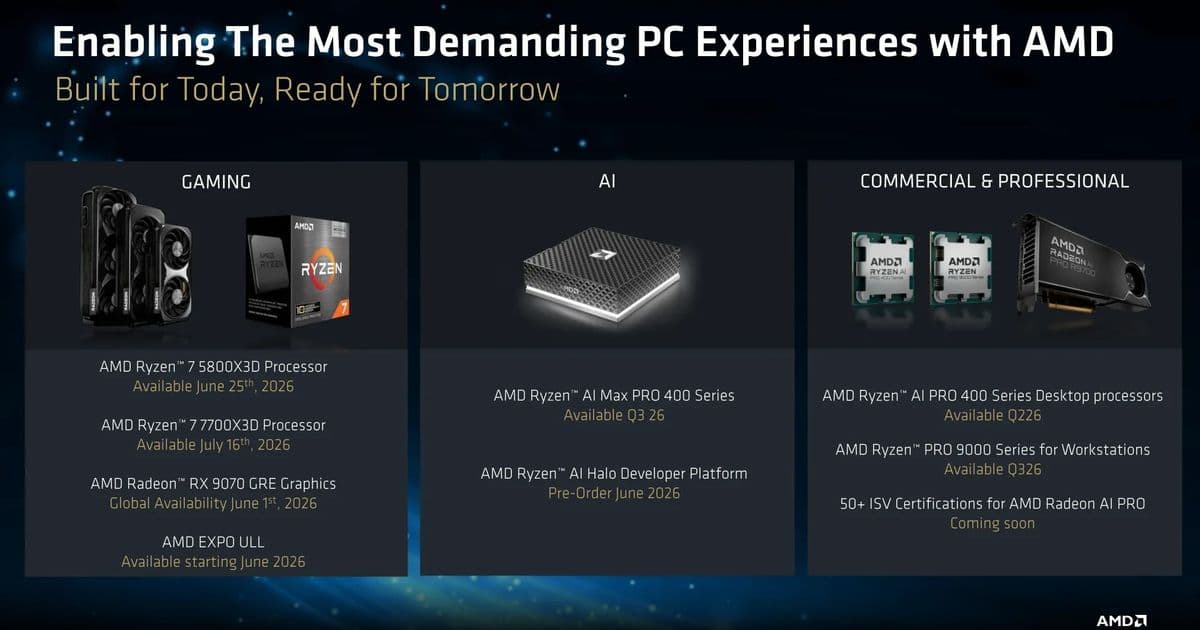
AMD's Computex 2026 announcements bring a new mid-range GPU, anniversary AM4 CPU, expanded AM5 support, and powerful AI processors with enhanced memory capabilities.
AMD's Summer Hardware Offensive: RX 9070 GRE, Ryzen AI Max PRO 400, and More
AMD kicked off Computex 2026 with a wave of new hardware announcements targeting gamers, content creators, and AI enthusiasts. The company's latest offerings include a new graphics card positioned between existing models, anniversary editions for legacy AM4 users, expanded AM5 platform support, and next-generation AI processors with significant memory improvements. Let's dive into the specifications and implications of these new products.
Radeon RX 9070 GRE: RDNA 4 for 1440p Gaming
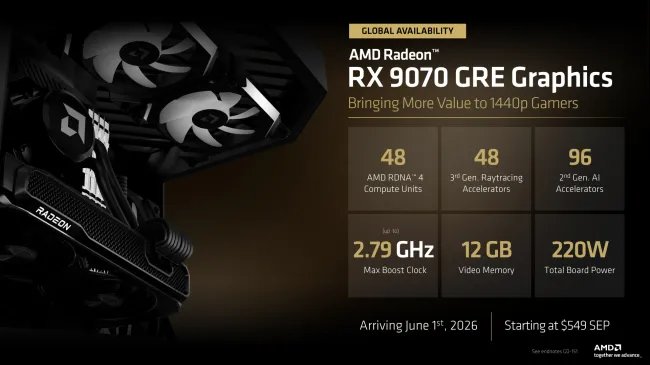
AMD's Radeon RX 9070 GRE arrives as a new addition to the RDNA 4 family, positioned just below the RX 9070 and RX 9070 XT models. The card launches on June 1, 2026, with a starting price of $549 USD, targeting the competitive 1440p gaming market.
Key Specifications:
- 48 compute units
- 48 ray-tracing accelerators
- 96 AI accelerators
- Up to 2.79GHz maximum boost clock
- 12GB GDDR6 memory
- 220W board power rating
The RX 9070 GRE represents AMD's continued focus on the 1440p resolution sweet spot, offering a compelling option for gamers who want high frame rates without the premium price of top-tier cards. The 12GB of VRAM should handle modern titles at this resolution comfortably, while the 220W TDP suggests a reasonable power efficiency profile for its class.
For Linux users, this RDNA 4 card will be important to watch as AMD continues to improve their open-source driver support. The 96 AI accelerators could be particularly interesting for emerging AI-accelerated gaming features.
Build Recommendation: RX 9070 GRE Systems
For a balanced 1440p gaming build:
- CPU: Ryzen 7 7700 or 7800X3D (if available)
- Motherboard: B650 or X670 chipset
- Memory: 32GB DDR5-6000 CL30 EXPO memory
- Storage: 1TB NVMe PCIe 4.0 SSD
- PSU: 750W 80+ Gold or better
- Case: Mid-tower with excellent airflow
This configuration would provide excellent gaming performance while leaving room for future upgrades. The RX 9070 GRE's power requirements mean a quality 750W PSU should provide plenty of headroom.
Professional Graphics: Radeon AI FSR PRO
Alongside the gaming-focused RX 9070 GRE, AMD announced Radeon AI FSR PRO for professional graphics applications. This technology includes Ray Generation support and Radeon AI PRO R9700 certifications, targeting content creators and professionals who leverage AI acceleration in their workflows.
While details are still emerging, this suggests AMD is expanding their AI capabilities beyond gaming into professional applications, potentially competing with NVIDIA's RTX professional features. The inclusion of Ray Generation support indicates improved ray tracing performance for rendering and visualization workloads.
AM4 Platform: Ryzen 7 5800X3D 10th Anniversary Edition
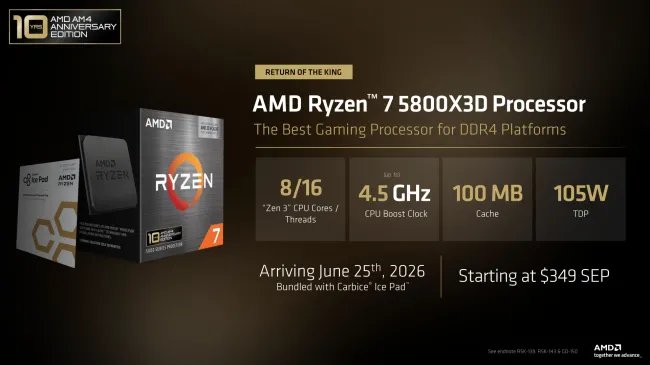
For users still on AMD's AM4 platform, the Ryzen 7 5800X3D 10th Anniversary Edition offers a compelling upgrade path. Launching on June 25, 2026, at $349 USD, this CPU provides significant performance for those with existing AM4 motherboards who wish to avoid the higher costs associated with moving to AM5.
The original Ryzen 7 5800X3D launched in 2022 and remains competitive today due to its innovative 3D V-Cache technology. The anniversary edition likely brings the same 8-core/16-thread configuration with 96MB of L3 cache (64MB traditional + 32MB 3D V-Cache), making it particularly effective for gaming workloads where cache size can be as important as clock speeds.
Build Recommendation: AM4 Anniversary System
For an AM4-based gaming build:
- CPU: Ryzen 7 5800X3D 10th Anniversary Edition
- Motherboard: B550 or X570 chipset with updated BIOS
- Memory: 32GB DDR4-3600 CL16 EXPO memory
- Storage: 1TB NVMe PCIe 3.0 or 4.0 SSD
- PSU: 650W 80+ Bronze or better
- Case: Mid-tower with adequate cooling
This configuration offers excellent gaming performance at a lower total system cost compared to AM5 builds, making it ideal for budget-conscious gamers or those with existing AM4 investments.
AM5 Expansion: Ryzen 7 7700X3D and Platform Support Through 2029
AMD affirmed their commitment to the AM5 platform, announcing support will continue through 2029. This long-term support provides confidence for early adopters and those planning future upgrades.
Joining the AM5 family is the Ryzen 7 7700X3D, launching on July 16, 2026, at $329 USD. This CPU brings 3D V-Cache technology to the AM5 platform with these specifications:
- 8 cores / 16 threads
- 4.5GHz maximum boost clock
- 120W TDP
- 104MB total cache (80MB traditional + 24MB 3D V-Cache)
The Ryzen 7 7700X3D offers a slightly different cache configuration compared to the AM4 5800X3D, with more traditional L3 cache but less 3D V-Cache. The 120W TDP is higher than the 105W of the original 5800X3D, reflecting the architectural differences between AM4 and AM5.
Build Recommendation: AM5 X3D System
For a high-end AM5 gaming build:
- CPU: Ryzen 7 7700X3D
- Motherboard: X670E or B650E chipset
- Memory: 32GB DDR5-6000 CL30 EXPO memory
- Storage: 1TB NVMe PCIe 5.0 SSD
- PSU: 750W 80+ Gold or better
- Case: High-flow mid-tower or full-tower
This configuration leverages AM5's advantages including PCIe 5.0 support and DDR5 memory, while the X3D variant provides excellent gaming performance. The platform's confirmed support through 2029 means this system remains viable for several years of upgrades.
Memory Technology: EXPO Ultra Low Latency (ULL)
AMD teased EXPO Ultra Low Latency (ULL) technology, the next iteration of AMD EXPO memory profiles. This automatic overclocking technology claims to provide an additional 4% FPS boost on average compared to standard EXPO memory.
While 4% may seem modest, in competitive gaming or high-frame-rate scenarios, every percentage point counts. The automatic nature of ULL means users won't need to manually tweak memory settings to achieve these benefits, simplifying the optimization process.
Ryzen AI Max PRO 400: Enhanced AI Processing
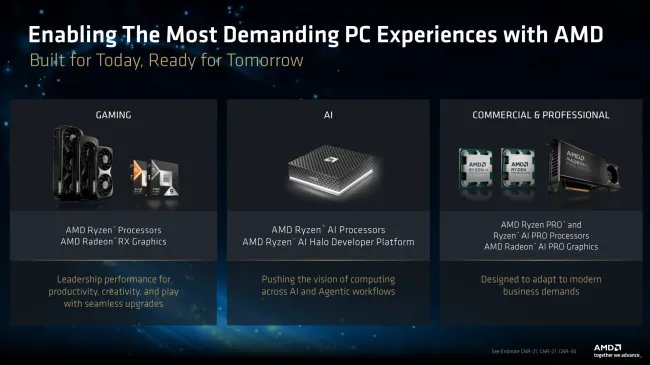
AMD's most significant announcement for AI professionals and enthusiasts is the Ryzen AI Max PRO 400 series. Based on the Zen 5 architecture, these processors expand memory support to 192GB, a substantial increase from the 128GB limit of the previous Ryzen AI Max (PRO) 300 series.
The new models include:
- Ryzen AI Max+ PRO 495 (top-tier)
- Ryzen AI Max PRO 490
- Ryzen AI Max PRO 485
The increased memory capacity enables running larger language models and AI workloads that wouldn't fit in the previous generation's memory limits. This positions AMD as a serious competitor in the AI PC space, particularly for local AI model inference and development.
AMD also continues development of their Ryzen AI Halo box, initially powered by the Ryzen AI Max+ 395, with plans to later offer a version with the Ryzen AI Max+ PRO 495. This all-in-one system appears targeted at AI professionals and developers who need a compact, powerful platform for AI work.
Build Recommendation: AI Development Workstation
For a Ryzen AI Max PRO 400 development workstation:
- CPU: Ryzen AI Max+ PRO 495
- Motherboard: WRX90 or other Ryzen AI workstation motherboard
- Memory: 192GB DDR5 ECC UDIMMs
- Storage: 2TB NVMe PCIe 5.0 SSD + additional storage
- PSU: 1000W 80+ Platinum or better
- Case: Full-tower with excellent cooling
This configuration maximizes the potential of the Ryzen AI Max PRO 400 series, providing the memory capacity and processing power needed for demanding AI development and inference tasks.
Performance Analysis and Market Positioning
AMD's Computex 2026 announcements show a clear strategy across multiple segments:
Gaming Segment: The RX 9070 GRE fills an important mid-range position, offering 1440p performance at a competitive price point. The continued development of X3D processors for both AM4 and AM5 shows AMD's commitment to gaming performance through cache optimization.
Professional/AI Segment: The Ryzen AI Max PRO 400 series with 192GB memory support directly addresses the growing needs of AI professionals and developers. This positions AMD to compete with Intel's AI-optimized processors in the workstation market.
Platform Strategy: By supporting AM4 through 2026 and AM5 through 2029, AMD provides flexibility for users at different budget levels and upgrade cycles. The AM4 5800X3D anniversary edition serves users who want to extend their existing platform investment, while AM5 offers the latest technology for those willing to upgrade.
Memory Innovation: EXPO ULL technology demonstrates AMD's continued focus on memory optimization, squeezing additional performance out of DDR5 without requiring manual overclocking expertise from users.
Linux Compatibility and Open Source Support
For Linux users, these announcements bring several points of interest:
- The RX 9070 GRE's RDNA 4 architecture will benefit from ongoing improvements to AMD's open-source drivers
- Ryzen AI processors, particularly the Max PRO series, show increasing importance in the Linux AI ecosystem
- EXPO memory support continues to improve on Linux, with ULL likely being adopted by major distributions
AMD's continued investment in open-source drivers makes their hardware increasingly attractive to Linux users, especially for gaming and AI workloads where driver performance directly impacts user experience.
Conclusion: A Strong Showing Across Segments
AMD's Computex 2026 announcements demonstrate the company's broad strategy and commitment to multiple market segments. From the gaming-focused RX 9070 GRE to the AI-optimized Ryzen Max PRO 400 series, AMD is addressing key market needs with competitive products.
The combination of continued AM4 support through the 5800X3D anniversary edition and long-term AM5 commitment through 2029 provides flexibility for users at different upgrade points. Meanwhile, the Ryzen AI Max PRO 400 series with 192GB memory support positions AMD as a serious competitor in the AI PC space.
As we move through 2026, these products will likely form the backbone of many gaming PCs, workstations, and AI development systems. The performance improvements, particularly in memory capacity and AI acceleration, reflect the evolving demands of modern computing workloads.
For enthusiasts and professionals alike, AMD's Computex 2026 offerings provide compelling options across price points and use cases, reinforcing the company's position as a competitive force in the CPU and GPU markets.
Comments
Please log in or register to join the discussion