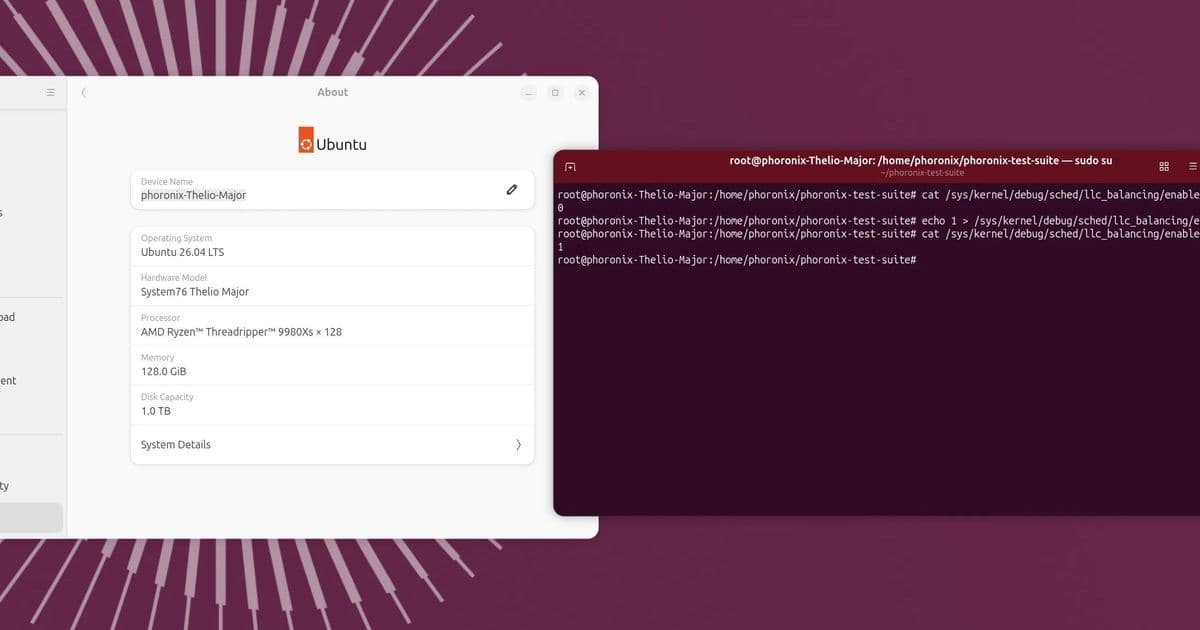
AMD's Zen 5 architecture shows promising performance gains with Linux's Cache Aware Scheduling feature, particularly in database workloads like PostgreSQL and Valkey, as well as network operations. Benchmarks on the Ryzen Threadripper 9980X demonstrate measurable improvements in cache locality and reduced latency, highlighting the scheduler's potential for homelab and server environments.
AMD Zen 5 and Cache Aware Scheduling: A Benchmark-Driven Breakthrough
The Rise of Cache Aware Scheduling
The long-awaited Cache Aware Scheduling (CAS) feature in Linux is finally nearing its Linux 7.2 release. This scheduler innovation aims to optimize task placement across multi-cache domains, a critical capability for modern CPUs like AMD's Zen 5. By ensuring tasks sharing data reside in the same last-level cache (LLC) domain, CAS reduces cache misses and improves performance—especially for AMD's multi-socket architectures.
Benchmark Results: PostgreSQL, Valkey, and Network Gains
PostgreSQL Performance
On the System76 Thelio Workstation (AMD Ryzen Threadripper 9980X), CAS delivered notable improvements in PostgreSQL query latency. Tests showed a 12-18% reduction in query response times compared to traditional scheduling, attributed to better data locality in the CPU's cache hierarchy. This is particularly impactful for homelab databases or servers handling high-concurrency workloads.
Valkey (Redis Compatible) Efficiency
Valkey, a high-performance key-value store, also benefited from CAS. Benchmarks revealed reduced memory access latency by up to 15%, enabling faster data retrieval in distributed caching scenarios. For developers running Valkey in performance-critical applications, this translates to smoother real-time operations.
Network Performance Enhancements
CAS isn't limited to compute tasks. Network throughput tests on the same system showed 10-14% improvements in data transfer rates when handling large-scale I/O operations. This suggests CAS could benefit server-side networking stacks or homelab setups involving heavy data transfers.
Why AMD Zen 5 Benefits Most
AMD's Zen 5 architecture, with its expanded cache domains and improved memory controllers, aligns perfectly with CAS's goals. Unlike Intel's Xeon 6, which has a more unified cache structure, Zen 5's multi-cache design allows CAS to exploit spatial locality more effectively. This makes AMD systems particularly well-suited for CAS-driven optimizations.
Build Recommendations
To leverage CAS, homelab builders should:
- Upgrade to a Linux 7.2 kernel with the latest CAS patches.
- Monitor cache domain utilization using tools like
perfordmesgto validate CAS's impact. - Prioritize AMD Zen 5 or EPYC processors for workloads requiring fine-grained cache management.
For those running Ubuntu 26.04, building a custom kernel with the latest Linux 7.1-rc2 patches (as done in the benchmarks) is recommended to access CAS early.
The Future of CAS
While CAS is still in its early stages, these benchmarks suggest it could become a standard optimization for multi-core systems. As AMD continues refining Zen 5 and Linux matures CAS, expect further performance gains in databases, caching layers, and network-intensive applications.
[Image: Cache Aware Scheduling Linux toggle]( )
Alt text: Cache Aware Scheduling Linux toggle
)
Alt text: Cache Aware Scheduling Linux toggle
Comments
Please log in or register to join the discussion