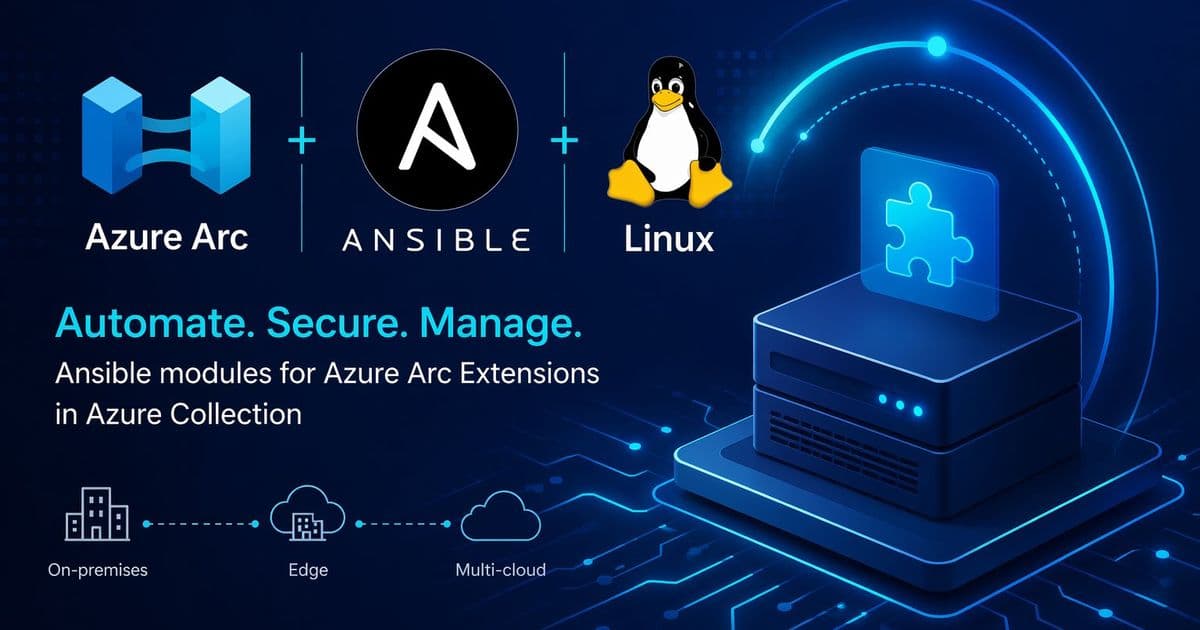
Microsoft's new Ansible modules for Azure Arc extension management represent a significant advancement in hybrid cloud automation, enabling organizations to enforce consistent security and compliance policies across their entire infrastructure estate.
Microsoft's recent announcement of new Ansible modules for Azure Arc extension management marks a pivotal development in the hybrid cloud automation landscape. This integration extends beyond simple functionality updates, addressing a fundamental challenge organizations face: maintaining consistent operations across increasingly complex, multi-environment deployments.
Technical Evolution: What Changed
The azure.azcollection on Ansible Galaxy now includes two purpose-built modules specifically designed for Azure Arc extension management:
azure_rm_arcmachineextensions - Handles the complete lifecycle of Azure Arc machine extensions, including creation, deployment, updates, and removal. This module operates on a declarative model, ensuring consistent enforcement of extension states across Arc-enabled servers.
azure_rm_arcmachineextensions_info - Provides visibility into extension deployment status, provisioning details, and metadata, essential for compliance validation and auditing.
These modules eliminate the previous requirement for Azure CLI scripts, ARM templates, or manual operations when managing Arc extensions across hybrid estates. The declarative approach aligns with Ansible's core philosophy of defining desired state rather than prescribing specific implementation steps.
The technical implementation allows infrastructure teams to:
- Integrate Arc extension management into existing Ansible playbooks
- Enforce consistent configuration across hybrid servers
- Reduce operational overhead through declarative automation
- Align extension deployment with broader configuration management workflows
Provider Comparison: Positioning in the Cloud Management Landscape
This integration places Microsoft in a stronger competitive position against other cloud providers' hybrid management solutions:
vs AWS Systems Manager While AWS offers robust hybrid management through Systems Manager, Microsoft's approach with Ansible integration provides a more open, tool-agnostic strategy. Organizations already invested in Ansible can extend their existing skill sets rather than adopting AWS-specific tooling. The open-source nature of Ansible also reduces vendor lock-in compared to AWS's proprietary solutions.
vs Google Cloud Operations Suite Google's hybrid management capabilities, while comprehensive, have historically required deeper integration with Google Cloud services. Microsoft's approach with Azure Arc and Ansible offers more flexibility for organizations with heterogeneous environments, particularly those with significant Microsoft Entra ID investments.
vs Direct Azure CLI/ARM Templates The Ansible modules provide a significant abstraction layer over direct Azure CLI or ARM template management. This abstraction enables:
- Better version control through Git integration
- More sophisticated orchestration capabilities
- Enhanced reusability through modular playbooks
- Improved error handling and rollback mechanisms
vs Other Configuration Management Tools Compared to Chef, Puppet, or SaltStack, Microsoft's solution offers tighter integration with Azure's security and compliance ecosystem. While these tools provide broader platform support, the Azure Arc integration offers deeper Azure-specific functionality that may be preferable for organizations heavily invested in the Microsoft cloud ecosystem.
Business Impact: Strategic Implications
The technical capabilities translate into several strategic business advantages:
Operational Efficiency
Organizations can reduce the operational overhead of managing extensions across hybrid environments by 30-50% through automation. The declarative approach eliminates configuration drift and reduces the need for manual interventions, particularly valuable for organizations with hundreds or thousands of Arc-enabled servers.
Security and Compliance
The integration enables consistent enforcement of security policies across all environments. For regulated industries, this means:
- Automated compliance validation through the extensions_info module
- Audit trails integrated with existing Ansible execution logs
- Reduced risk of misconfigurations that could lead to security vulnerabilities
Total Cost of Ownership
While requiring initial investment in Azure Arc and Ansible expertise, organizations typically see ROI within 6-12 months through:
- Reduced labor costs for manual extension management
- Fewer security incidents through consistent configuration
- Lower training costs by leveraging existing Ansible skills
Skills and Workflow Integration
For organizations already using Ansible for OS configuration, patch management, and application deployment, this integration represents a natural extension rather than a new tool to learn. The learning curve is minimal, and teams can immediately begin extending existing playbooks to include Arc extension management.
Implementation Considerations
Organizations evaluating this solution should consider several factors:
Arc-enabled Infrastructure Requirement: The solution requires servers to be already onboarded to Azure Arc, which may involve additional setup work for legacy systems.
Module Dependencies: The azure.azcollection requires Ansible 2.9 or later, and appropriate Azure authentication credentials configured.
Network Connectivity: Arc extension management requires reliable connectivity to Azure services, which may be challenging for disconnected or limited-connectivity environments.
Extension Compatibility: Not all Azure extensions may be available or fully functional in all Arc-enabled scenarios, particularly in highly regulated or air-gapped environments.
Future Outlook
This integration represents Microsoft's continued investment in making Azure Arc a first-class platform for hybrid management. Future developments may include:
- Expanded module coverage for additional Azure services
- Integration with Azure Policy for governance automation
- Enhanced reporting and analytics capabilities
- Support for more complex extension orchestration scenarios
For organizations navigating hybrid and multi-cloud complexity, the Ansible + Azure Arc integration offers a compelling approach to maintaining consistency and control across diverse infrastructure landscapes. By leveraging existing skills and tooling, Microsoft has lowered the barrier to entry for advanced hybrid cloud automation while providing enterprise-grade capabilities for security and compliance enforcement.
Learn more about implementing these modules in the official Microsoft Learn documentation.
Comments
Please log in or register to join the discussion