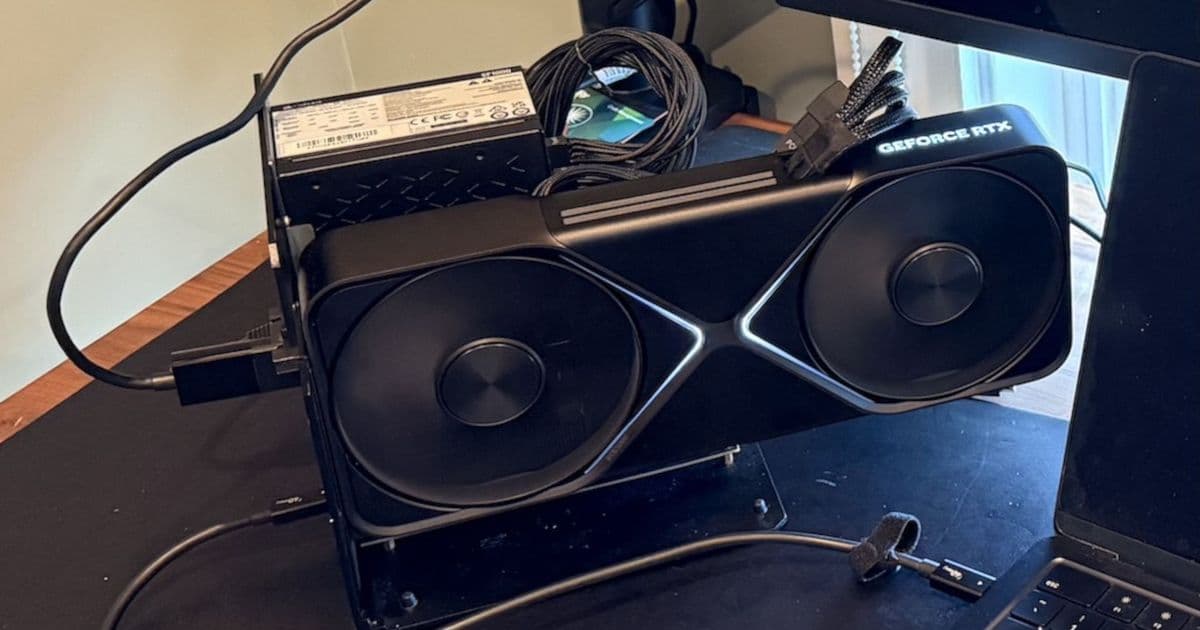
A custom virtualization stack lets an M5 Max‑based MacBook Pro run an Nvidia RTX 5090 via Thunder‑bolt eGPU. Benchmarks show over 100 FPS in Cyberpunk 2077 at max settings when DLSS 3 frame generation is enabled, but performance drops sharply without it. The setup highlights the CPU overhead of the FEX translation layer and the bandwidth limits of Thunderbolt, while confirming that Apple silicon can host high‑end discrete GPUs in a niche gaming scenario.
Announcement
A proof‑of‑concept built by software engineer Scott J. Goldman demonstrates that an Apple M5 Max MacBook Pro can drive Nvidia’s flagship RTX 5090 through a Thunderbolt‑connected eGPU dock. Using a Linux virtual machine, the QEMU hypervisor, and the FEX translation layer, Goldman achieved more than 100 FPS in Cyberpunk 2077 at the RT Ultra preset with DLSS 3 frame generation turned on.
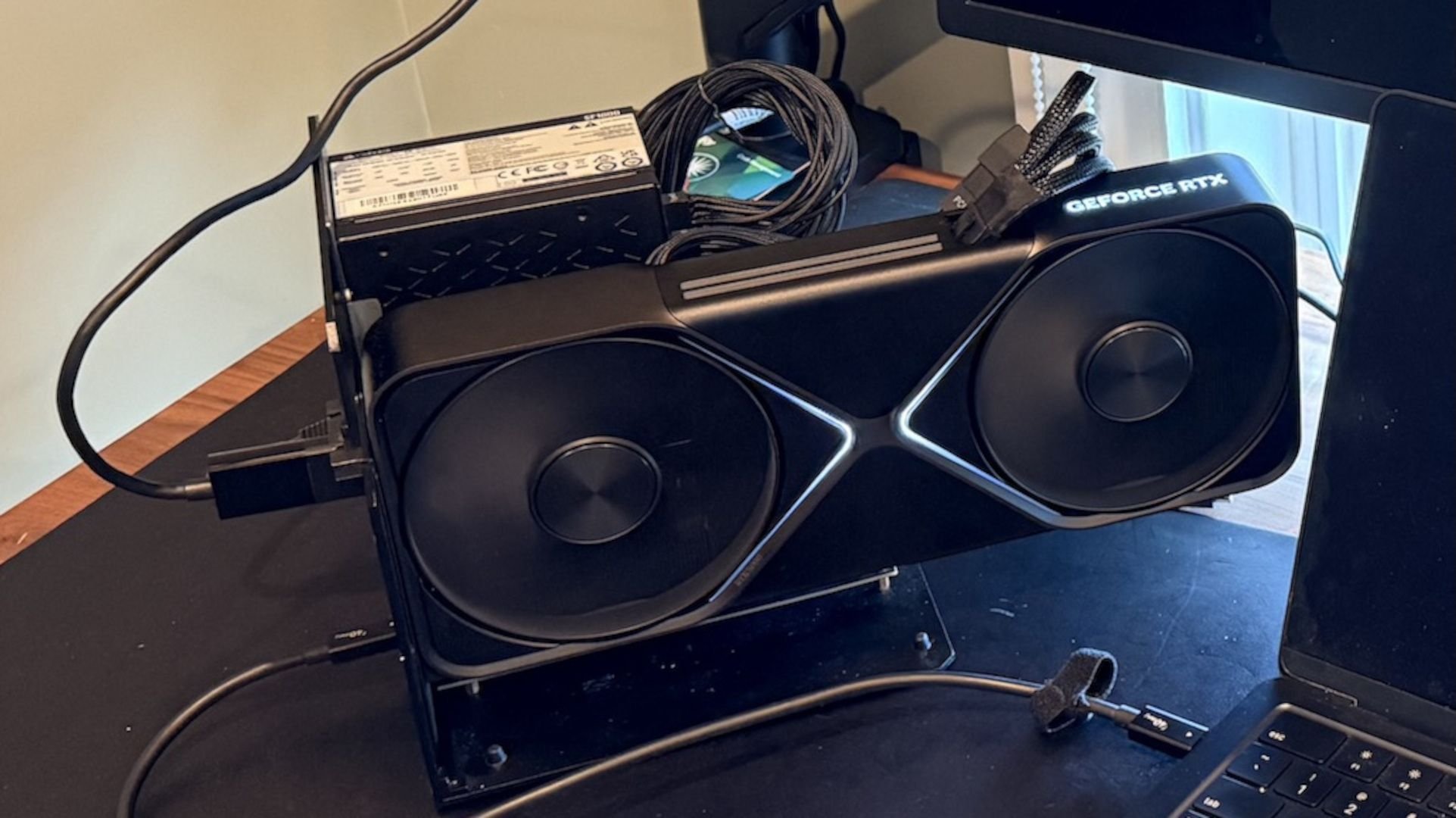
Technical specifications
| Component | Specification |
|---|---|
| CPU | Apple M5 Max (8‑core high‑performance + 2‑core efficiency) |
| GPU (external) | Nvidia RTX 5090 – 24 GB GDDR6X, 163 TMUs, 2nd‑gen RT cores |
| Interconnect | Thunderbolt 4 (40 Gbps PCIe 3.0 x4) |
| OS stack | macOS host → QEMU VM → Linux (Ubuntu 24.04) → FEX (x86‑to‑ARM translation) |
| Additional layers | PCI BAR mapping, DMA enable, QEMU CPU‑thread priority tuning |
How the stack works
- Virtualization – macOS cannot load Nvidia drivers, so a QEMU VM provides a Linux environment where the official Nvidia driver can be installed.
- PCI passthrough – The eGPU’s PCIe device is exposed to the VM via Thunderbolt, requiring manual BAR configuration to make the GPU visible.
- FEX translation – Most PC games ship only x86 binaries. FEX intercepts those instructions and translates them to ARM at runtime, allowing the M5 Max’s cores to execute the game code.
- DLSS 3 frame generation – Nvidia’s AI‑based up‑sampling adds a generated frame every cycle, effectively doubling perceived frame rate while keeping GPU workload constant.
Performance numbers
- Cyberpunk 2077 (1080p, RT Ultra, DLSS 3): 102 FPS (M5 Max) vs 149 FPS (i5‑12600K desktop) – the gap narrows when frame generation is active.
- Cyberpunk 2077 (same settings, no frame generation): 61 FPS (M5 Max) vs 158 FPS (i5‑12600K).
- Shadow of the Tomb Raider: 57 FPS (M5 Max) – below 60 FPS, indicating the translation overhead dominates in less DLSS‑friendly titles.
- Crysis Remastered: 48 FPS (M5 Max).
- Geekbench 6: single‑core score drops from ~3,900 (native) to ~1,950 with FEX enabled; multi‑core falls from ~22,000 to ~11,000, confirming roughly a 50 % CPU penalty.
- GravityMark: 20 % slower than the desktop baseline, showing that raw GPU throughput is less affected than CPU‑bound workloads.
Market implications
- Niche validation – The experiment proves that Apple silicon can host a top‑tier discrete GPU, but only with a complex software stack. For professional creators who already run GPU‑accelerated workloads on macOS, the result is a proof point that high‑end gaming is technically feasible.
- Supply‑chain perspective – Nvidia’s RTX 5090 remains in short supply; repurposing a single unit for an eGPU experiment does not shift market dynamics, but it does illustrate a potential secondary demand channel among power users who prefer the Mac ecosystem.
- Competitive pressure – Intel’s upcoming Xe‑HPG GPUs and AMD’s Radeon 8000 series are expected to support native macOS drivers via the upcoming Metal‑compatible stack. If Apple were to open its Thunderbolt controller to third‑party drivers, the barrier to entry for high‑performance eGPU rigs would drop dramatically.
- Software ecosystem – The 50 % CPU hit from FEX is the biggest obstacle. Should Apple or third‑party developers deliver an ARM‑native Windows layer (e.g., a future version of Parallels or a native x86‑to‑ARM emulator with lower overhead), the performance gap could shrink to within 10 % of a comparable Windows desktop.
- Consumer outlook – For most gamers, the setup remains impractical: the configuration requires deep system knowledge, multiple manual tweaks, and a willingness to accept occasional instability. However, the data point may influence future MacBook designs, encouraging Apple to expose a higher‑bandwidth PCIe lane or to certify eGPU docks for Nvidia hardware.
Bottom line
The M5 Max + RTX 5090 eGPU experiment shows that over‑100 FPS gaming is achievable on Apple silicon when AI‑assisted frame generation compensates for CPU translation overhead. Without that assistance, performance regresses to the mid‑60 FPS range, comparable to older MacBook Air hardware. The primary limitation is the FEX translation penalty, not the Thunderbolt bandwidth, suggesting that a native driver stack would unlock the full potential of the RTX 5090 on Mac laptops.
For a deeper dive into the virtualization steps, see the QEMU documentation and the FEX project page.
Comments
Please log in or register to join the discussion