
ASCILINE’s 30 FPS ASCII and pixel-streaming engine turns video into browser-rendered text and colored blocks, shifting the performance question from codec silicon to bandwidth, CPU preprocessing, and canvas rendering economics.

Announcement
ASCILINE Engine, a new MIT-licensed project from YusufB5, has been released as a real-time ASCII video rendering system that streams video-like output through text and canvas operations rather than a conventional video element. The project is available on GitHub at YusufB5/ASCILINE, where it is described as a cross-platform engine for turning source video into structured typographic or pixel-like frames delivered to the browser.
The headline claim is intentionally provocative: a 360p-class, 30 FPS video stream rendered as pure text or colored blocks, pitched by the developer as harder for normal browser video controls and ad blockers to classify as media. That is the source of the controversy. A stream that looks like video but behaves like JavaScript updating a canvas can bypass some media-specific rules, but it is not literally impossible to block. Canvas elements, scripts, WebSocket traffic, and page containers can still be detected, throttled, hidden, or removed by browser tooling.
The more meaningful technical story is less about being unblockable and more about changing the cost model of video delivery. ASCILINE moves work from mature video codecs such as H.264, VP9, or AV1 into a pipeline built around Python preprocessing, OpenCV frame handling, NumPy pixel mapping, binary WebSocket transport, and browser-side canvas drawing. That substitution matters because the industry is already constrained by three numbers: GPU availability, network egress cost, and client-device power budgets.
In normal streaming, compression efficiency comes from dedicated video encoders and decoders. Those blocks are baked into client CPUs, phone SoCs, GPUs, and media engines across many process nodes, from older 28nm and 16nm embedded silicon to 7nm, 5nm, 4nm, and 3nm-class client and data-center chips. ASCILINE instead treats the browser as a typographic display surface. That does not make silicon irrelevant, but it changes which parts of the system are stressed. The backend still has to decode and transform video, while the client must handle steady canvas updates at 24 to 30 frames per second.
Technical Specs
ASCILINE’s public repository lists three major pieces: a Python backend using FastAPI, video processing through OpenCV and NumPy, and a vanilla JavaScript frontend that receives binary frames over WebSockets. Audio support depends on FFmpeg, which is also standard infrastructure in many video pipelines.
The engine has several rendering modes. Mode 3 is the higher-fidelity ASCII path, using a 32K-color palette and a 30 FPS source. Mode 5 is the more visually aggressive path, replacing characters with colored blocks and supporting 16 million colors when paired with the pixel flag. In the project’s own framing, Mode 5 approaches 360p video quality. That comparison is useful, but it should be read carefully: 360p is a spatial-resolution target, not a guarantee of codec-grade detail retention, motion handling, or display scaling quality.

The core trade-off is simple. A normal 360p compressed video stream relies on temporal prediction, motion vectors, quantization, entropy coding, and hardware decode blocks. ASCILINE uses a frame-to-symbol or frame-to-block mapping. Instead of asking the browser to decode a video file, it asks the browser to render a canvas grid that changes over time. That makes the output easy to style with CSS effects and easier to inspect as structured frame data, but it also means the engine is not competing with H.264 or AV1 on pure compression science.
For bandwidth, ASCILINE’s strongest claim is that ASCII mode can stream only a few kilobytes per frame, especially when delta frames and GZIP compression are applied. At 30 FPS, even a small per-frame payload adds up quickly. A 5 KB frame budget implies roughly 150 KB per second before transport overhead, or about 1.2 Mbps. A 2 KB frame budget would be closer to 480 Kbps. Those numbers are competitive for low-resolution, stylized, or telemetry-like media, but they are not automatically superior to a tuned video codec at the same perceptual quality.
The compute profile is also different. The backend decodes source video, samples or transforms pixels, maps them to characters or colored blocks, packages frames, and streams them through an optimized binary protocol. The frontend maintains timing, buffers incoming frames, and renders them to a canvas. The GitHub README describes an INIT handshake for dynamic resolution and FPS adjustment, plus a jitter buffer for playback stability. Audio acts as the master clock, which is the right design choice because humans notice audio-video sync drift quickly, often before they notice minor spatial artifacts.
This approach favors predictable frame cadence over maximum visual efficiency. High-FPS sources are decimated for stable 24 to 30 FPS playback, which is sensible. A browser canvas renderer fed by WebSockets has a tighter margin for timing jitter than a standard video element backed by years of buffering, decode scheduling, and hardware acceleration work. If frames arrive late, the player has fewer codec-native tools to hide the delay.
The project’s AI angle is credible but narrower than the marketing language suggests. If a video is converted into a stream of characters, colors, and grid positions, lightweight models can summarize motion or scene changes without full computer-vision preprocessing. That could be useful for low-power monitoring, accessibility experiments, terminal-native media tools, or quick semantic sketches of visual input. It is not a replacement for vision models when object boundaries, fine text, faces, depth, or physical measurements matter.
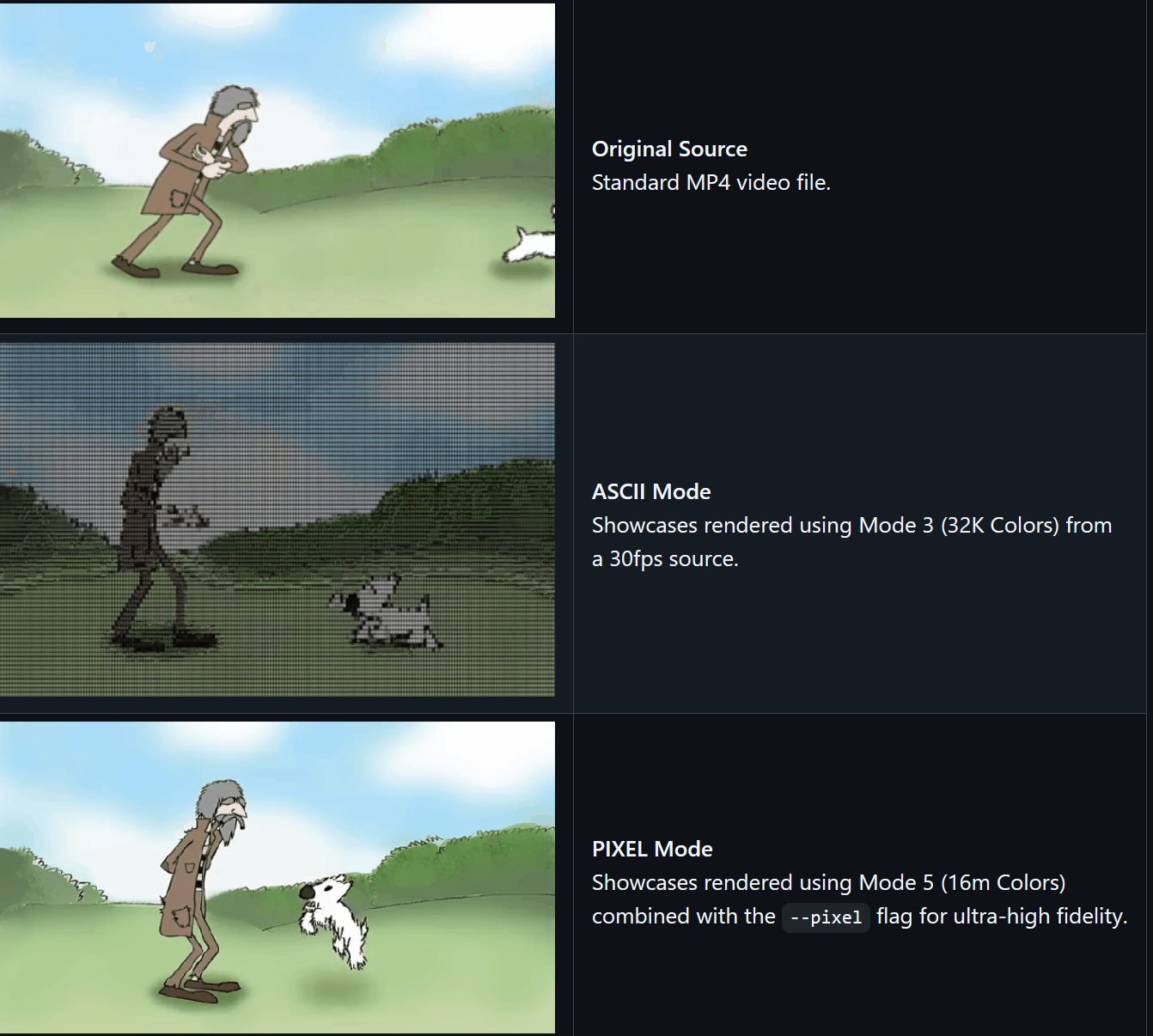
The licensing and abuse angle deserves scrutiny. The repository presents ASCILINE as MIT-licensed while also discussing anti-ad intent. Classic MIT licensing is permissive, and restrictions on field of use can make a license no longer match standard open-source definitions. Even if a project states an anti-ad policy, that does not guarantee bad actors will comply. Enterprises may care about license terms, procurement review, and reputation risk. Malicious operators usually do not.
Market Implications
ASCILINE is not going to displace video codecs in mainstream streaming. Netflix, YouTube, Twitch, Zoom, and enterprise video platforms are optimized around silicon that already exists in massive volume. AV1 decode is now common in newer client devices, H.264 is nearly universal, and data-center transcode fleets are built around dedicated media hardware, GPUs, and ASIC paths. Those supply chains span TSMC 5nm and 4nm-class accelerators, mature-node networking chips, DRAM, NAND, and client SoCs with fixed-function media engines.
Where ASCILINE matters is at the edge of the market, where compatibility, inspection, styling, and bandwidth constraints can matter more than photographic fidelity. Think constrained dashboards, browser-based visual telemetry, remote terminal environments, low-bandwidth status feeds, art tools, small educational demos, and systems where a server can preprocess content once and many clients can render a simplified stream without dedicated video elements.
The supply-chain context is practical. AI accelerator demand has absorbed large amounts of advanced packaging, HBM, and leading-node capacity. If a workload can avoid GPU inference or heavy media transcode, even at small scale, it has a cost argument. ASCILINE does not need a 3nm-class client chip or an HBM-equipped data-center GPU to show value. It can run through commodity CPUs, Python libraries, WebSockets, and browser canvas support. That makes it more aligned with software efficiency than with raw wafer allocation.
But the cost does not disappear. Backend decoding and frame conversion still consume CPU cycles. At volume, operators would need to measure frames per watt, server concurrency, memory bandwidth, WebSocket fan-out cost, and browser battery drain. A 30 FPS canvas workload on a laptop may be acceptable. The same workload on a low-end phone, kiosk, or 40nm-class embedded controller may expose thermal and scheduling limits quickly. In semiconductor terms, ASCILINE shifts the bottleneck from fixed-function decode blocks to general-purpose compute, memory movement, and network scheduling.
The ad-blocking debate could also shape adoption. If developers position this mainly as a way to avoid user controls, browser vendors and extension authors have clear countermeasures. They can classify repeated canvas updates, detect suspicious WebSocket frame cadence, block known script signatures, or expose stronger user controls for high-frequency canvas rendering. The web platform has a long record of turning nuisance patterns into new permission prompts, throttling rules, or extension filters.
For legitimate use, the better positioning is as a typographic media engine. The project gives developers a way to render video-like motion as styled text, run visual streams through CSS effects, and package low-fidelity visual information in a format that can be easier to inspect than compressed video. That is a real niche. It is especially interesting because it sits between media streaming, terminal art, browser rendering, and lightweight AI preprocessing.
ASCILINE’s performance figures, 30 FPS playback, 32K-color ASCII mode, 16M-color pixel mode, and 360p-class output, are enough to make the project technically interesting. The market question is whether those numbers hold under load: multiple clients, mobile browsers, noisy networks, longer videos, larger windows, and mixed audio tracks. If the engine can preserve timing while keeping frame payloads in the low-kilobyte range, it could become a useful tool for constrained visual streams. If it becomes associated mainly with forced ads, it will invite blocking faster than adoption.
The semiconductor read is clear: this is not a new chip story, but it is a workload-placement story. ASCILINE asks whether some video-adjacent experiences can be handled with cheaper compute, fewer codec assumptions, and lighter transport. In a market where advanced-node capacity, HBM supply, and accelerator allocation remain expensive, even small software-level shifts in where frames are decoded, transformed, and displayed deserve attention.
Comments
Please log in or register to join the discussion