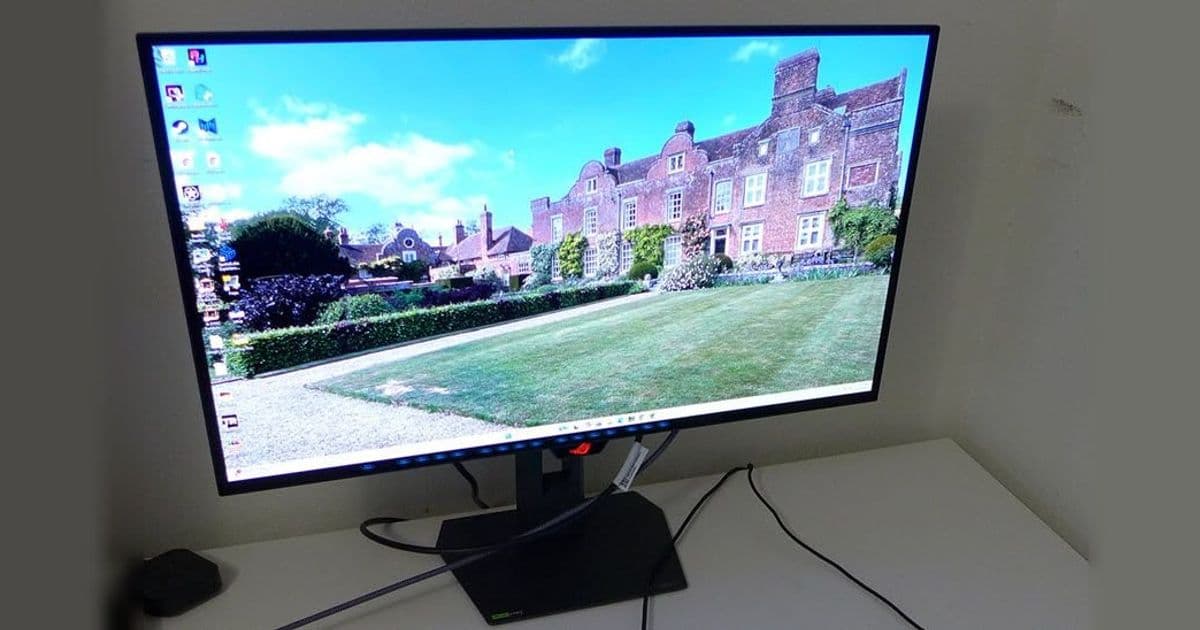
The Asus ROG Strix XG27AQWMG delivers exceptional QD-OLED image quality and 280 Hz gaming performance, challenging the premium monitor market with a competitive $599 starting price that undercuts many rivals while offering superior brightness and motion clarity.
The Asus ROG Strix XG27AQWMG enters the crowded OLED gaming monitor market with a clear value proposition: premium QD-OLED performance at a price point that challenges the competition. At a launch price of $599, this 27-inch QHD display offers 280 Hz refresh rates, exceptional brightness, and the inherent advantages of OLED technology, creating a compelling option for gamers seeking high-end performance without the typical premium price tag.
Technical Specifications and Panel Technology
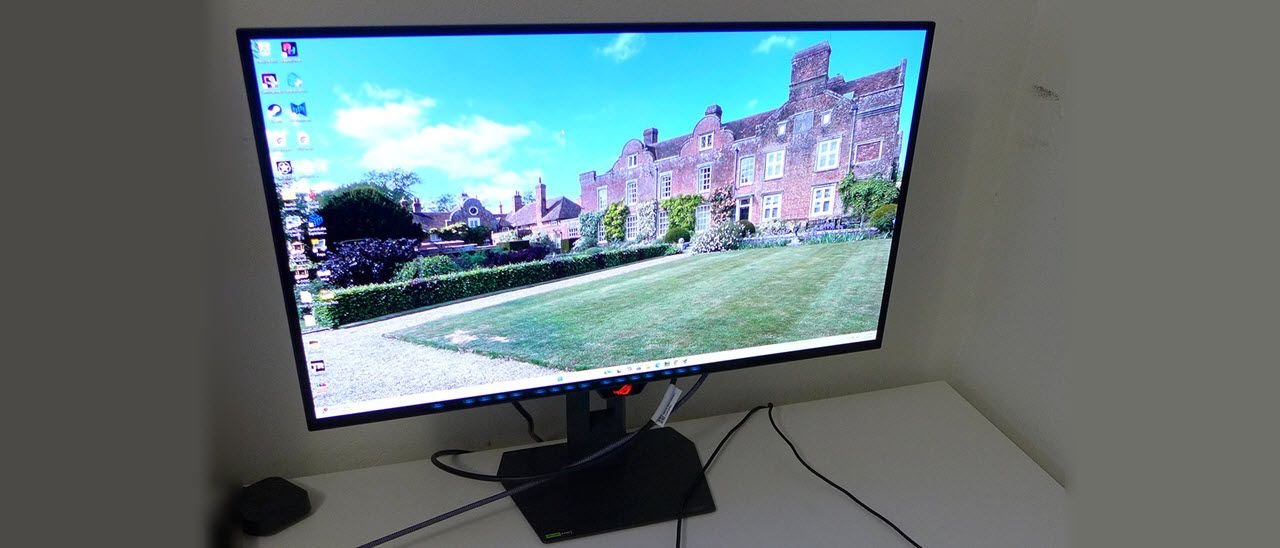
The XG27AQWMG features a 27-inch Quantum Dot OLED (QD-OLED) panel with a native resolution of 2560x1440, delivering a pixel density of 109 PPI. This resolution strikes a balance between visual fidelity and performance demands, allowing modern gaming hardware to achieve high frame rates without requiring the massive GPU horsepower needed for 4K displays.
The panel's refresh rate reaches 280 Hz, which, while lower than some 360 Hz or 500 Hz LCD competitors, offers superior motion clarity due to OLED's near-instantaneous pixel response times. The manufacturer lists a 0.03ms gray-to-gray (GTG) response time, which is effectively instantaneous for human perception. This eliminates the motion blur inherent to LCD panels, even at higher refresh rates.
Brightness performance is a standout feature. The monitor achieves 557 nits in SDR mode with a 25% window and 653 nits in HDR mode under the same conditions. These figures place it among the brightest OLED monitors available, addressing a traditional weakness of OLED technology compared to high-end LCD and Mini LED displays. Asus employs what it calls "Tandem OLED Technology," which the company claims enhances both brightness output and panel longevity.
Color reproduction is exceptional, with native 10-bit color depth and DCI-P3+ gamut coverage. The display supports HDR10 and carries a DisplayHDR 500 True Black certification, ensuring deep blacks and vibrant highlights that leverage OLED's per-pixel illumination capabilities.
Connectivity includes one DisplayPort 1.4 with Display Stream Compression (DSC) and two HDMI 2.1 ports, providing sufficient bandwidth for 1440p at 280 Hz. The DisplayPort connection uses DSC to achieve this bandwidth without compromising visual quality. Audio output is handled through a 3.5mm headphone jack, as the monitor lacks internal speakers—a common cost-saving measure in gaming displays.
Performance and Gaming Experience
The XG27AQWMG's gaming performance benefits from OLED's fundamental advantages. Unlike LCD panels, which rely on a backlight that must be dimmed or blocked to create dark areas, OLED pixels can turn completely off, achieving infinite contrast ratios. This results in unparalleled black levels and shadow detail that LCD technology cannot match.
Motion clarity is another OLED strength. At 280 Hz, the panel delivers perfect motion resolution with zero blur, as pixels can change state faster than the human eye can perceive. This eliminates the ghosting and smearing common in even high-refresh-rate LCD displays. The monitor supports both AMD FreeSync Premium Pro and Nvidia G-Sync Compatible certifications, ensuring tear-free gaming across different GPU ecosystems.
For scenarios where frame rates drop below the panel's native refresh rate, Asus includes ELMB (Extreme Low Motion Blur), which functions as black frame insertion. Unlike LCD implementations that can introduce artifacts, the OLED version works smoothly without phasing issues, though it requires dropping the refresh rate to 140 Hz. This feature helps maintain motion clarity during demanding scenes or when paired with less powerful hardware.
Input lag measurements show the XG27AQWMG performing at the top tier of gaming monitors, with control response feeling instantaneous. During testing with a GeForce RTX 4090, frame rates remained locked at 280 fps in titles like Doom Eternal, eliminating the need for adaptive sync technologies entirely.

Build Quality and Ergonomics
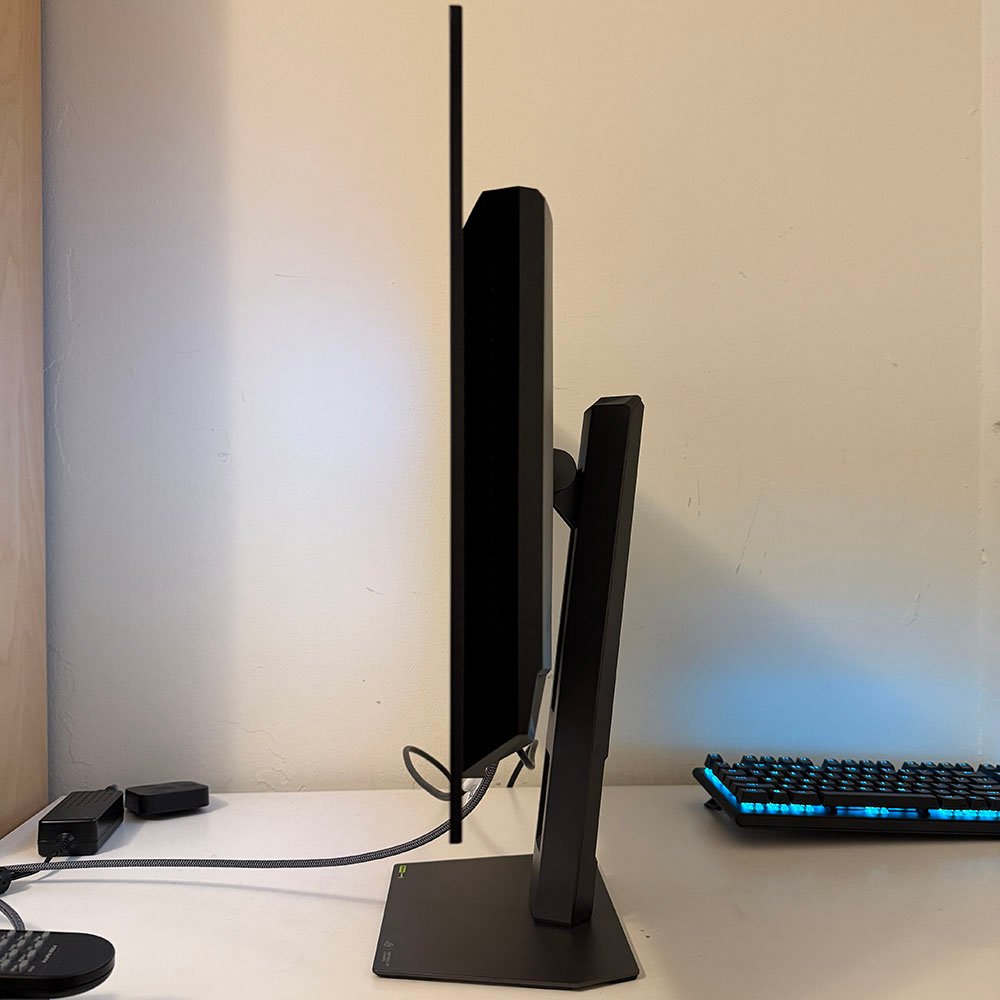
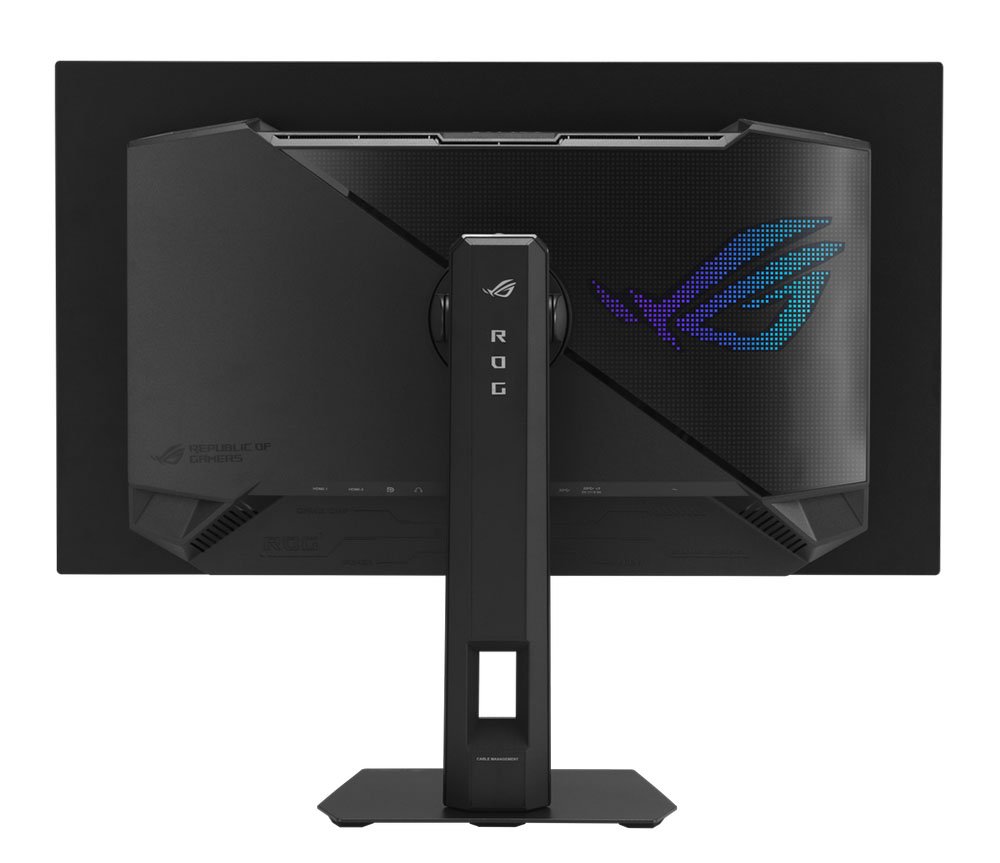
The monitor's physical design reflects Asus's ROG branding with gamer-centric aesthetics that remain tasteful. The panel features a slim profile with a textured black plastic bulge housing the electronics and connectivity. The backlit ROG logo offers customizable RGB lighting effects through Asus's Aura system, which can sync with on-screen content when connected via USB.
The included stand provides comprehensive ergonomics: 25 degrees of tilt, 45 degrees of swivel, 90-degree portrait mode rotation, and 4.3 inches of height adjustment. Movements feel premium, with firm positioning and minimal wobble. The base is compact but heavy, ensuring stability on desktop surfaces.
Build quality extends to the accessory package, which includes a zippered pouch containing all necessary cables (HDMI, DisplayPort, USB, and power) and a selection of ROG decals. The monitor uses an internal power supply, eliminating the need for an external power brick.
OSD Features and Calibration
The On-Screen Display (OSD) follows Asus's established menu structure, navigated via a joystick control. The system offers extensive customization, including:
- GamePlus: Aiming overlays, sniper magnification, timers, and frame rate monitoring
- GameVisual: Nine picture modes including a highly accurate sRGB calibration mode
- Image Settings: Uniform brightness (for consistent SDR output) or variable brightness (for HDR impact), plus OLED anti-flicker controls
- Color Controls: Full calibration options with selectable color spaces and user-adjustable RGB values
- Panel Care: Pixel orbiter, refresh routines, screen savers, and proximity sensors that blank the screen when users leave their desk
For HDR content, four picture modes are available with subtle differences between them. The "Gaming HDR" mode provides accurate color and luminance without adjustment, while enabling "Adjustable HDR" unlocks maximum brightness output up to 653 nits.
The DisplayWidget Center software allows control from the Windows desktop, offering an alternative to the physical OSD joystick. Two memory slots let users save and recall preferred settings for different use cases.
One critical setting is hidden in the System Setup menu: "Power Setting." By default, it's set to "Power Saving," which limits brightness. Changing this to "Performance Mode" is essential to access the monitor's full brightness potential.
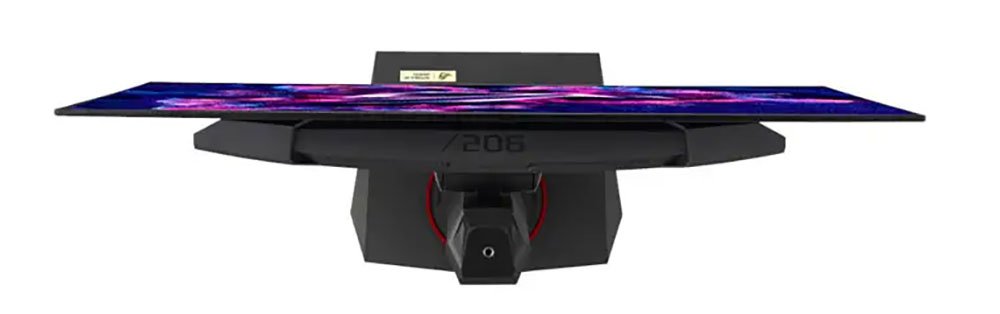
Image Quality and Real-World Performance
In practice, the XG27AQWMG delivers exceptional image quality that surpasses most OLED monitors tested. The combination of high brightness and OLED's infinite contrast creates a three-dimensional effect in content, making images and videos appear more lifelike. The QHD resolution provides sufficient pixel density to hide the sub-pixel structure, resulting in a crystal-clear image.
Color reproduction is vibrant and accurate, with the wide gamut setting delivering saturated hues without oversaturation in sRGB content. The panel's tuning of the HDR luminance curve (EOTF) is precise in the Gaming HDR mode, ensuring highlights appear as intended without clipping or crushing details.
For productivity tasks, the monitor's 109 PPI density makes text sharp and readable, while the uniform brightness mode provides consistent output for document work. The anti-glare coating is relatively glossy, so placement away from direct light sources is recommended to minimize reflections.
Market Positioning and Value Proposition
At $599, the XG27AQWMG enters a competitive market where OLED gaming monitors typically command premium prices. Many 27-inch QHD OLED displays with similar specifications retail for $700-$900, making Asus's pricing aggressive. The monitor sacrifices only a modest refresh rate (280 Hz vs. 360+ Hz) to achieve this price point, while maintaining the core OLED advantages of perfect blacks, instantaneous response, and superior motion clarity.
The value proposition is strengthened by the monitor's brightness performance. While some OLED monitors struggle to exceed 400 nits in HDR scenarios, the XG27AQWMG's 653-nit output brings it closer to high-end LCD and Mini LED displays, reducing one of OLED's traditional trade-offs.
For gamers with mid-to-high-end systems (RTX 3070 or RX 6800 XT and above), the 1440p resolution at 280 Hz is achievable in most competitive titles, making the monitor a practical choice rather than an overkill specification. The inclusion of both FreeSync and G-Sync compatibility ensures broad hardware support.
Limitations and Considerations
The primary omission is the lack of internal speakers, which is common in gaming monitors but worth noting for users seeking an all-in-one solution. The 3.5mm headphone jack mitigates this for audio output, but users with powered speakers will need an external audio solution.
The glossy panel coating, while excellent for optical clarity, may present challenges in brightly lit environments. Users should consider their desk setup and lighting conditions before purchase.
OLED panel longevity remains a consideration, though modern QD-OLED technology includes built-in mitigation features. The XG27AQWMG includes comprehensive panel care options, including pixel refresh routines and proximity sensors that help prevent static image retention. The reviewer notes that after extensive testing with static patterns and daily productivity use, no burn-in was observed on similar OLED monitors.
Conclusion
The Asus ROG Strix XG27AQWMG represents a significant value in the OLED gaming monitor market. It delivers the core advantages of OLED technology—infinite contrast, instantaneous response, and perfect motion clarity—at a price point that challenges high-end LCD alternatives. The 280 Hz refresh rate, while not the highest available, is more than sufficient for competitive gaming and pairs perfectly with the panel's response characteristics.
Brightness performance is particularly impressive, addressing a traditional OLED weakness and making the monitor viable for HDR content and well-lit environments. Build quality, ergonomics, and feature set are comprehensive, reflecting Asus's ROG brand positioning without the premium price typically associated with it.
For gamers seeking the best possible image quality and motion performance without spending over $800, the XG27AQWMG presents a compelling option. It successfully bridges the gap between premium OLED performance and accessible pricing, making high-end display technology more attainable for a broader audience.
Key Specifications Summary:
- Panel Type: QD-OLED
- Size: 27-inch, 16:9
- Resolution: 2560x1440 (109 PPI)
- Refresh Rate: 280 Hz
- Response Time: 0.03ms GTG
- Brightness: 557 nits SDR, 653 nits HDR (25% window)
- Color: 10-bit, DCI-P3+ gamut
- HDR: DisplayHDR 500 True Black, HDR10
- Connectivity: DisplayPort 1.4 (DSC), 2x HDMI 2.1, USB 3.2
- Adaptive Sync: FreeSync Premium Pro, G-Sync Compatible
- Price: $599 (launch)
- Warranty: 3 years
Comments
Please log in or register to join the discussion